Best Credit Card to Use in South Korea (2026): What Works for Americans, What Doesn’t, and How to Skip the Fees

The best credit card to use in South Korea is a Visa or Mastercard with no foreign transaction fee, plus a backup. Here’s where US cards work, where they still don’t, and how to avoid paying extra.

best credit card to use in South Korea

Last updated: October 14, 2026

On March 17, 2026, the Seoul subway finally let visitors buy transit tickets with a foreign credit card. In the first month, an average of about 9,000 people a day did exactly that, and Visa was the most-used card. That number tells you two things. Plenty of travelers now arrive in Korea planning to pay with plastic, and until this spring, one of the most basic purchases in Seoul still required cash.

So what’s the best credit card to use in South Korea? The short answer: a Visa or Mastercard with no foreign transaction fee, plus a backup card from a different bank. The longer answer is about where US cards still hit walls, and those walls aren’t always where you’d expect.

Koreans pay for almost everything by card or phone, so friends here assume Korea will feel like a city where you tap and go. Mostly, it does. But Korea’s payment system was built around Korean-issued cards and Korean phone numbers, and a visitor’s card lives slightly outside that system. This guide is about that gap.

Quick Answer: The Best Credit Card to Use in South Korea

  • Bring a Visa or Mastercard with no foreign transaction fee. That’s your main card for almost everything: convenience stores, cafes, restaurants, department stores, hotels, and taxis.
  • Bring a second card from a different bank, ideally on a different network. If one gets flagged for fraud, you’re not stuck.
  • American Express and Discover can work, but don’t make either your only card.
  • Always pay in Korean won, never US dollars. Choosing dollars triggers a conversion markup.
  • Your card won’t open the subway gates yet. You still need a transit card. New kiosks on Seoul subway Lines 1 to 8 sell tickets and short-term passes to foreign cards, with a service fee.
  • Carry a little cash for traditional markets, street food, and topping up a T-money card.
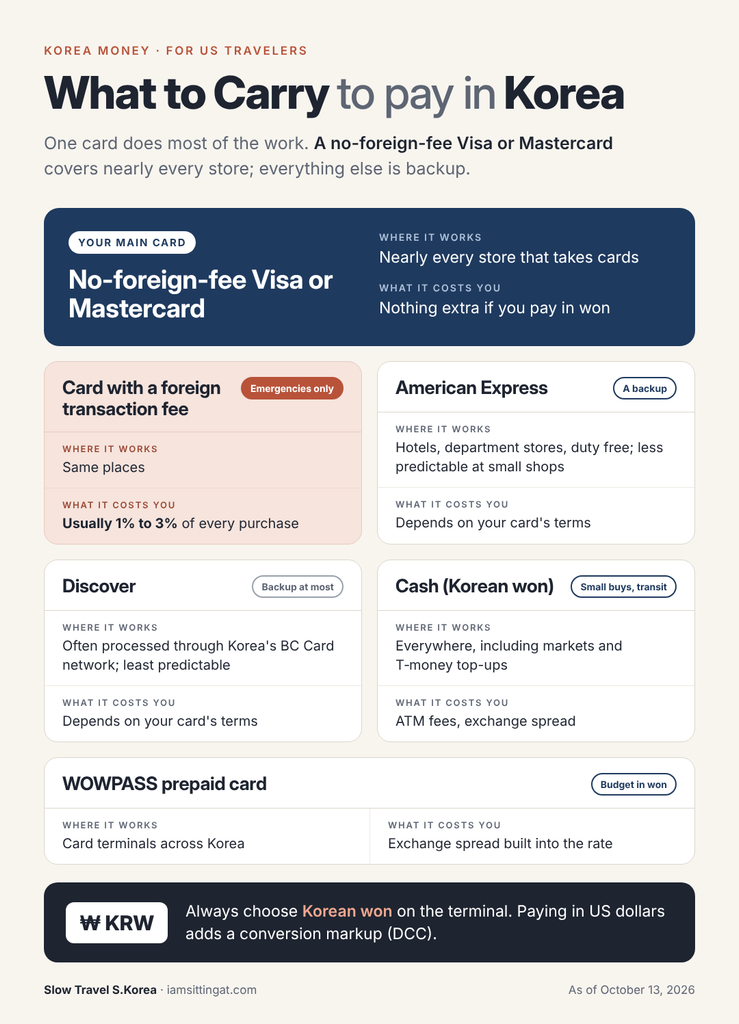
Infographic comparing payment options for US travelers in South Korea: no-foreign-fee Visa or Mastercard, Amex, Discover, cash, and WOWPASS

Why Using a US Credit Card in Korea Is Mostly Easy

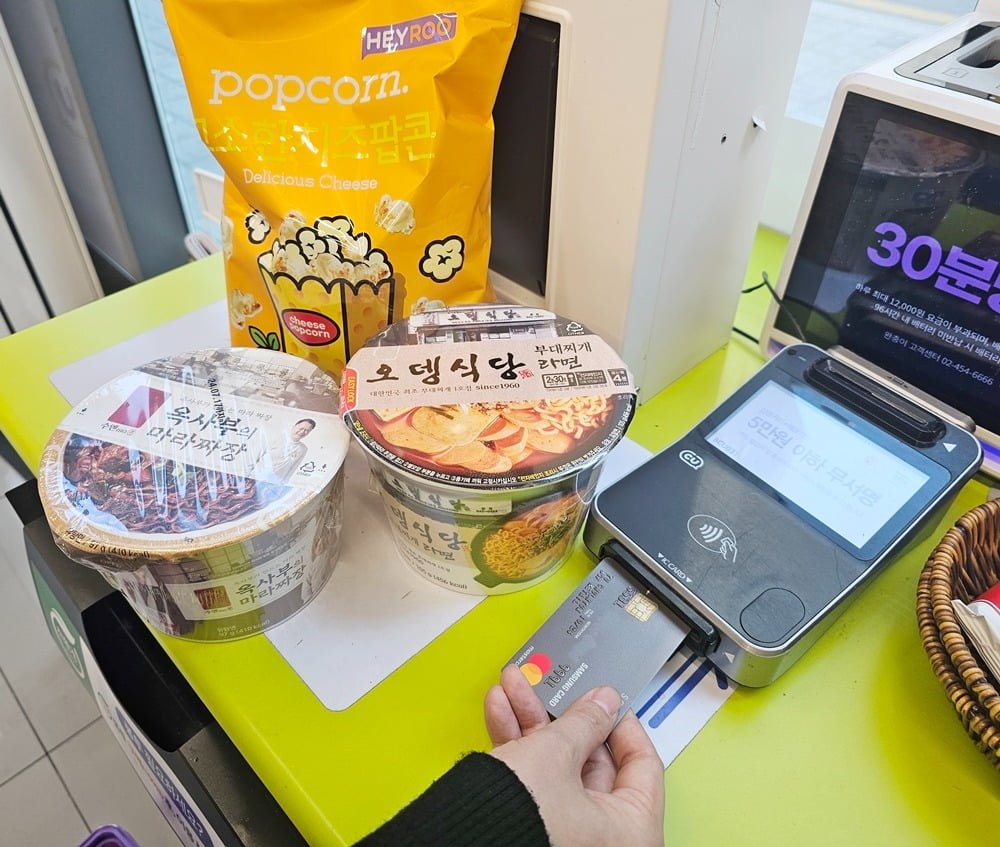
Walk into a convenience store in Seoul, hand over your Visa, and it will almost certainly go through. Card terminals at Korean stores are designed to handle international cards, and the people behind the counter process foreign cards all day, especially in areas like Myeongdong, Hongdae, and Gangnam.

Where things get harder is anything built as a closed Korean system:

  • Transit cards and subway gates. Korea’s transit network runs on its own card standard, not the tap-to-pay system you use on OMNY in New York.
  • Korean apps and websites. Many ask for Korean phone verification before you even get to the payment screen, and some only accept Korean-issued cards.
  • Some self-order kiosks and table tablets. Many take foreign cards; some older ones don’t. Staff can usually ring you up at the counter instead.

Think of it this way: using a US credit card in Korea is easy face to face and harder through a screen. If you remember that, most surprises stop being surprises.

Visa, Mastercard, Amex, or Discover?
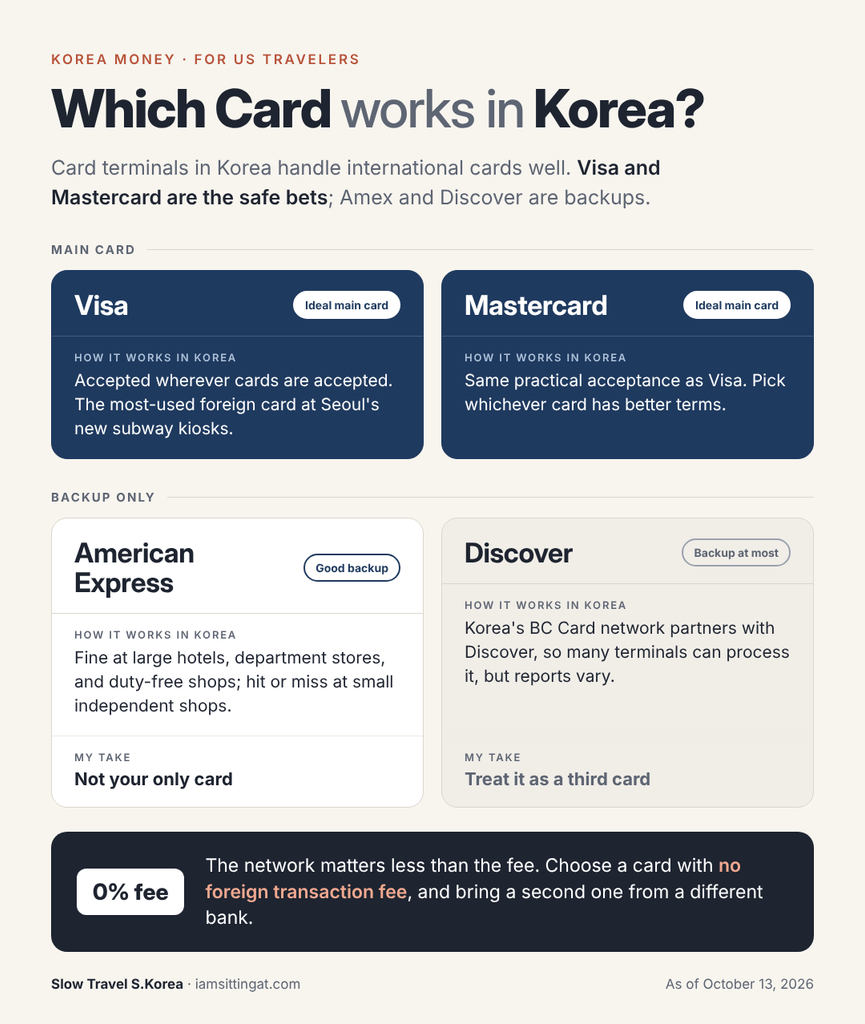
Infographic comparing Visa, Mastercard, American Express, and Discover acceptance in South Korea for US travelers

Visa vs. Mastercard: For a trip to Korea, there’s no meaningful difference. Pick whichever of your cards has the better terms.

American Express: Amex has a real presence in Korea. Several Korean card companies issue Amex-branded cards, and in 2026 Amex is running tourist offers at Korean hotels, restaurants, and duty-free shops for its cardholders. That said, I wouldn’t land with only an Amex. Small restaurants and shops are where it’s most likely to be refused.

Discover: Discover’s acceptance in Korea runs through its partnership with BC Card, one of the country’s largest domestic card networks. In practice, it’s the least predictable of the four. Treat it as a third card, not a first.

What to Look For in a Card for Korea

1. No foreign transaction fee

This matters more than rewards. Many US cards add a fee of roughly 1% to 3% to every purchase made outside the US. On a $3,000 trip, a 3% fee costs you $90 for nothing. Check your card’s “Rates and Fees” page or cardholder agreement before you go.

2. A Visa or Mastercard logo

See the table above. Your main card should be on one of these two networks.

3. Chip and contactless, plus a PIN you actually know

You’ll insert your card most of the time in Korea. Contactless works at more places than it used to, but don’t count on tapping everywhere. You’ll need a PIN for ATM withdrawals with a debit card, so confirm yours before you leave.

4. Rewards that match how you’ll spend

A slow trip to Korea is mostly meals, coffee, small shops, and the occasional taxi. A card that earns more on dining and travel usually beats a flat-rate card for this kind of trip, but either is fine as long as there’s no foreign fee.

5. A real backup

Bring a second card from a different bank. If your main card gets frozen by a fraud alert at 11 p.m. Korea time, it’s the middle of the morning in New York, and you may spend a while on hold.

Examples of US cards with no foreign transaction fee

These are examples to check against your own spending, not personal recommendations. Fees and benefits change, so confirm the current terms on the issuer’s site.

  • Capital One: Capital One says none of its US-issued credit cards charge foreign transaction fees. That includes no-annual-fee cards like Quicksilver and travel cards like Venture X.
  • Chase Sapphire Preferred: A Visa card with a $95 annual fee and no foreign transaction fees. [AFFILIATE: Chase Sapphire Preferred]
  • Other travel cards from most major issuers also waive the fee. If you’re comparing, I wrote about this from the New York side.

Where Your US Card Works in Korea (and Where It Doesn’t)

WhereDoes a US card work?What to know
Convenience stores (CU, GS25, 7-Eleven)YesThe easiest place to test your card on day one
Cafes and restaurants with kiosksUsuallySome kiosks reject foreign cards; pay at the counter instead
Department stores, duty free, hotelsYesWatch for the “pay in dollars?” prompt here
TaxisUsually, with your physical cardIn-app payment through Korean taxi apps is less reliable
Subway ticket kiosks (Lines 1–8, new machines)YesSingle-journey tickets and Climate Card short-term passes; about 3.7% service fee
Subway gates and busesNo, not yet in SeoulYou need a transit card for now
Traditional markets and street foodOften cash onlyKeep 30,000 to 50,000 won in small bills
Delivery appsSometimesBaemin accepts Apple Pay with foreign-issued cards since June 2026
Korean websites and ticketingHit or missMany require Korean phone verification first

A few notes on the tricky rows.

Cafes and kiosks. I covered kiosk ordering in detail in my Seoul Cafe Etiquette guide. The short version: if the kiosk won’t take your card, walk up to the counter. Nobody will think twice.

Taxis. Hailing a cab on the street and paying with your physical card at the in-car terminal is usually smooth. Registering a foreign card inside a Korean taxi app is where people run into trouble.

Korean apps. Booking sites, ticketing platforms, and some shopping apps often want a Korean phone number before they’ll show you a payment screen.

Can You Use Your Credit Card on the Seoul Subway?
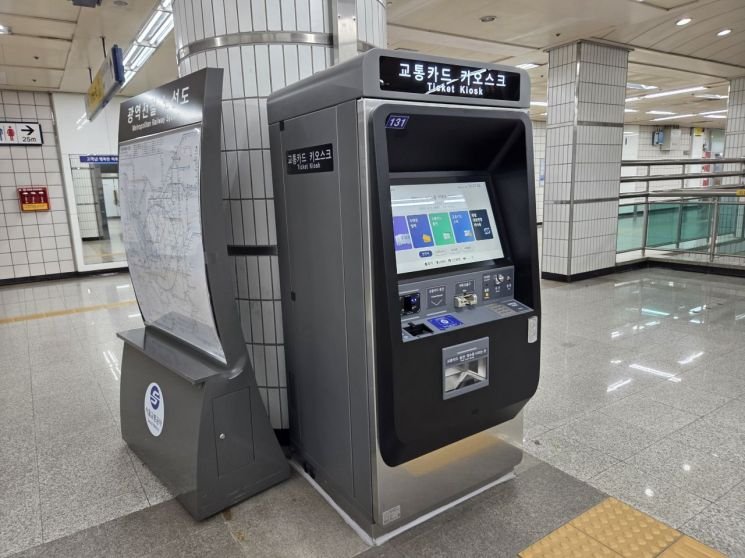
New ticket kiosk at a Seoul subway station that accepts foreign credit cards

Not at the gates, at least not yet. This is the biggest difference from New York, where you can tap a contactless card at any OMNY reader.

Here’s where things stand as of October 2026:

  • New subway kiosks accept foreign cards. Since March 17, 2026, the new ticket kiosks on Seoul subway Lines 1 to 8 take foreign-issued credit and debit cards. You can buy single-journey tickets and buy or recharge Climate Card short-term passes (1, 2, 3, 5, and 7 days).
  • There’s a service fee. The fare itself doesn’t change, but foreign card payments at these kiosks carry a service fee that averages about 3.7%. On a short-term pass, that’s small but worth knowing.
  • Not every machine is new. Older ticket machines are still in some stations. Look for the newer touchscreen kiosk.
  • T-money top-ups: As far as I can confirm, buying a regular T-money card with a foreign card at the kiosk isn’t supported, and convenience-store top-ups are generally cash.
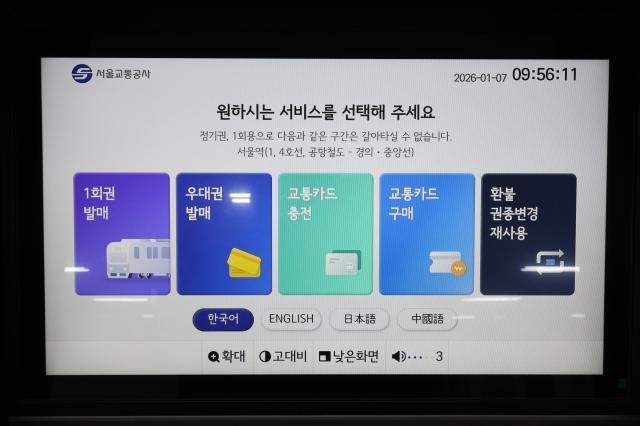
New ticket kiosk at a Seoul subway station that accepts foreign credit cards

What’s coming in 2027. In September 2026, T-money signed an agreement with Visa, Mastercard, UnionPay, JCB, and Hana Card to build tap-to-pay with regular bank cards, often called “open-loop” payment. The plan is to finish testing by the end of 2026, start with Seoul city buses in 2027, and then expand to Incheon buses and airport buses. No date has been set for the Seoul subway. Jeju’s city buses already accept tap-to-pay with international cards.

Until that arrives, your choices are a T-money card, a Climate Card short-term pass, or a prepaid card with a transit function.

Apple Pay and Google Pay in Korea

Apple Pay launched in Korea in 2023, but only for Korean cards from one issuer, and many Korean stores still don’t have the NFC terminals it needs. For visitors, the picture is getting better slowly:

  • In apps: Baemin, Korea’s biggest food delivery app, started accepting Apple Pay with foreign-issued Visa, Mastercard, JCB, and Amex cards on June 2, 2026.
  • In stores: Some chain stores and cafes have NFC terminals, but whether a foreign card in your phone’s wallet goes through varies by terminal.

My advice: treat your phone wallet as a bonus, not a plan. Keep the physical card in your pocket.

Always Pay in Won: How to Avoid the DCC Markup
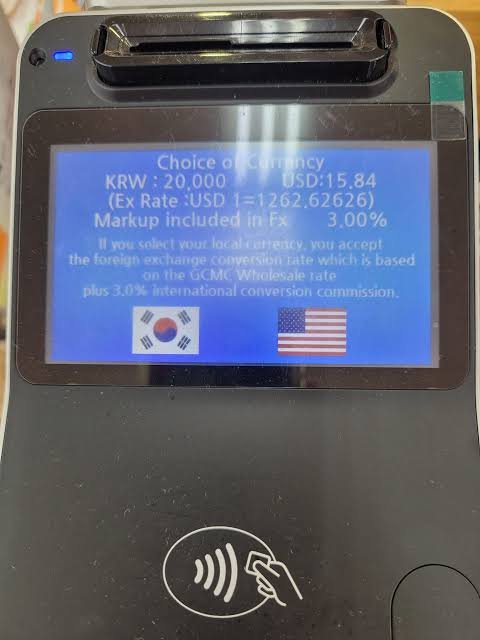
Card terminal screen asking to pay in US dollars or Korean won

At duty-free shops, department stores, hotels, and some ATMs, the terminal may offer to charge you in US dollars instead of Korean won. It sounds helpful, because you see a familiar number. It isn’t.

This is called dynamic currency conversion, or DCC. The merchant’s payment provider sets the exchange rate, and the markup is built into it. KB Kookmin Card, one of Korea’s largest card companies, warns its own customers that DCC can add roughly 3% to 8% when they shop abroad. The same mechanism works against you in Korea.

What to do:

  1. When the screen asks, choose KRW (won).
  2. If a cashier asks, say “won, please,” or in Korean, “wonhwa-ro hae-juseyo“.
  3. Check the receipt. If it shows a USD amount, ask them to cancel and run it again in won. Do it on the spot. It’s much harder to fix later.
  4. At ATMs, decline the conversion offer and let your own bank handle the exchange.

Cash, ATMs, and Prepaid Cards as Backups

You don’t need much cash in Korea, but you do need some.

  • ATMs: Look for machines labeled “Global” or “Foreign Card,” usually in bank branches, subway stations, airports, and some convenience stores. Expect a per-withdrawal operator fee, commonly reported at around 3,000 to 6,000 won, on top of whatever your US bank charges.
  • Debit card tip: A US debit card that reimburses ATM fees makes withdrawals much cheaper. [AFFILIATE: no-ATM-fee debit card]
  • Prepaid travel cards: WOWPASS and similar cards let you load money in won and pay like a local card. They’re handy if you want a fixed budget, but compare their exchange rate with your no-fee credit card before loading a lot.
  • How much cash to bring: That depends on how much time you’ll spend at markets and small restaurants.

Reality Check: Fees, Declines, and Gaps

Korea is one of the easier countries to travel with a card, but here’s what can still go wrong.

  • Your bank may flag your first purchase. A charge in Seoul at 9 a.m. Korea time looks unusual from New York. Turn on app notifications so you can approve or unlock the card quickly. Many issuers no longer require a travel notice, but check your issuer’s app either way.
  • Small fees add up. The subway kiosk service fee, ATM operator fees, and any DCC markup are each small. Together, on a two-week trip, they can cost more than the price of a nice dinner.
  • Kiosks and tablets aren’t always foreign-card friendly. When a screen refuses your card, go to a person.
  • Korean apps are the hardest part. Food delivery, taxi apps, and ticketing are where foreign cards fail most often, usually because of Korean phone verification, not the card itself.
  • Refunds take time and can come back at a different exchange rate. If you return something, the refund may arrive days later and won’t always match what you paid in dollars.
  • Markets and small eateries may be cash only. That’s less common every year, but it still happens.
  • Mobile pay apps aren’t for tourists yet. Kakao Pay and Naver Pay are everywhere in Korea, but registering a card in them generally requires a Korean card.

My Wallet Setup for a Korea Trip

If you want a simple template, this is what I’d suggest to a first-time visitor from the US:

  • Main card: a no-foreign-fee Visa or Mastercard
  • Backup card: from a different bank, ideally a different network
  • Debit card for ATM withdrawals, with a PIN you’ve confirmed
  • Cash: enough for a day of markets and a T-money top-up
  • Transit: a Climate Card short-term pass from a new subway kiosk, or a T-money card
  • Phone data sorted before you land, since card alerts and maps both need it
  • Entry paperwork done
  • Apps downloaded: Korea Travel Apps for Foreigners

FAQ

Can I use my US credit card in South Korea?

Yes. Visa and Mastercard work at almost every store, cafe, restaurant, and hotel that takes cards. The main exceptions are subway gates and buses in Seoul, some self-order kiosks, traditional markets, and Korean apps that require local phone verification.

What is the best credit card to use in South Korea?

A Visa or Mastercard with no foreign transaction fee. Bring a second card from a different bank as a backup, and pay in Korean won every time.

Does American Express work in South Korea?

Often, at larger places. Hotels, department stores, and duty-free shops generally take Amex, but small shops and restaurants are less predictable. Don’t make Amex your only card.

Can I use my credit card on the Seoul subway?

You can use it to buy tickets and Climate Card short-term passes at the new kiosks on Lines 1 to 8, with a service fee of about 3.7%. You can’t tap it at the gates yet. Tap-to-pay with regular cards is planned for Seoul city buses first, starting in 2027.

Should I pay in dollars or won in Korea?

Won. Paying in dollars triggers dynamic currency conversion, which builds a markup into the exchange rate. Choose KRW on the screen, and if a receipt shows dollars, ask the cashier to redo it in won.

The Bottom Line

The best credit card to use in South Korea is a boring one: a no-foreign-fee Visa or Mastercard that you’ll use for coffee, dinner, and taxis without thinking about it. Add a backup card, a little cash, and a transit card, and pay in won every time. The places your card won’t work are shrinking each year, and by 2027 you may be able to tap it on a Seoul bus. Until then, a little preparation keeps the money side of the trip quiet, which is exactly how it should be.

Related posts you might enjoy:

K-ETA for US Citizens in 2026: The e-Arrival Card, the Dec. 31 Deadline, and What Changes in 2027

K-ETA for US citizens is optional until December 31, 2026, Korea time, but you still need to file the free Korea e-Arrival Card. Here’s what to do now and how to plan a trip that lands in 2027.

K-ETA for US citizens

A nonstop flight from JFK to Incheon takes around 15 hours, and somewhere over the Pacific you lose a full calendar day. On most trips, that’s just jet lag trivia. This year it matters, because the rules on K-ETA for US citizens come down to a single date: December 31, 2026, Korea time.

Until then, Americans don’t need a K-ETA. You do need something else, though, and that’s the part that trips people up.

When friends here ask me about Korean entry rules, the question is almost always some version of “Wait, do I need that K-ETA thing or not?” The honest answer this year is “No, but.” The “but” is the Korea e-Arrival Card.

This guide covers what you need right now, how the two systems differ, and how to plan if your trip runs into January 2027.

Quick Answer: K-ETA for US Citizens in 2026

  • Arriving in Korea by December 31, 2026 (KST): You don’t need a K-ETA. You do need to file an arrival card, and the free Korea e-Arrival Card is the easy way to do it.
  • Arriving on or after January 1, 2027: You’ll need an approved K-ETA unless Korea extends the exemption again. As of October 12, 2026, no extension has been announced.
  • A K-ETA replaces the arrival card. If you hold a valid K-ETA, you skip the arrival card on every trip for three years.
  • You still don’t need a visa for a tourist trip of up to 90 days.
  • Use only the official sites: k-eta.go.kr and e-arrivalcard.go.kr. Anything else is a third-party service you don’t need.
Arriving by Dec. 31, 2026Arriving on or after Jan. 1, 2027
Visa for tourism (up to 90 days)Not neededNot needed
K-ETAOptionalRequired, unless the exemption is extended
Arrival cardRequired, unless you hold a valid K-ETANot needed with a valid K-ETA
What it costs youe-Arrival Card is freeK-ETA fee: 10,000 won (about $7) plus a card fee

The US is one of 22 countries and territories covered by Korea’s temporary K-ETA exemption. Korea’s Ministry of Justice extended it through December 31, 2026, Korea Standard Time, and the Korean Consulate General in New York published the same notice. I’ll update this post as soon as Korea says anything about 2027.

K-ETA vs. the Korea e-Arrival Card: Two Different Things

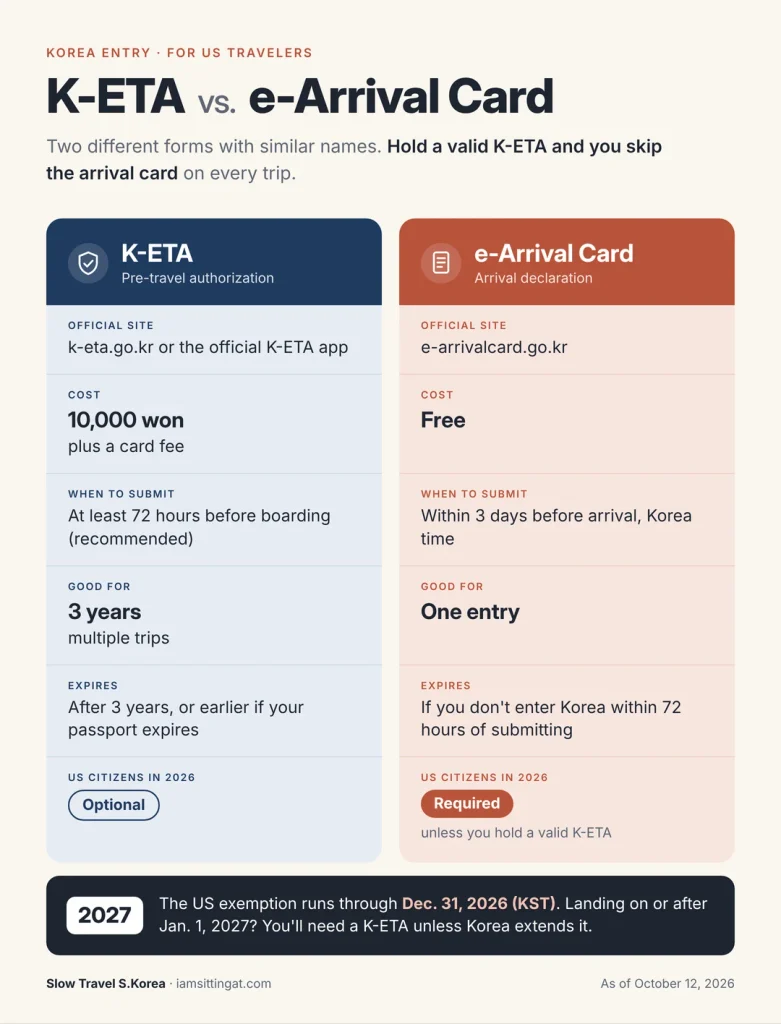
Comparison chart of K-ETA and Korea e-Arrival Card for US travelers

Most of the confusion comes from the fact that these are two separate systems with similar-sounding names.

K-ETA (Korea Electronic Travel Authorization) is a pre-travel approval for people who can enter Korea without a visa. You apply online, pay a fee, and get a decision before you fly. It’s valid for three years and covers multiple trips. Airlines check it at check-in, so if you need one and don’t have it, you may not get a boarding pass.

If that sounds familiar, it’s because the US has its own version. Europeans and others flying to America under the Visa Waiver Program need an ESTA. K-ETA is Korea’s equivalent, and it exists for the same reason: screening travelers before they board, not at the immigration desk.

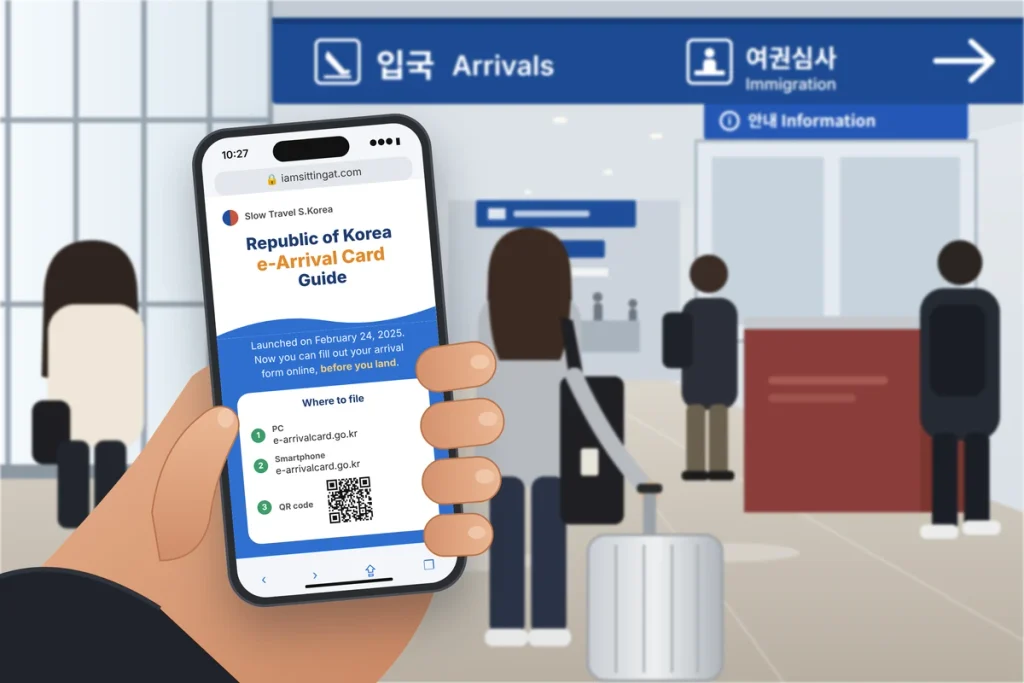
The Korea e-Arrival Card is the online version of the paper arrival form people used to fill out on the plane. It’s a one-trip declaration: who you are, which flight you’re on, where you’re staying. It’s free, and you submit it within three days before you land.

The connection between them is simple. If you hold a valid K-ETA, you don’t file an arrival card. That’s why a K-ETA still has some value in 2026, even though Americans don’t need one.

K-ETAKorea e-Arrival Card
What it isPre-travel authorizationArrival declaration
Official sitek-eta.go.kr or the official K-ETA appe-arrivalcard.go.kr
Cost10,000 won plus a card feeFree
When to submitAt least 72 hours before boarding (recommended)Within 3 days before arrival, Korea time
Good for3 years, multiple tripsOne entry
ExpiresAfter 3 years, or earlier if your passport expiresIf you don’t enter Korea within 72 hours of submitting
Required for Americans in 2026?NoYes, unless you hold a valid K-ETA

Korea launched the e-Arrival Card in February 2025 and ran it alongside the paper form through the end of that year. The plan was to go online-only in 2026, but according to reports citing the Ministry of Justice, paper cards are still being accepted in parallel until an official end date is announced. Either way, I’d file online. It takes a few minutes at home instead of balancing a pen and a form on a tray table.

Your Two Options If You Land in Korea in 2026

Because K-ETA is optional for Americans right now, you get to choose.

Option 1: File the free e-Arrival Card

This is what most travelers on a single trip should do. It costs nothing, takes a few minutes, and you do it once per trip.

Option 2: Pay for a K-ETA and skip the arrival card

A K-ETA approval covers you for three years, and you won’t file an arrival card on any of those trips. It makes sense if:

  • Your trip crosses into 2027. This is the big one. More on it below.
  • You expect to visit Korea again in the next three years. One application covers every visit, and you’re already set if the exemption ends.
  • You’d rather handle paperwork weeks ahead than inside a 72-hour window before landing.

Travelers 17 and under or 65 and over are excluded from the K-ETA requirement even when it’s in force. They can still apply voluntarily to skip the arrival card, and the fee applies.

What Happens on January 1, 2027

Unless Korea announces another extension, the rules on K-ETA for US citizens flip on January 1, 2027: from that date, you’ll need an approved K-ETA to enter Korea.

Has Korea extended it before? Yes, twice. The exemption started on April 1, 2023, for the 2023–2024 Visit Korea Year. It was extended through 2025, then again through 2026, with the second extension announced in December 2025, just weeks before the deadline. So a late announcement this year wouldn’t be unusual. That pattern isn’t a promise, though, and I wouldn’t plan around it.

The New York time-zone trap

This is the detail I’d flag for anyone flying from the East Coast. The exemption runs on Korea Standard Time, and what counts is when you arrive in Korea.

In late December, Seoul is 14 hours ahead of New York. Add a flight of roughly 15 hours, and you land more than a full day “later” on the calendar than when you left. Here’s how that plays out with a typical afternoon departure (times are illustrative, so check your own itinerary):

Leave JFK (New York time)Land at Incheon (Korea time)K-ETA needed?
Dec. 29, 1:00 p.m.Dec. 30, around 6:00 p.m.No
Dec. 30, 1:00 p.m.Dec. 31, around 6:00 p.m.No
Dec. 31, 1:00 p.m.Jan. 1, around 6:00 p.m.Yes, unless extended

So if you’re planning a New Year’s trip to Seoul, look at your arrival date in Korea, not your departure date in New York. If it’s January 1, 2027, or later and no extension has been announced, apply for a K-ETA.

My practical advice

  • Landing by December 31, 2026: File the free e-Arrival Card. No K-ETA needed.
  • Landing on or after January 1, 2027: Apply for a K-ETA once your dates are set, unless an extension has been announced. Don’t wait until the week before Christmas to see what Korea decides.
  • Trip that starts in December and ends in January: Entry is what counts, so landing by December 31 keeps you under the exemption. If you leave Korea mid-trip and come back (say, a side trip to Japan), your re-entry date is the one that matters.

How to Apply for a K-ETA as a US Citizen

Use only the official site

Apply at k-eta.go.kr or through the official K-ETA app. Search results are full of look-alike sites that charge far more than the official fee for “processing.” The government fee is 10,000 won per person. If a site is asking for much more, close the tab.

What you’ll need

  • Your passport
  • A recent color photo of your face
  • An email address
  • Your address in Korea (hotel or rental)
  • A credit or debit card

Step by step

  1. Go to k-eta.go.kr or open the K-ETA app.
  2. Scan or enter your passport information page.
  3. Upload your photo.
  4. Fill in your trip details: purpose of visit, address in Korea, contact information.
  5. Pay the fee: 10,000 won, plus a small card processing fee on top.
  6. Check your result under the “Check Results” menu. The official processing window is up to 72 hours.

Apply at least 72 hours before you board, which is what the Ministry of Justice recommends. One person can submit applications for a group, like a family traveling together.

If your hotel changes after approval, update your stay address on the K-ETA site. You don’t need to reapply for that.

How to Fill Out the Korea e-Arrival Card

When

You can submit starting three days before your arrival date, counted in Korea time. For a flight from New York, that usually means filing a day or two before you leave home, since you lose a day in the air.

If you submit and then don’t enter Korea within 72 hours, the card becomes invalid and you’ll need to file a new one. Keep that in mind if your flight is canceled or pushed back a day.

Where

e-arrivalcard.go.kr, on your phone or laptop. It’s free. Same rule as with K-ETA: ignore any site that charges a fee.

What you’ll need

  • Passport
  • Flight number
  • Your address in Korea
  • An email address (your confirmation goes there)

Worth knowing

  • Every traveler needs their own card, kids included. You can fill them out on someone else’s behalf.
  • You don’t need to print anything. The immigration officer can see your submission in the system. I’d still screenshot the confirmation email.
  • Your Korean address: Copy it straight from your booking confirmation. Korea has two address systems, the newer road-name addresses and the older lot-number addresses, and you’ll often see both for the same building. Either works.

At Incheon: What Happens When You Land

Korea e-Arrival Card form on a smartphone screen

Once your arrival card is filed (or you hold a K-ETA), arrival is straightforward.

  1. Immigration. Follow the signs for foreign passport holders and hand over your passport. The officer can see your e-Arrival Card or K-ETA on screen.
  2. Baggage claim.
  3. Customs. If you have nothing to declare, you don’t fill out a customs form. Walk through the “Nothing to Declare” lane. You do need to declare goods worth more than $800 in total, cash over $10,000, and food, plants, or animal products that need inspection.

From there, your next decision is how to get into Seoul.

Reality Check: Costs, Limits, and Things That Go Wrong

Korea’s entry process is one of the smoother ones I know of, but it has a few sharp edges.

  • The K-ETA fee isn’t refundable. If you apply now and Korea extends the exemption in December, you don’t get the 10,000 won back. It’s a small amount, but it’s gone either way.
  • A K-ETA isn’t a guarantee of entry. It gets you on the plane. The immigration officer at Incheon still makes the final call, the same way an ESTA works in the US.
  • The 72-hour windows are tight. K-ETA can take up to 72 hours to process, and the e-Arrival Card can only be filed within three days of landing. A last-minute trip during the holiday rush is where people get caught.
  • Your K-ETA is tied to your passport. If your passport expires within three years, the K-ETA ends with it. If you renew your passport, plan on applying again.
  • Copycat sites are the real cost risk. The official fees are 10,000 won for K-ETA and zero for the arrival card. Paying a middleman doesn’t speed anything up.
  • Dual citizens have different rules. If you’re Korean American and also hold Korean nationality, how you enter and leave Korea may be different. Check with the Korean Consulate General in New York before you book.

Other Entry Basics for Americans

  • Visa-free stay: US citizens can visit Korea for tourism or short business trips for up to 90 days per entry without a visa.
  • Passport validity: Your passport needs to cover your whole stay, and some airlines apply stricter rules at check-in. If your passport expires within six months of your trip, check with your airline.
  • Transit only: If you’re connecting through Incheon without going through immigration, you need neither a K-ETA nor an e-Arrival Card.

My Pre-Flight Checklist for Korea

  • Check your arrival date in Korea time, not New York time
  • Landing by Dec. 31, 2026: file the e-Arrival Card within 3 days before arrival
  • Landing in 2027: apply for a K-ETA at least 72 hours before boarding, unless an extension has been announced
  • Screenshot your confirmation email
  • Make sure your passport covers your whole trip
  • Sort out phone data before you land: [AFFILIATE: Korea eSIM]
  • Consider travel insurance, since many US health plans offer limited coverage abroad: [AFFILIATE: travel insurance for Korea]
  • Download the essential apps before you fly: Korea Travel Apps for Foreigners

FAQ

Do US citizens need a K-ETA for South Korea in 2026?

No. Americans are covered by Korea’s temporary K-ETA exemption through December 31, 2026, Korea Standard Time. You do need to file an arrival card instead, and the free Korea e-Arrival Card is the simplest way, unless you choose to get a K-ETA.

Will Americans need a K-ETA in 2027?

Yes, unless Korea extends the exemption again. As of October 12, 2026, nothing has been announced. The last extension came in December, so check k-eta.go.kr before you fly. If you land in 2027, applying now is the safe choice.

Is the Korea e-Arrival Card free?

Yes. The official site, e-arrivalcard.go.kr, charges nothing. Any site that asks for a fee is a third-party service you don’t need.

If I have a K-ETA, do I still need the e-Arrival Card?

No. A valid K-ETA exempts you from the arrival card, paper or online.

How long does K-ETA approval take?

The official processing time is up to 72 hours, and the Ministry of Justice recommends applying at least 72 hours before you board. It’s often faster, but don’t count on that around the holidays.

The Bottom Line

The confusion this year is all about timing. Check your arrival date in Korea first. If it’s on or before December 31, 2026, file the free e-Arrival Card and you’re done. If it’s in 2027, get a K-ETA unless Korea says otherwise. Either way, use the official sites, keep a screenshot, and the rest of the arrival takes care of itself.

Related posts you might enjoy: