Last updated: October 22, 2026
A $100 dinner in Manhattan ends up costing about $129 once you add 8.875% sales tax and a 20% tip. A ₩100,000 dinner in Seoul costs ₩100,000. That’s the short version of tipping in Korea: the number on the menu is the number on your receipt, and nobody is waiting for anything extra.
For Americans, that sounds simple, but it rarely feels simple at the table. You’ve been trained to tip for twenty years, and leaving a restaurant without doing anything can feel wrong. I’ve lived on both sides of this. Growing up in Korea, I never tipped anyone. In New York, I tip almost every day. So this guide explains not just the rule but the reason behind it, the handful of exceptions, and what to do with the urge to say thank you.
Quick Answer: Do You Tip in Korea?
- No, in almost every case. Restaurants, cafes, bars, taxis, hair salons, and spas don’t expect tips.
- Prices already include tax. Korean law requires restaurants and cafes to post the final price, including VAT and any service charge.
- Leaving cash on the table can backfire. Staff may think you forgot it and chase you down the street.
- Luxury hotels are the main exception, and even there, the “tip” is usually a 10% service charge built into the bill, not something you add.
- Private tour guides who work with foreign visitors are the one place where a tip is genuinely welcomed, though still optional.
- “Delivery tip” (배달팁) in Korean apps isn’t a tip. It’s the delivery fee.
- The Korean way to say thanks is a warm “gamsahamnida,” a good review, and coming back.
Tipping Culture in Korea vs. the US, Place by Place
Here’s how tipping culture in Korea vs. the US compares in the places you’ll actually spend money.
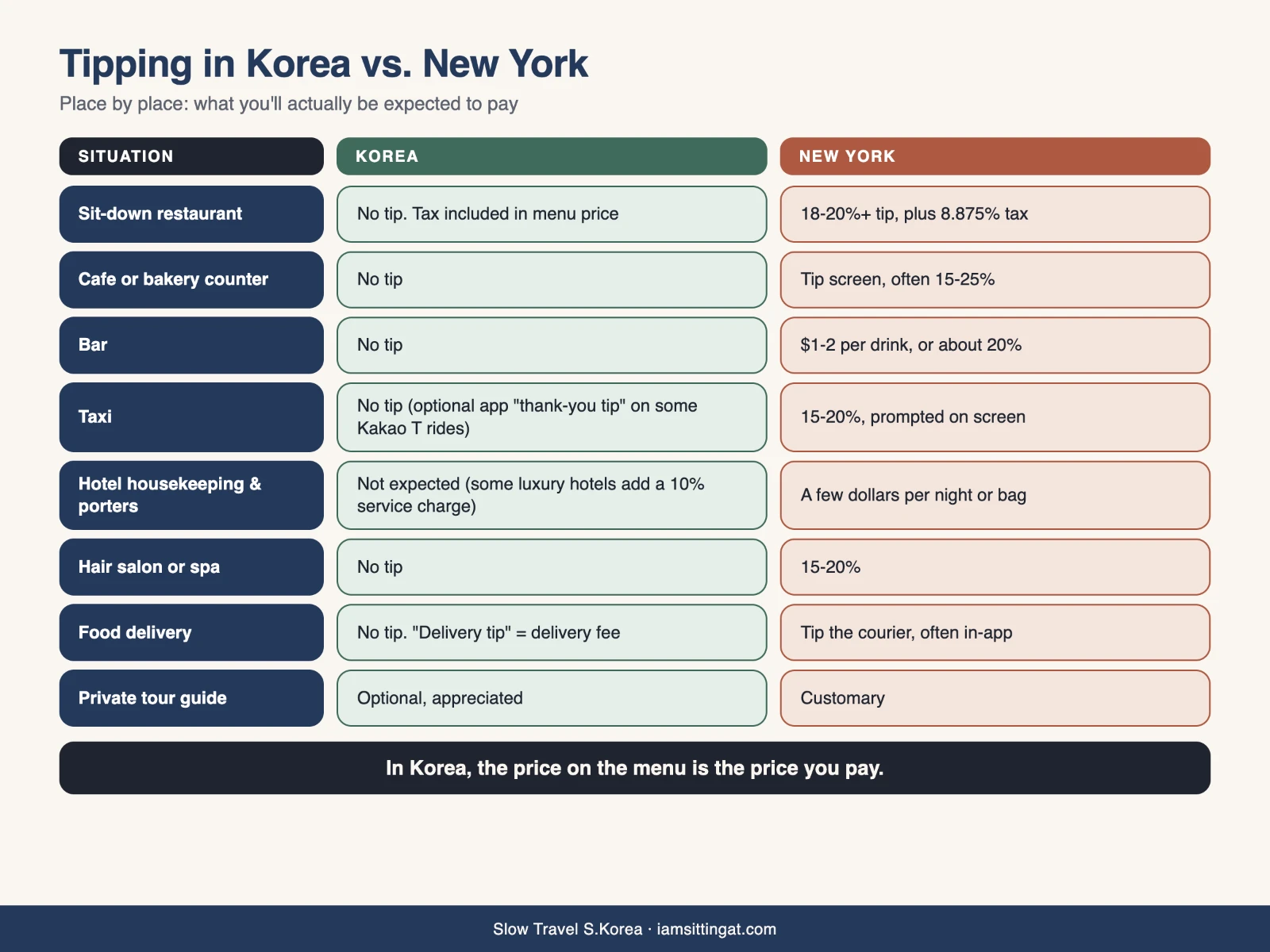
If you want to run the New York numbers before your trip, my sister site has an NYC tip and tax calculator.
Why Koreans Don’t Tip
Tipping in Korea isn’t missing by accident. Three things hold the no-tip system in place: wage law, price law, and a service style that was never built around tips.
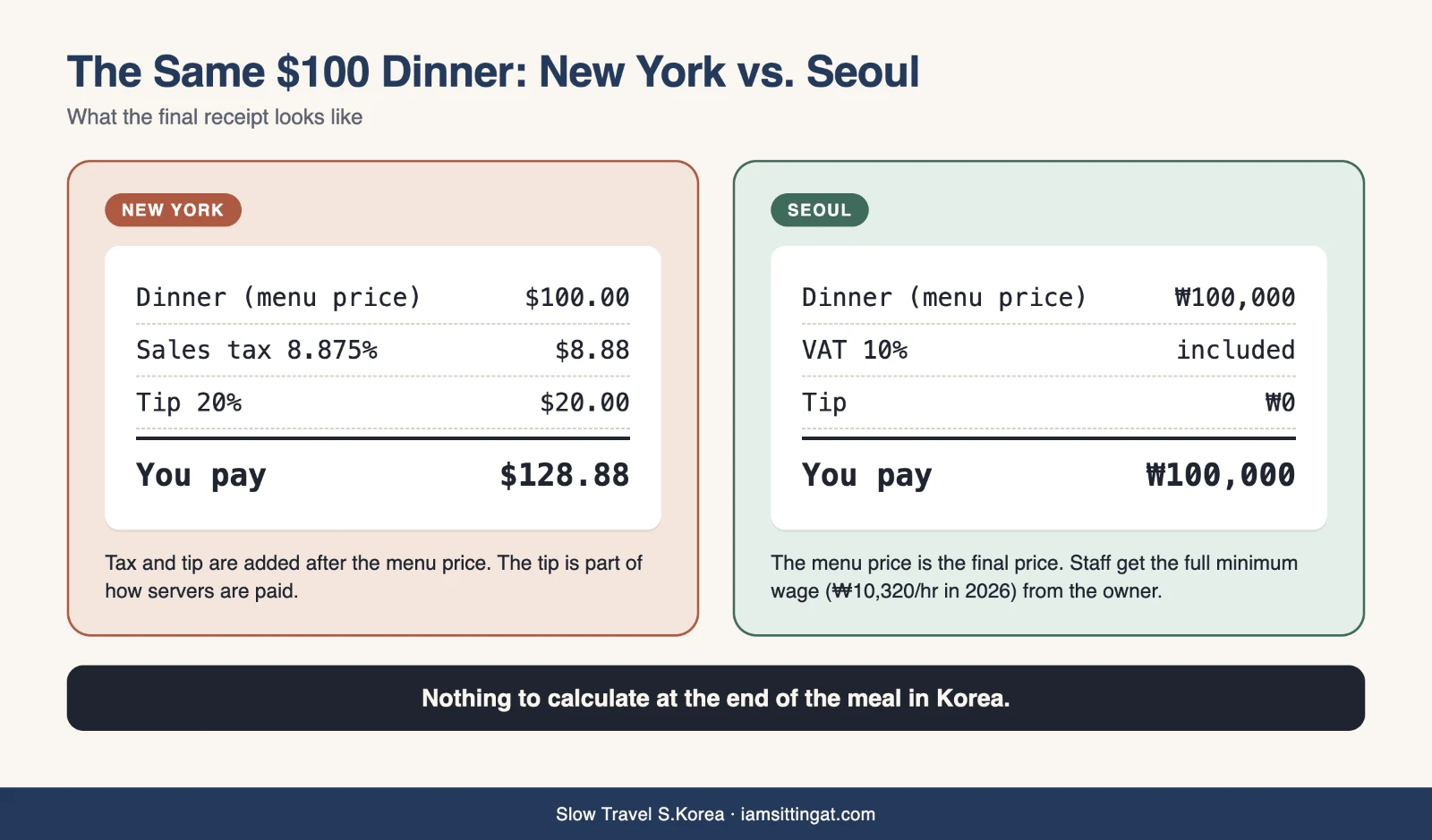
1. Everyone gets the full minimum wage
In 2026, Korea’s minimum wage is ₩10,320 an hour, and it applies the same way to a server, a cashier, and an office worker. There is no lower “tipped” wage. Korea’s Ministry of Employment and Labor finalized the 2026 rate in August 2025, a 2.9% increase over 2025.
Compare that with New York City. The minimum wage here is $17.00 an hour in 2026, but restaurants can pay tipped food service workers a cash wage of $11.35 and count $5.65 of their tips toward the rest. That gap is the reason American tips feel like an obligation rather than a bonus: in New York, part of a server’s base pay really does come from you. In Korea, it comes from the owner, and it’s already in the price of your bibimbap.
2. The menu price has to be the final price
Since 2013, Korea’s Food Sanitation Act rules have required restaurants, cafes, and bakeries to show the price you actually pay, with VAT and any service charge already included. The old “VAT 10% excluded” fine print disappeared from menus. Larger restaurants also have to post prices outside the door.
The rule got tougher this year. Since September 1, 2026, a restaurant or cafe that doesn’t post prices, or charges more than the posted price, can be suspended for five days on the very first violation, rising to 10 and then 20 days for repeat offenses. It used to be just a correction order the first time. Hair salons have their own version of the rule: the posted price must include materials, service charges, and VAT.
So when you see ₩12,000 on a menu, there’s no tax line waiting at the register, no automatic gratuity, and no room in the system for a “suggested tip.”
3. Service works differently
At most casual Korean restaurants, you get your own water, order on a tablet or by pressing a call bell, and pay at the counter on your way out. Nobody checks in on you every ten minutes, because nobody’s income depends on it. I walked through how this works in How to Order at a Korean Restaurant.
There’s also a habit that runs the other direction. In Korea, the word seobiseu (서비스, “service”) means something free the owner adds for you: an extra side dish, a bottle of soda, a bigger portion for a regular. In the US, service is what you pay extra for. In Korea, “service” is often a small gift to the customer.
Tipping in Korea, Situation by Situation
Restaurants, cafes, and bars
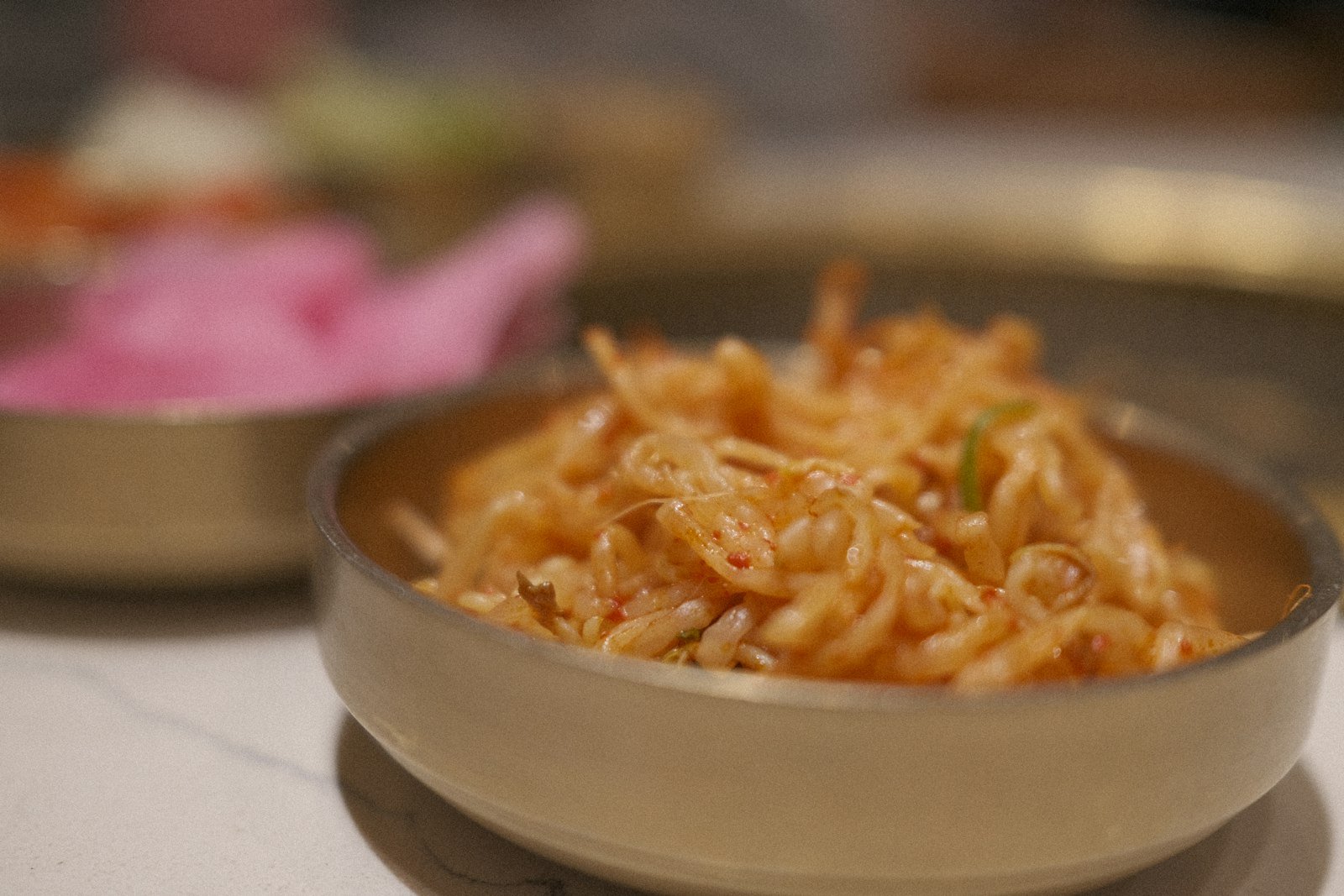
Don’t tip. Pay the posted price at the counter or on the tablet, and you’re done. This includes Korean BBQ restaurants where staff cook the meat at your table. Grilling is part of the job and part of the price.
Korean cafes are almost entirely tip-free, which can feel strange if you’re used to the tip screen at every New York coffee counter. If you want to know how Korean cafes work in general, see my Seoul cafe etiquette guide.
Paying by card: If a card terminal offers to charge you in US dollars, choose won. The dollar option uses the merchant’s exchange rate and usually costs more. A card with no foreign transaction fees saves you another 3% on every meal. [AFFILIATE: no-foreign-transaction-fee credit card]
Taxis
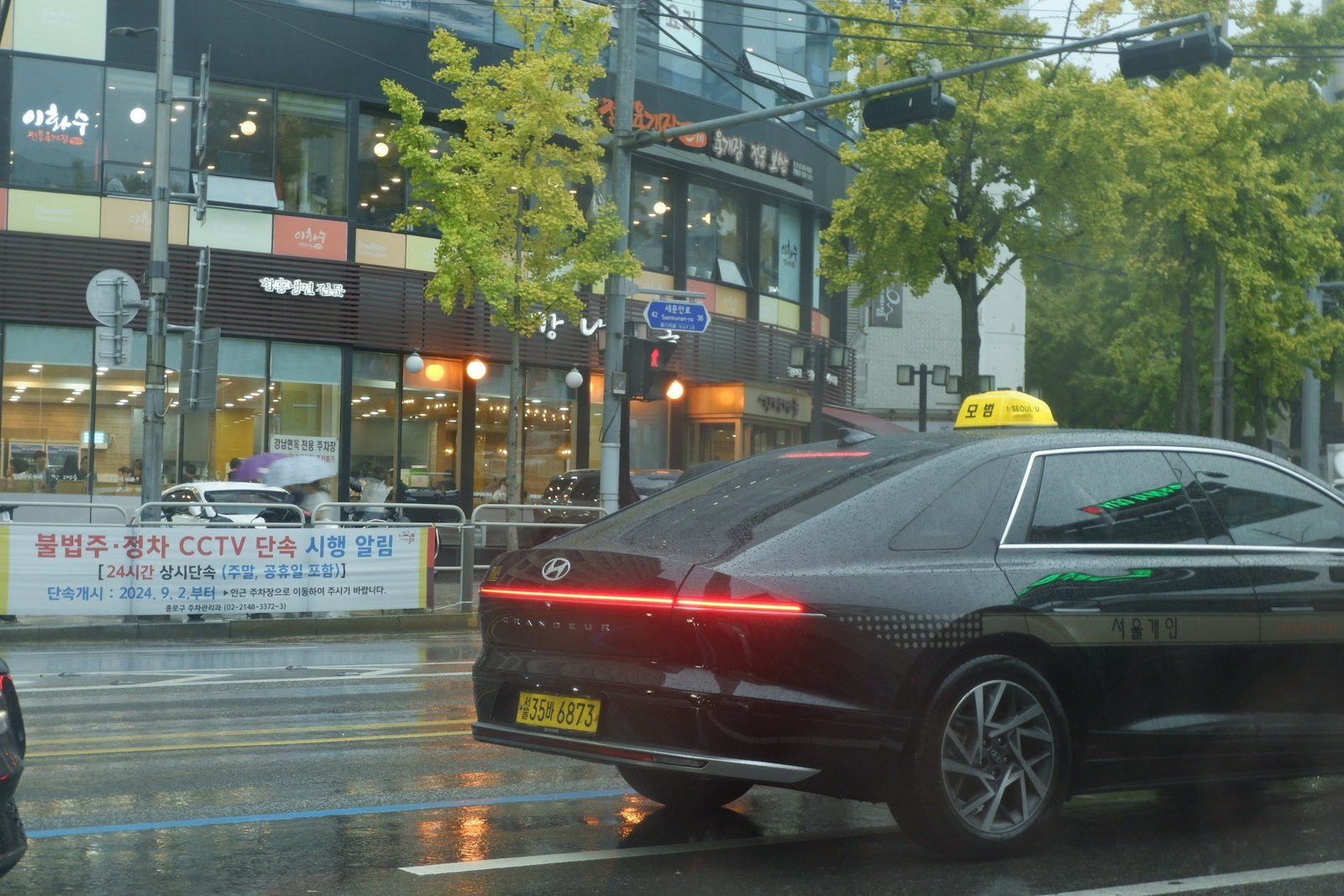
Regular taxis don’t expect tips, and most rides are paid by card anyway. Some Koreans who pay in cash round up and say “keep the change,” but it’s a small personal gesture, not a custom.
The one twist is Kakao T, Korea’s main taxi app. In July 2023, Kakao Mobility started a pilot “thank-you tip” (감사 팁) on some premium and franchise taxi types, including Kakao T Blue, Venti, and Black. After a ride, if you give the driver five stars, the app offers an optional tip of ₩1,000, ₩1,500, or ₩2,000, and you can also choose not to pay. Kakao says the tip goes to the driver minus card processing fees, and that passengers who are pressured for a tip should report it.
It wasn’t popular. In a 2023 Opensurvey poll of 1,000 Korean adults in their 20s to 50s, 71.7% said they were against tipping features in taxi apps, and only 17.2% were in favor. If the prompt shows up for you, skipping it is completely normal. For how to sign up and pay with a US card, see my Kakao T for foreigners guide.
Hotels
This is where things get closer to the American system, but in a different form.
Many upscale Korean hotels charge a 10% service charge on rooms, room service, and hotel restaurants, plus 10% VAT. That service charge is what replaced tipping at these properties. If you see “service charge” on your folio, you’ve already tipped.
Watch the booking screen, too. When the Seoul Metropolitan Government checked 27 five-star hotel websites in 2024, 24 of them didn’t show the final price on the first screen, and the final payment ran 10% to 21% higher than the rate first shown. Korea’s e-commerce rules on deceptive “drip pricing” took effect in February 2025, so this should be improving, but always check the total before you pay.
Housekeeping and porters don’t expect tips at Korean-run hotels. At international chains with lots of foreign guests, staff may accept a tip graciously, but they won’t expect one. If you want to thank housekeeping, a short note does the job. Cash left loose in the room can be treated as a forgotten item rather than a tip, so if you do leave money, put it with a note that says it’s for them.
Hair salons, spas, and jjimjilbang
No tip. The posted price includes everything. If a stylist or massage therapist did a great job, say so, and if the shop uses Naver Map or Kakao Map for bookings, leave a review there. In Korea, reviews matter a lot to small businesses.
Food delivery
Korean delivery apps show a line called baedal tip (배달팁), which translates to “delivery tip.” It isn’t a tip. It’s the delivery fee, set by the app or the restaurant, and it changes with distance and time of day. Pay it as part of the order and don’t add anything else for the rider.
Tour guides
This is the one area where a tip is common among foreign visitors. Private English-speaking guides, especially on full-day tours, are used to international guests and generally appreciate a tip. It’s still optional. For group tours and free walking tours, follow what the operator says. [AFFILIATE: Seoul private tour or day tour]
Korea’s Small “Tip Box” Debate
Tipping in Korea isn’t entirely frozen in time. In the summer of 2023, a few businesses tried it and the backlash was immediate.
A well-known bakery put a glass “tip box” by the register and removed it after criticism. A cafe in Yeonnam-dong reportedly showed customers a tablet with 5%, 7%, and 10% tip buttons before payment, and a post about it set off a long online argument. Most Koreans were against it, and a common complaint was that customers now order from kiosks and carry their own trays, so what exactly is the tip for? In 2025, a “TIPBOX” sign at a restaurant in Yeouido started the debate again.
What this means for you: you might, rarely, see a tip jar or a tip screen in a trendy area. It’s optional, and declining is what most Koreans do. Nobody will treat you differently.
What to Do Instead of Tipping
The urge to show appreciation is a good one. Korea just channels it differently.
- Say thank you, and mean it. Gamsahamnida (감사합니다) works everywhere.
- After a meal, say jal meogeosseumnida (잘 먹었습니다), “I ate well,” on your way out. Owners love hearing it, and it’s what Koreans say.
- When leaving a shop, try sugohaseyo (수고하세요), roughly “keep up the good work.” It’s a casual phrase used with staff and drivers.
- Leave a review on Naver Map, Kakao Map, or Google Maps. For small Korean businesses, a review often matters more than cash.
- Come back. Being a regular is the Korean version of a big tip, and it’s how you end up getting seobiseu.
If you really want to give something
Sometimes a guide spent eight hours with your family, or a hotel concierge fixed a real problem. If you want to give money:
- Hand it over directly, ideally in a plain envelope, with both hands or your right hand supported by your left.
- Say why: “Thank you for today” is enough. Korean staff are more comfortable taking money when it’s clearly a personal thank-you, not a fee.
- Expect a polite refusal at first. One gentle second offer is fine. If they still decline, let it go.
- Don’t leave cash on the table at a restaurant or cafe. It usually just creates a lost-and-found problem.
A small gift from home, like snacks or a souvenir from New York, can work even better than cash with a guide or a host.
Phrases at the register
| English | Korean | Say it like |
|---|---|---|
| Thank you | 감사합니다 | gam-sa-ham-ni-da |
| I ate well (after a meal) | 잘 먹었습니다 | jal meo-geo-sseum-ni-da |
| Keep up the good work | 수고하세요 | su-go-ha-se-yo |
| Keep the change | 잔돈은 괜찮아요 | jan-don-eun gwaen-cha-na-yo |
| No, thank you (to a tip prompt) | 괜찮습니다 | gwaen-chan-seum-ni-da |
Reality Check: What Can Still Catch You Off Guard
- No tipping doesn’t mean “cheap.” Prices already reflect full wages. Seoul restaurant and cafe prices have climbed in recent years, so budget realistically.
- Hotel bills can still surprise you. A 10% service charge plus 10% VAT at a luxury hotel adds about 21%. Check whether your rate is “inclusive” before you book.
- Dynamic currency conversion is the real hidden fee. Paying in dollars instead of won can cost you more than a tip would have.
- Brisk service isn’t rude service. Without tips, staff aren’t performing friendliness for a better tip. Being left alone to eat is considered good service.
- App prompts exist. You may see an optional thank-you tip in a taxi app or, rarely, a tip screen at a cafe. Skipping is normal.
- Foreigner-heavy businesses may accept tips more readily, especially in places like Itaewon or at international hotels. That’s an accommodation, not a Korean norm.
FAQ
Is it rude to tip in Korea?
It isn’t offensive, but it can be awkward. Most staff aren’t used to it and may refuse, or assume you forgot your money. A sincere thank-you is the expected way to show appreciation.
Do you tip taxi drivers in Korea?
No. Pay the fare on the meter or in the app. Some Kakao T premium and franchise taxis have offered an optional ₩1,000 to ₩2,000 thank-you tip after a five-star rating, but most Koreans skip it, and so can you.
Do you tip at hotels in Korea?
Usually not. Many upscale hotels add a 10% service charge to the bill, which takes the place of a tip. At international chains, staff may accept a tip, but it isn’t expected.
Do restaurant prices in Korea include tax?
Yes. Korean law requires restaurants and cafes to show the final price, including VAT and any service charge. Since September 2026, businesses that charge more than their posted price can be suspended on the first violation.
Should I tip a tour guide in Korea?
It’s optional. Private guides who work with foreign visitors appreciate a tip, especially after a full-day tour. For group tours, follow the operator’s guidance.
The Bottom Line
Tipping in Korea comes down to one idea: the price is the price. Koreans don’t tip because wages aren’t built around tips and the law makes businesses show the full price up front. Once you get used to it, it’s one of the most relaxing parts of a Korea trip. You don’t have to do math at the end of a meal, you don’t have to wonder whether 18% is enough, and you don’t have to read a tip screen while someone watches.
Save the tipping instinct for when you get back to New York. In Korea, a “gamsahamnida,” a good review, and a return visit say everything a tip would.