Last updated: October 14, 2026
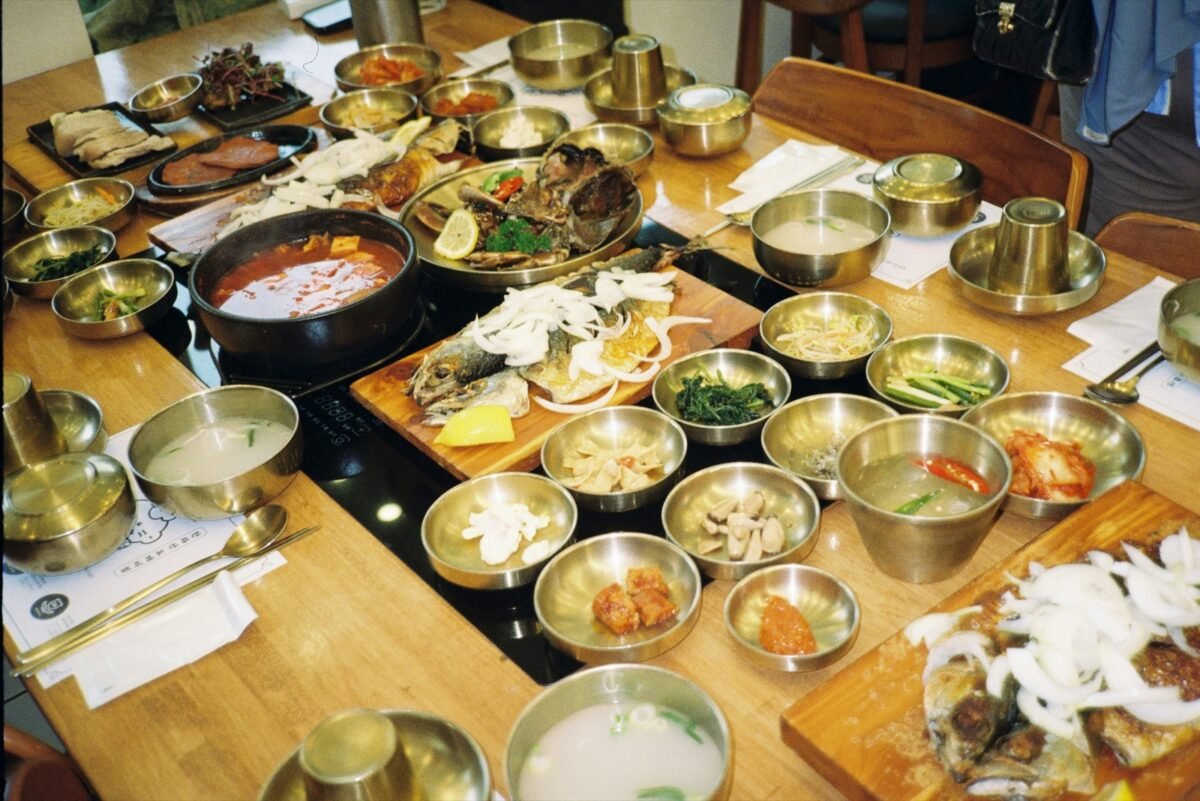
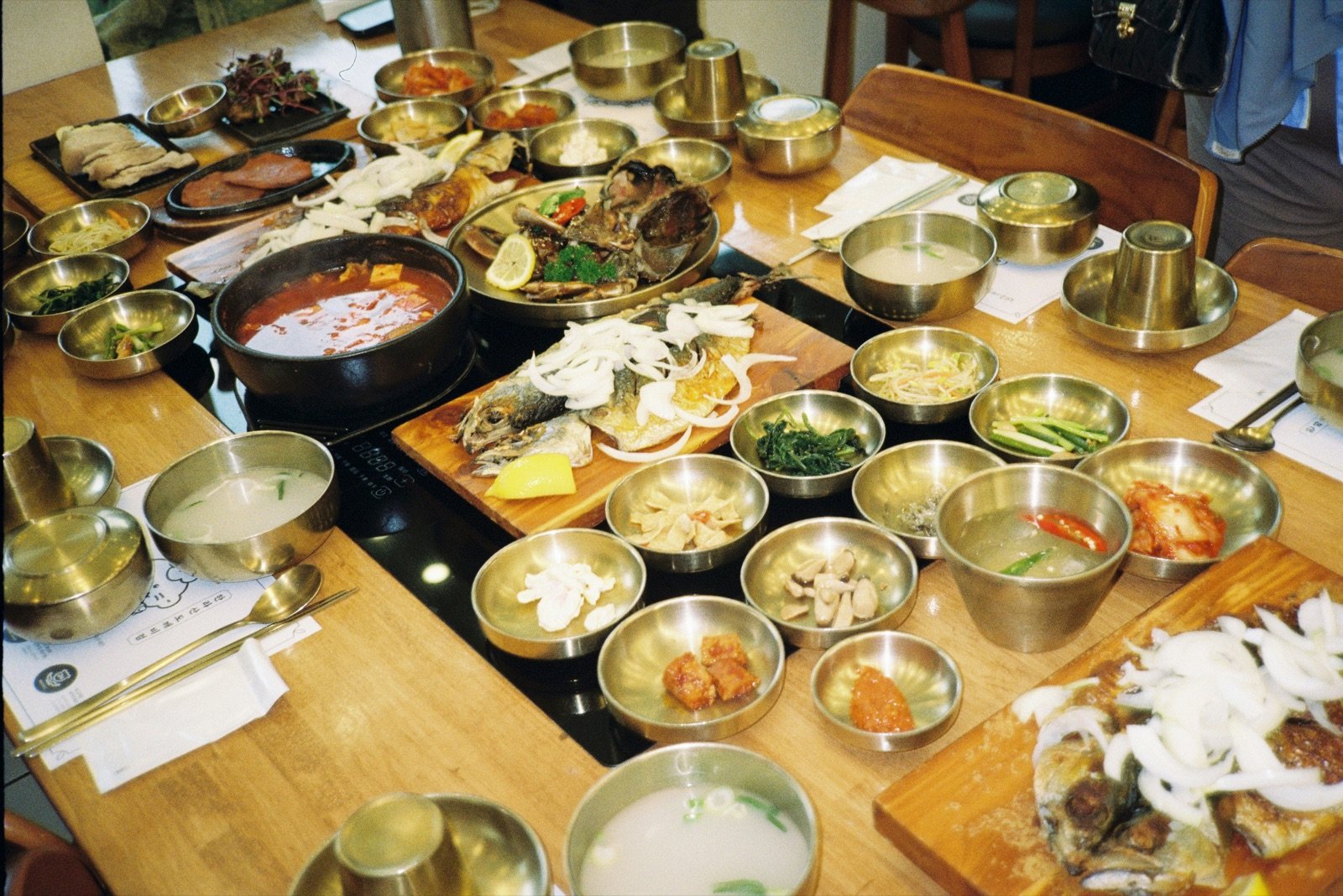
Sit down at a casual restaurant in Seoul, and three things are usually waiting on the table: a tablet propped against the wall, a small round button near the napkins, and a drawer with spoons and chopsticks built into the side. What’s missing is a server walking over with menus and a pitcher of ice water. For most Americans, that’s the first moment of confusion, and it’s why learning how to order at a Korean restaurant before your trip saves you a few awkward minutes at every meal.
Nobody is ignoring you. Korean restaurants are set up so that you call staff when you need them, help yourself to the basics, and pay at the counter on your way out. It’s close to the opposite of a sit-down meal in New York, where a server checks in, refills your glass, and brings the check to the table. Growing up in Korea, I never thought of any of this as a system. Eating out mostly in New York now, I do.
This guide covers the table order tablet, the call bell, self-serve water and side dishes, reading the menu, eating alone, and paying.
Quick Answer: How to Order at a Korean Restaurant
- Show how many people at the door, with your fingers if you like. Some places won’t seat one person at busy times, and some dishes have a two-serving minimum.
- Help yourself to water and utensils. Water is often at a self-serve station or already on the table, and spoons and chopsticks are usually in a drawer on the side of the table.
- If there’s a tablet, order on it. Most have a language button, and many switch to English.
- If there’s no tablet, press the call bell or say jeogiyo, “excuse me,” and point at the menu.
- Side dishes are free and usually refillable, either from staff or at a self-serve bar.
- The menu price is the final price. Tax is included, and you don’t tip.
- Pay at the counter on your way out, unless the tablet or a kiosk asks you to pay first.
Korea vs. New York: Why Ordering Feels Different
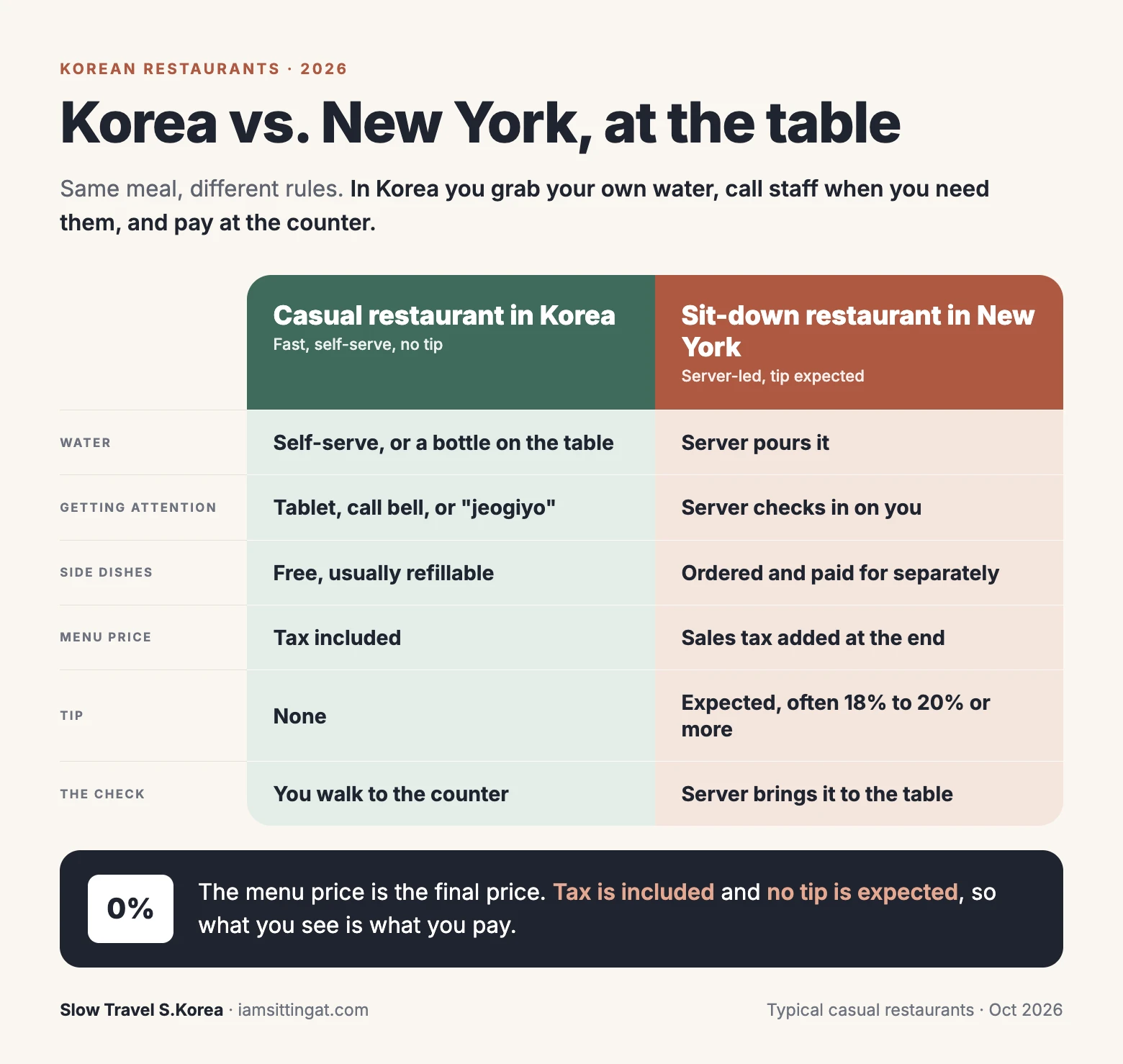
The logic is simple once you see it. Korean restaurants run on speed and turnover, with fewer staff on the floor than you’d expect. A server who doesn’t hover isn’t being cold. In Korea, being left alone to eat is part of good service, and you’re trusted to ask when you need something.
Five Ways Korean Restaurants Take Your Order
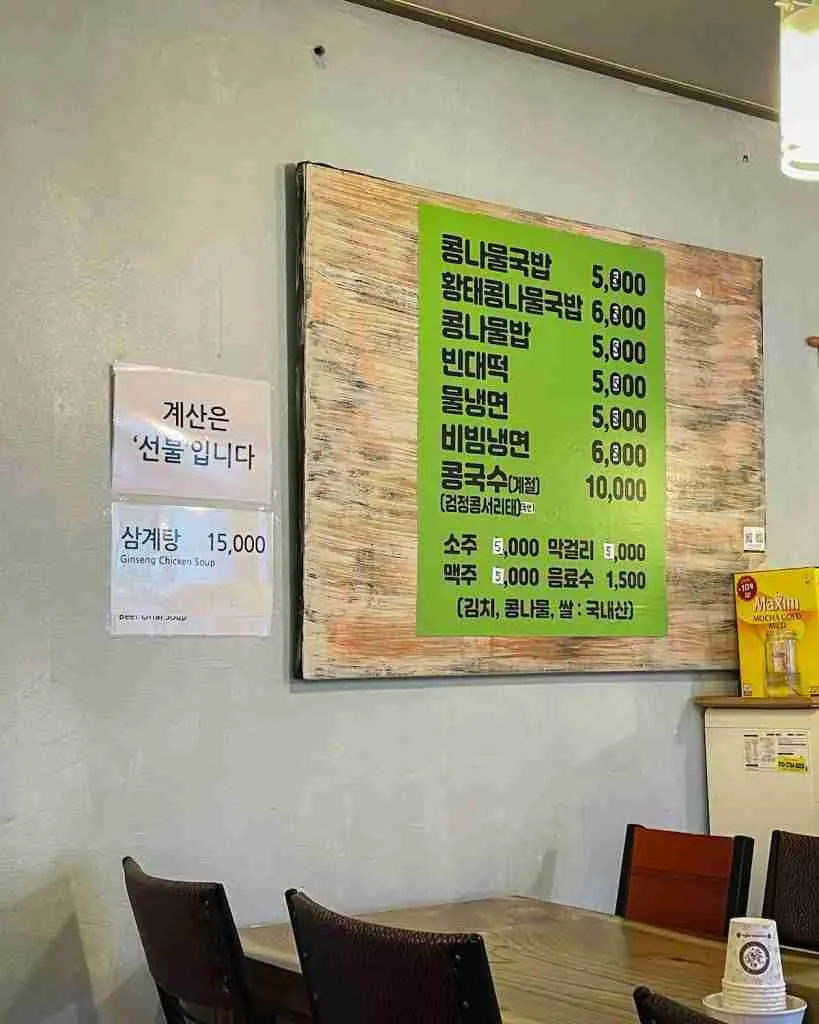
Not every restaurant works the same way. Figure out which kind you’re in, and the rest follows.
| Setup | Where you’ll see it | How you order | When you pay |
|---|---|---|---|
| Table order tablet | Chains, Korean BBQ, pubs, newer restaurants | Tap the tablet at your table | At the counter after eating, or on the tablet at some places |
| Call bell | Most casual sit-down restaurants | Press the button, then point at the menu | At the counter after eating |
| Counter kiosk | Gimbap and snack shops, food courts, fast food, some noodle shops | Order at the machine by the door | Before you eat |
| Just call out | Small family-run places, market stalls | Say “jeogiyo” and point | At the counter or to staff, sometimes cash only |
| Waitlist or reservation | Popular and trendy spots | Tablet at the door or an app, then one of the above | Same as above |
If you’ve already ordered coffee at a Korean cafe, the counter kiosk will look familiar. I covered kiosks in my Seoul Cafe Etiquette guide, so this guide focuses on what happens at the table.
How to Order at a Korean Restaurant, Step by Step
1. At the door
At many places, a staff member will ask how many people, or you’ll just hold up fingers. If nobody comes over and there are open tables, it’s usually fine to sit down. Popular spots may have a waitlist tablet by the entrance (more on that below).
Some restaurants with floor seating ask you to take off your shoes. If you see shoes lined up at a raised platform, follow along.
2. Water, cups, and utensils
Look around before you wait for anyone. Common setups:
- A water purifier or a fridge with water bottles near the counter, with stacked cups beside it. A sign that says self (셀프) means help yourself.
- A bottle of water already on the table, sometimes barley tea instead of plain water.
- Spoons and chopsticks in a drawer built into the side of the table, or in a box on the table. Napkins are usually in a dispenser on the table.
It’s normal for whoever sits closest to set out utensils and pour water for everyone. If you’re with Korean friends, you’ll see someone do this almost without thinking.
3. Order, eat, and pay
Order on the tablet if there is one. If not, press the call bell or say “jeogiyo” and point at the menu or a photo on your phone. Side dishes, or banchan (반찬), arrive with or before your food, and you can ask for more anytime. When you’re done, walk to the counter to pay. Each of these steps is covered in more detail below.
Using a Table Order Tablet in Korea
The table order tablet in Korea has gone from novelty to normal in a few years, and for visitors, it’s mostly good news: photos, prices, and no need to say a word. Payhere, one of Korea’s payment system companies, says the number of stores adopting its table ordering grew by 99.7% in the first half of 2026 compared with a year earlier. At one popular noodle restaurant in Apgujeong, staff told a Korean business magazine that foreign visitors went from about 20% of customers to 40 to 50% in a year, and that tourists simply switch the tablet to English and order.
How to use one
- Find the language button. It’s usually in a top corner, marked with a globe icon, “Language,” or “EN.” Some systems, like KT’s HiOrder, support 13 foreign languages and switch instantly.
- Browse the categories across the top or side: mains, sides, drinks, and sometimes a “set” or “for two” tab.
- Tap an item and pick options, such as spice level, size, or extra rice.
- Add it to the cart, then review the order before you send it.
- Tap the order button. It may say “Order” or 주문하기. You’ll usually see a confirmation screen, and many tablets keep an order history you can check later.
What the tablet can and can’t do
- English depends on the restaurant. On some systems, the owner has to type in English menu names, and translations can be literal, so trust the photos. Toss Place, another major provider, says its English mode doesn’t yet translate store notices, staff-call options, or origin labels, so parts of the screen may stay in Korean even after you switch.
- There’s usually a staff-call menu. Look for a button with a bell icon or 직원호출. It opens a list of quick requests like water, a spoon, an apron, or “just call staff.” If it’s only in Korean, the bell or “jeogiyo” works just as well.
- Payment varies. At most places, the tablet only sends your order to the kitchen, and you pay at the counter later. Some systems handle payment at the table, and HiOrder even lets a group split the bill on the tablet. Whether a US card goes through a tablet’s card reader depends on the restaurant’s setup. If it doesn’t work, pay at the counter.
- It may enforce minimums. If you can’t select one serving of a dish, it probably has a two-serving minimum.
The Call Bell: How to Get a Server’s Attention
If there’s no tablet, look for a small button on the table or on the wall beside it. Press it once. A chime sounds, and a display near the kitchen shows your table number. A server will come over.
To an American, pressing a button for a server can feel a little rude. In Korea, it’s the opposite: the bell is the quiet, polite way to get attention. Press once, and if it’s busy, give it a minute.
No bell? Raise your hand slightly and say:
- Jeogiyo (저기요): “Excuse me.” This is the safe, all-purpose choice.
- Yeogiyo (여기요): “Over here.” Also common and fine.
You’ll hear Koreans call servers imo (이모, literally “auntie”). It’s friendly and very common, but as a visitor, stick with jeogiyo. Don’t snap your fingers or whistle, which reads as rude in Korea just as it does in the US.
Self-Serve Water, Side Dishes, and the Banchan Bar
Free side dishes are one of the things visitors love most about eating in Korea, and Koreans feel the same way. In a March 2026 survey of 1,000 Korean adults by research firm Embrain Trend Monitor, 63.9% said free banchan are part of the identity of Korean restaurants, and 82.5% said they refill side dishes at a self-serve bar.
How refills work:
- At the table: Hold up the empty dish and say banchan deo juseyo (반찬 더 주세요), “more side dishes, please,” or name the dish if you know it, such as kimchi deo juseyo.
- At a self-serve bar: Many restaurants set out kimchi, pickled radish, lettuce, garlic, peppers, and sauces in a corner for you to take what you want. Take small amounts and go back for more. Banchan that have been served at a table can’t be reused, so whatever you leave gets thrown out.
- Rice is often separate. A bowl of rice, gonggibap (공기밥), is often a separate, inexpensive add-on at Korean BBQ and stew restaurants. Check the menu or the tablet.
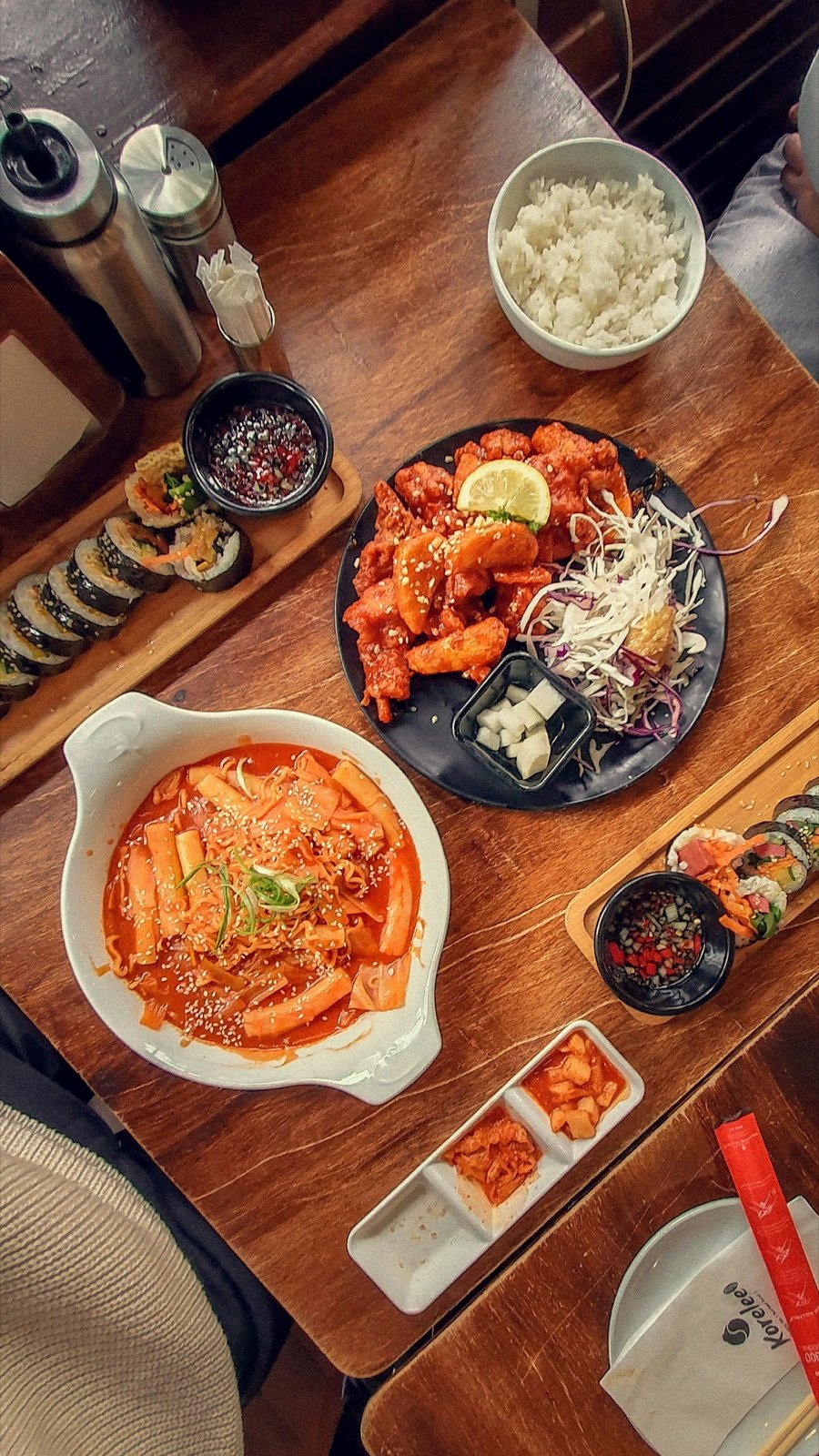
One note on where this is heading. With vegetable prices up sharply, some Korean restaurant owners have been openly debating whether to charge for extra side dishes. Most diners are against it (64.8% in the same survey), and free refills are still the norm. But if you see a sign about extra charges for refills, that’s why.
Reading the Menu Without Surprises
A few rules make Korean menus easier to read.
- The price you see is what you pay. Since 2013, Korean restaurants have been required to list the final price, including VAT and any service charge. No 8.875% added at the register, no automatic gratuity.
- Inbun (인분) means “serving.” 1인분 is one serving, 2인분 is two. “2인분 이상” means you must order at least two servings.
- Meat is priced by weight. At Korean BBQ restaurants, menus must show the price per 100 grams, and many also list the weight and price of one serving. Compare the grams, not just the price.
- Dishes meant for sharing are sized for groups. Stews served in a pot at the table (jeongol, 전골), whole fried chicken, and grilled meat are often for two or more people.
- Spice levels are real. You can ask for deol maepge (덜 맵게), “less spicy,” but many sauces are made ahead, so it isn’t always possible.
Useful phrases at the table
| English | Korean | Say it like |
|---|---|---|
| Excuse me | 저기요 | jeo-gi-yo |
| This one, please | 이거 주세요 | i-geo ju-se-yo |
| Can I order one serving? | 1인분 돼요? | il-in-bun dwae-yo? |
| Water, please | 물 좀 주세요 | mul jom ju-se-yo |
| More side dishes, please | 반찬 더 주세요 | ban-chan deo ju-se-yo |
| Less spicy, please | 덜 맵게 해 주세요 | deol maep-ge hae ju-se-yo |
| The check, please | 계산해 주세요 | gye-san-hae ju-se-yo |
| Separate checks | 따로 계산할게요 | tta-ro gye-san-hal-ge-yo |
Eating Alone in Korea
This is the part of Korean restaurant etiquette that surprises solo travelers most. Korea has more single-person households than ever, and eating alone, honbap (혼밥), is common. But some restaurants still don’t want one person at a four-person table during the lunch or dinner rush.
In May 2026, a CNN Travel writer described being turned away twice in one day while trying to eat alone in Seoul, and the piece made headlines in Korea. Late in 2025, a Seoul noodle shop drew criticism for a sign telling solo diners to order for two or bring someone. Refusing solo diners or requiring two servings isn’t illegal in Korea, so it comes down to each restaurant.
How to make it easy:
- Go off-peak. Before noon or after 1:30 p.m. for lunch, and before 6 p.m. for dinner, owners are much more relaxed about one diner.
- Choose dishes built for one. Noodle soups, gukbap (rice in hot soup), bibimbap, gimbap and snack shops, and set meals are all normal solo meals.
- Look for counter seats or a menu that lists single servings.
- Ask first: Honja dwaeyo? (혼자 돼요?), “Is one person OK?” A quick no at the door is better than an awkward moment after you sit.
- For Korean BBQ, expect a two-serving minimum at many places, or look for restaurants that advertise single servings.
Waitlists and Reservations
At popular restaurants, you’ll often see a tablet by the door asking for your party size and a Korean phone number. The restaurant texts you when your table is ready. Without a Korean number, that system doesn’t help you, so try one of these:
- Ask staff to add you in person. Many will take your name and wave you in when it’s your turn, as long as you wait nearby.
- CatchTable Global, the international version of Korea’s biggest restaurant reservation app, lets you sign up with an email address instead of a Korean phone number. It’s in English, Japanese, and Chinese, and you can pay deposits with a foreign card.
- Naver Map now offers passport verification for foreign visitors, which unlocks bookings at restaurants that use Naver’s reservation system. See How to Use Naver Map in English.
- A tourist plan with a Korean number can receive waitlist texts at many places. See Best eSIM for Korea. [AFFILIATE: Korea eSIM]
Paying the Check
- Go to the counter. Bring the receipt if one was left on your table; otherwise just tell staff your table or point.
- One person usually pays. Among Korean friends, it’s common for one person to cover the meal and someone else to get the next round or the coffee. Splitting is fine, though. Say ttaro gyesanhalgeyo (따로 계산할게요), “we’ll pay separately.” It’s easiest when it’s not the peak of the lunch rush.
- No tip. Not at the counter, not on the table. Leaving cash behind can confuse staff, and some will run after you to return it.
- Pay in won. If the card terminal offers US dollars, choose won. My guide to the best credit card to use in South Korea explains why. [AFFILIATE: no-foreign-transaction-fee credit card]
- Carry some cash for market stalls and small family places. A prepaid card like WOWPASS also works at terminals that reject US cards. See WOWPASS Review.
- Meals don’t qualify for tax refunds. The tourist VAT refund covers goods you take home, not food you eat here. See Korea Tax Refund for Tourists.
Reality Check: What Can Still Go Wrong
- English is uneven. The tablet may switch to English while staff-call options, notices, or specials stay in Korean. Photos and a translation app fill the gaps.
- Your card may not work on the tablet. If table payment fails, pay at the counter. That almost always works.
- Solo dining can mean a “no” at the door, especially at BBQ and stew restaurants during peak hours.
- Two-serving minimums double the bill for one. Check the menu for “2인분 이상” before you sit down.
- Lunch moves fast. At busy weekday lunch spots, people eat and leave. Lingering is what cafes are for.
- Waitlists assume a Korean phone number. Ask staff in person, or use an app built for visitors.
- Allergies are hard to explain. Some tablets let restaurants mark allergy and vegan options, but many don’t. If you have a serious allergy, carry a short note in Korean and show it before you order.
My Restaurant Checklist for a Korea Trip
- Phone data sorted so you can translate menus and check maps: [AFFILIATE: Korea eSIM]
- Learn jeogiyo and gyesanhae juseyo
- Look for a language button on the tablet before ordering
- Check for “2인분 이상” if you’re eating alone
- Help yourself to water and utensils, and refill side dishes in small amounts
- Pay at the counter, in won, and skip the tip
- Download the rest of the essentials: Korea Travel Apps for Foreigners
FAQ
How do you order at a Korean restaurant?
If there’s a tablet at your table, switch it to English and order there. If not, press the call bell on the table or say “jeogiyo” (excuse me) and point at the menu. Water and utensils are usually self-serve, and you pay at the counter when you leave.
Do you tip at restaurants in Korea?
No. Menu prices already include tax, and tipping isn’t part of Korean restaurant culture. Staff don’t expect it, and some may try to return money you leave behind.
How do I call the waiter in a Korean restaurant?
Press the call bell on or near your table once, or use the staff-call button on the table tablet. If neither exists, raise your hand and say “jeogiyo.” It’s polite in Korea, not rude.
Are side dishes free in Korean restaurants?
Yes. Banchan come with your meal at no charge, and refills are usually free. Ask staff or use the self-serve bar, and take only what you’ll eat. A small number of restaurants have started charging for extra side dishes.
Can I eat alone at a Korean restaurant?
Usually, yes. Noodle shops, soup and rice places, and snack shops welcome solo diners. Some restaurants, especially Korean BBQ and stew places, may turn away one person at peak hours or require you to order two servings, so go off-peak or ask “honja dwaeyo?” at the door.
The Bottom Line
Knowing how to order at a Korean restaurant comes down to one shift in mindset: nobody is going to come check on you, and that’s by design. Grab your own water, order on the tablet or press the bell, ask for more side dishes whenever you want, and pay at the counter on your way out. No tip, no tax at the end, no waiting for the check. After a meal or two, it starts to feel faster and easier than the version back home.