Last updated: October 25, 2026
If a Korean resident walks into a big Seoul emergency room with a stomach bug, the government estimates the visit will cost them about 220,000 won out of pocket, and that’s with national health insurance. Since a 2024 rule change, mild cases at major ERs pay 90% of the bill themselves. As a tourist, you don’t have that insurance at all. You pay 100%.
So, do I need travel insurance for South Korea? Legally, no. Korea doesn’t ask for proof of insurance at the border. But for most Americans, the honest answer is yes, mainly because your US coverage probably does less abroad than you think. This guide walks through what US plans and credit cards really cover, what Korea hospital costs for tourists look like, and what kind of policy actually makes sense for a Korea trip.
Quick Answer: Do You Need Travel Insurance for Korea?
- It’s not required. Korea doesn’t require visitors to carry travel insurance, and neither K-ETA nor the e-Arrival Card asks about it.
- Medicare doesn’t cover care in Korea, with only rare exceptions. Many employer and marketplace plans pay something for emergencies abroad, but you usually pay up front and file a claim later.
- Korean medical care is good and often cheaper than in the US, but tourists pay the full uninsured price, and some hospitals use a separate rate for foreign patients.
- The real financial risk is a serious emergency, not a cold. A hospital stay plus a medical flight home can run into six figures.
- Most credit cards don’t pay medical bills abroad. A few premium cards help with evacuation, and one popular card reimburses up to $2,500 in medical costs.
- A travel medical plan is the minimum worth having. Comprehensive insurance also protects your flights and hotels, and costs more.
Why Your US Coverage Probably Isn’t Enough
In New York, we’re used to thinking about networks: in-network, out-of-network, prior authorization. Abroad, the question is simpler and harsher: will your plan pay anything at all, and how fast?
Employer plans and ACA marketplace plans. Many treat emergency care abroad as out-of-network and reimburse part of it after you get home. Some don’t cover international care at all. Very few pay for a medical flight back to the US. Call your insurer before you fly and ask three questions: Do you cover emergency care in South Korea? Do you pay the hospital directly, or do I pay and claim? Do you cover medical evacuation?
Medicare. Original Medicare generally doesn’t pay for care outside the US. The State Department and Medicare both say this plainly, and it surprises a lot of retirees planning a first trip to Asia.
Medigap (Medicare Supplement). Plans C, D, F, G, M, and N include a foreign travel emergency benefit: 80% of emergency care after a $250 deductible, with a $50,000 lifetime cap. It helps, but it doesn’t cover evacuation, and $50,000 is a lifetime limit, not per trip.
Medicare Advantage. Some plans include worldwide emergency coverage. Check your Evidence of Coverage, not the marketing brochure.
Korea Hospital Costs for Tourists: What You’d Actually Pay
Korea runs a single national health insurance system. Residents, including foreigners who live there long term, pay monthly premiums and then cover only a share of each bill. A short-term visitor isn’t enrolled, so the hospital bills you for the whole amount.
Two things push the number higher for tourists:
- You pay the full fee, not the insured share. That alone multiplies what a local pays by roughly two to ten times, depending on the type of care.
- Some hospitals charge foreign patients a separate “international” rate. Hospitals set these rates themselves, and they can run well above the national fee schedule. A Korean lawmaker recently questioned how these rates are applied, after finding that national university hospitals billed foreign patients noticeably more on average.
Here’s a rough picture of Korea hospital costs for tourists, based on Korean government figures and hospital fee patterns. Treat these as ballpark numbers, not quotes.
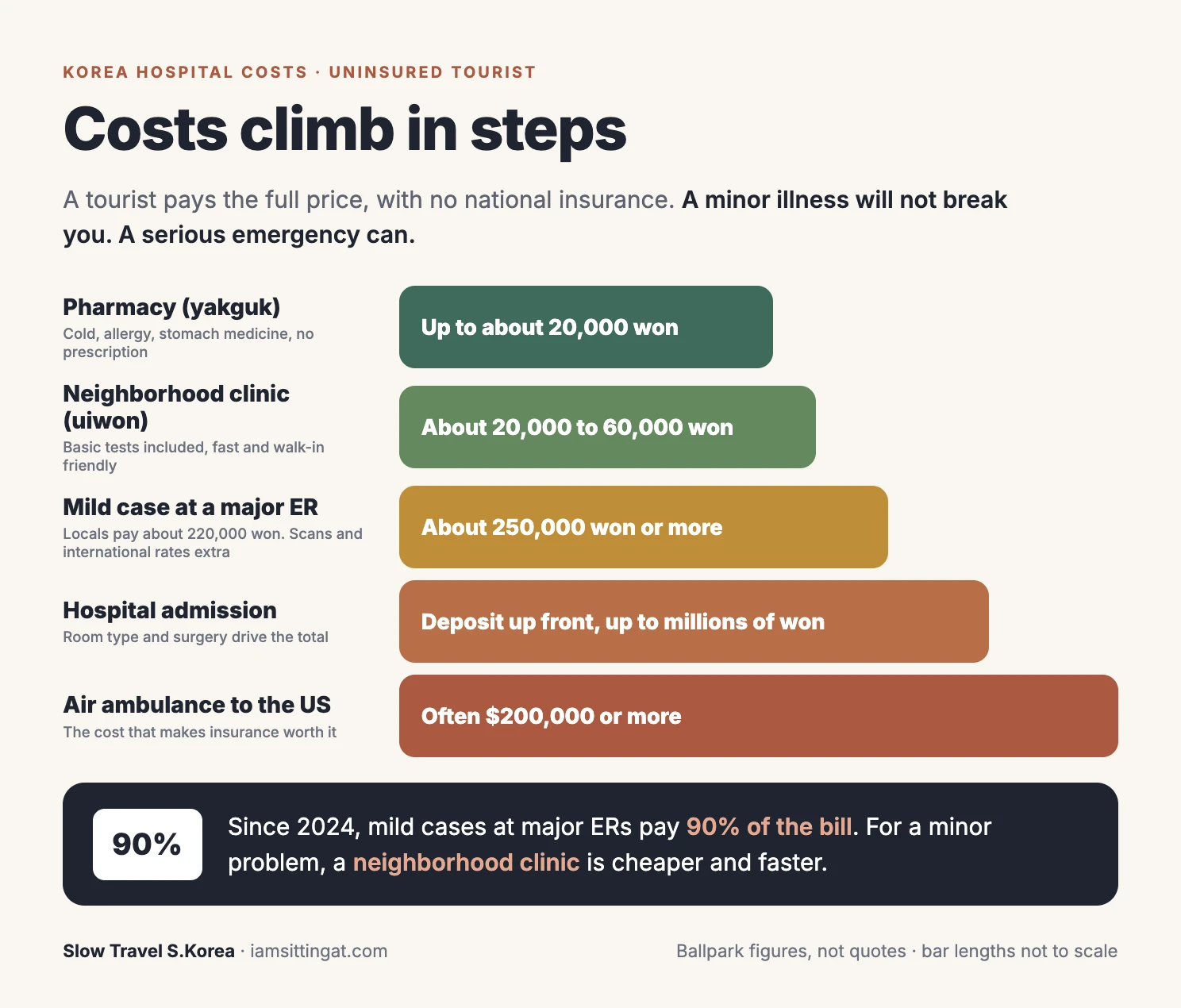
The takeaway: a minor illness in Korea won’t break you. Plenty of travelers pay a clinic or pharmacy bill and never bother filing a claim. A broken leg on a hiking trail, an appendix that needs to come out, or a heart problem that keeps you from flying home on schedule is a different story.
Why the ER rule matters for visitors
In September 2024, Korea raised what mild and non-emergency patients pay at its larger emergency centers to 90% of the bill, up from 50% to 60%. The goal was to keep big ERs free for severe cases. The health ministry estimated the average mild-case bill there would rise to about 220,000 won.
For a visitor, the practical lesson is to avoid walking into a major university hospital ER for something a clinic could handle. A fever or a sprained wrist on a weekday is usually a neighborhood clinic visit.
Travel Insurance for South Korea vs. Credit Card Coverage
Many Americans assume their travel card has them covered. For trip delays and lost bags, that’s often true. For medical bills, it usually isn’t.
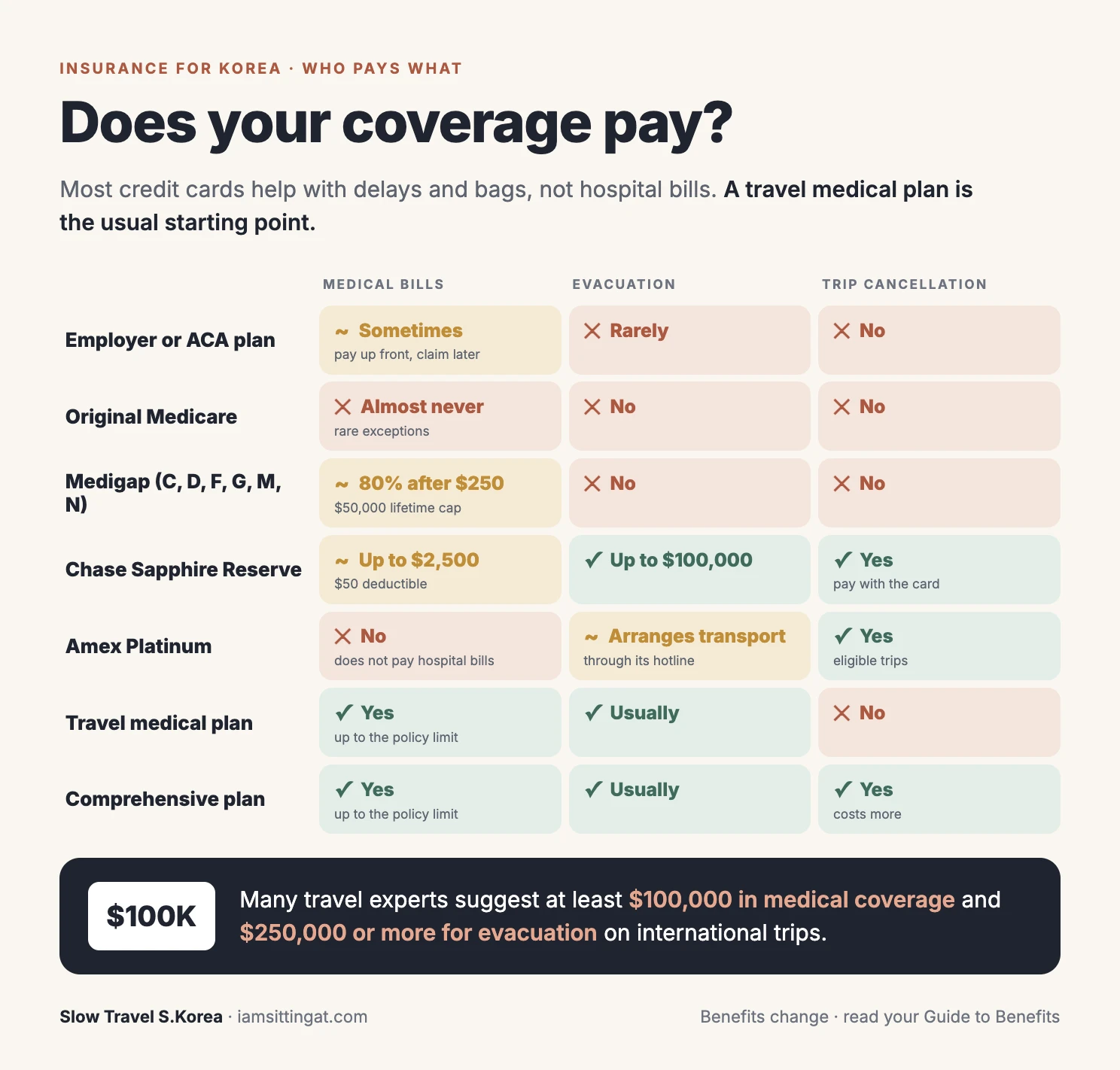
Card benefits change, so read your card’s Guide to Benefits before you rely on it. I cover how these cards work for spending in Korea in my guide to the best credit card to use in South Korea.
Travel Medical vs. Comprehensive: Which One Do You Need?
There are two main types of travel insurance, and they protect different things.
Travel medical insurance pays for emergency care abroad and usually medical evacuation. It doesn’t refund your trip if you have to cancel. It’s the cheaper option, and in the first quarter of 2026, about a third of travelers buying through the marketplace Squaremouth chose medical-only coverage.
Comprehensive travel insurance adds trip cancellation, interruption, delays, and baggage. Squaremouth says these plans typically cost 4% to 10% of your prepaid, nonrefundable trip cost. On a $5,000 trip, that’s about $200 to $500.
A simple way to decide:
- Booked with points, or mostly refundable? A travel medical plan is usually enough.
- Paid a lot up front for nonrefundable flights and hotels? Comprehensive makes sense, especially for a long-haul trip from New York.
- Already holding a card like the Sapphire Reserve? You might pair the card’s trip protections with a separate travel medical plan, since $2,500 in medical coverage doesn’t go far in a real emergency.
[AFFILIATE: travel insurance comparison site (comprehensive and travel medical quotes)]
If you’re flying business class on points, cancellation coverage matters less, since award tickets can often be canceled for a fee. I get into that in Business Class to Seoul with Points.
What to Look For in a Policy for Korea
Most travel insurance articles give the same generic checklist. These are the details that matter for Korea specifically.
Medical limit. Many travel experts suggest at least $100,000 in emergency medical coverage for international trips. Korea is cheaper than the US for most care, but a long hospital stay adds up.
Evacuation limit. Look for $250,000 or more. Korea has excellent hospitals, so you’re unlikely to be evacuated for lack of care. The bigger risk is needing a medically supervised flight home after surgery.
Hiking and skiing. Korea is a hiking country. Bukhansan, Seoraksan, and the coastal trails draw huge weekend crowds, and older Koreans hike seriously. Ordinary hiking is usually covered, but some policies exclude high-altitude or “hazardous” activities. In winter, check that downhill skiing is included if you’re heading to a resort like Yongpyong.
Scooters and e-scooters. Rental e-scooters and mopeds are common in Korean cities and on Jeju. Many policies exclude motorized two-wheelers or require a valid license. Read this one carefully.
Cosmetic and dermatology procedures. Standard travel insurance doesn’t cover elective treatment or complications from it. If you’re planning a skin clinic visit or a procedure in Seoul, you’ll need separate medical tourism coverage. See Seoul Dermatology Clinics for Foreigners.
Weather delays. Summer typhoons from July through September often ground flights, especially to and from Jeju. Trip delay coverage helps cover an extra night and meals.
Pre-existing conditions. Many comprehensive plans waive pre-existing condition exclusions only if you buy within a short window after your first trip payment, often 14 to 21 days. Medical-only plans may not offer a waiver at all.
Direct billing vs. reimbursement. In Korea, you’ll almost always pay first and claim later. A few large hospitals’ international clinics work directly with some insurers, but don’t count on it.
If You Get Sick in Korea: How It Actually Works
This is where a local perspective helps, because the Korean system is easier than it looks once you know the order of things.

For an emergency, call 119. Korea’s public ambulance is free, and dispatchers can connect you to an interpreter. If you’re in Seoul, the 119 line also offers medical guidance and hospital referrals in English.
For help in English, call 1330. The Korea Travel Hotline, run by the Korea Tourism Organization, can interpret for you at a clinic or pharmacy. Seoul’s city government lists it as a 24-hour service.
For something minor, start at a pharmacy (yakguk, 약국). Korean pharmacists sell cold, allergy, and stomach medicine without a prescription and are used to helping visitors in tourist areas. Prescriptions are filled at a separate pharmacy, usually right next to or downstairs from the clinic.
For something that needs a doctor but isn’t life-threatening, go to a clinic (uiwon, 의원). Korea has small specialist clinics on nearly every block: internal medicine, ENT, orthopedics, dermatology. Many take walk-ins. In Korea, people see a specialist clinic first and go to a big hospital only when referred. That’s the opposite of how many Americans use urgent care and ERs.
Ask for these documents before you leave. Your insurer will want them, and they’re much harder to get once you’re back in New York:
- Itemized receipt (jinryobi yeongsujeung, 진료비 영수증)
- Detailed statement of charges (jinryobi sebu sanjeong naeyeok, 진료비 세부산정내역)
- Diagnosis certificate in English (yeongmun jindanseo, 영문 진단서), which usually costs extra
- Pharmacy receipt for any prescription
Pay with a no-foreign-fee card if you can, and keep the card slip. Your phone data should already be working so you can call your insurer’s assistance line from the hospital: [AFFILIATE: Korea eSIM] See Best eSIM for Korea.
Reality Check: Costs, Limits, and Gaps
- Travel insurance isn’t cheap for older travelers. Premiums rise with age, and a comprehensive plan for a couple in their 60s can cost several hundred dollars or more.
- Exclusions do the real work. Alcohol-related injuries, undeclared pre-existing conditions, and risky activities are common reasons claims get denied.
- You still pay first. Most claims are reimbursements, so you need a card with enough available credit to cover a hospital deposit.
- Claims take time. Expect weeks, sometimes longer, and expect to send documents more than once.
- Insurance won’t fix a language barrier. An assistance line helps, but having 1330 saved in your phone helps more in the moment.
- For short, cheap trips, the math is closer. If you’re healthy, booked with points, and your US plan covers emergencies abroad, a low-cost medical-only plan may be all you need.
My Pre-Trip Insurance Checklist for Korea
- Call your US health insurer and ask about emergency care abroad and evacuation
- If you’re on Medicare, check whether your Medigap or Advantage plan has foreign travel coverage
- Read your credit card’s Guide to Benefits for medical and evacuation limits
- Decide between travel medical and comprehensive based on how much you prepaid: [AFFILIATE: travel insurance for Korea]
- Check exclusions for hiking, skiing, and scooters
- Buy early if you have a pre-existing condition and want the waiver
- Save 119 and 1330 in your phone, plus your insurer’s 24-hour assistance number
- Bring a card with enough credit for a hospital deposit
- Check entry rules for your arrival date: See K-ETA guide.
- Packing for winter? Ice and colds are the usual culprits: See Seoul in December guide.
FAQ
Do I need travel insurance for South Korea?
It’s not legally required, and you won’t be asked for proof at entry. But most US health plans offer limited coverage abroad, and Medicare generally doesn’t cover care in Korea at all, so travel insurance is strongly worth considering.
Does Medicare cover me in South Korea?
Original Medicare generally doesn’t. Medigap Plans C, D, F, G, M, and N cover 80% of foreign emergency care after a $250 deductible, up to a $50,000 lifetime limit. Some Medicare Advantage plans include worldwide emergency coverage.
How much does a hospital visit cost in Korea for tourists?
Minor care is affordable: a clinic visit or pharmacy purchase often costs tens of thousands of won. A mild case at a major ER can run 250,000 won or more for an uninsured visitor, and hospital admission usually requires a deposit.
Does my credit card cover medical bills in Korea?
Usually not. The Chase Sapphire Reserve reimburses up to $2,500 in medical expenses on covered trips, and the Amex Platinum can arrange emergency medical transport, but neither replaces a travel medical policy for serious care.
Can foreigners use Korean public health insurance as tourists?
No. Korea’s national health insurance is for residents. Foreigners generally become eligible only after registering and staying long term, so short-term visitors pay full price.
The Bottom Line
Do you need travel insurance for South Korea? Not to get in, and not for a cold. A pharmacy and a neighborhood clinic will take care of most small problems for less than a nice dinner in Manhattan. You buy insurance for the rare, expensive week: a hospital stay, surgery, or a supervised flight home. For most Americans, a travel medical plan with solid evacuation coverage is the right starting point, and comprehensive coverage makes sense when you’ve prepaid a lot. Sort it out before you fly, save 119 and 1330 in your phone, and then get back to planning the parts of the trip you’ll actually remember.