Last updated: November 6, 2026
In 2025, Busan counted 3,643,439 foreign visitors, up 24.4% from the year before. That growth is faster than Korea as a whole, and you can feel it in the usual places: the sand at Haeundae, the photo line at Gamcheon Culture Village, the cafes along Gwangalli. About 1,500 people live in Gamcheon, and roughly 3.12 million visitors walked through it last year. But Busan is a city of mountains and coastline, and most of it is still ordinary, calm, and lived-in. This guide covers the quiet places in Busan I’d point a friend toward, how to reach them without a car, and how to plan a Busan slow travel trip around them.
Key Takeaways
- Quiet in Busan usually means “one hill or one stop past the famous part.” The calm spots are often right next to the crowded ones.
- My shortlist: Yeongdo’s cliff-side coast, Choryang’s 168 Stairs, Beomeosa Temple, the Gijang coast, Ahopsan Forest, F1963 in Suyeong, and Dadaepo at sunset.
- Gamcheon now has visitor hours. It became a special management area on August 1, 2026. In the dense residential zone, visitors are limited to 9 a.m. to 6 p.m. Full enforcement starts January 1, 2027.
- Two Yeongdo attractions are paused. The Saturday 2 p.m. Yeongdo Bridge lifting has been suspended since October 10, 2026, and Taejongdae’s Danubi train stopped running after an accident in July 2026.
- Getting around is cheap. A subway ride is 1,600 won with a transit card, and a mobile one-day subway pass is 6,000 won.
- The trade-off: quiet Busan means hills, stairs, buses with long gaps, and fewer late-night options.
Why Busan Feels Different from Seoul (and from New York)
If you’ve read my guide to quiet neighborhoods in Seoul, you know quiet in Seoul mostly comes from turning off a main road into a residential alley. Busan works differently because of its shape.
The city is squeezed between mountains and the sea. Instead of one dense center, it has several separate pockets: the old downtown around Nampo and Busan Station, the beach districts in the east, and the river delta in the west. Between them are steep hills covered in houses. The roads that run along the middle of those hills are called sanbok-doro (산복도로), literally “mountain-belly roads.” Many of those hillside neighborhoods were built by refugees during the Korean War, when Busan was the temporary capital.
For a visitor from New York, the closest comparison I can offer is this: imagine if Brooklyn Heights, the Rockaways, and a forested Hudson Valley town were all reachable on one subway system for under two dollars. Busan’s quiet places aren’t remote. They’re just spread out, and the crowds concentrate in a few photogenic spots.
The other thing to know is that the most famous “villages” in Busan are real neighborhoods where people still live. That is why local governments have started setting rules, and why I’d rather send you somewhere with room to breathe.
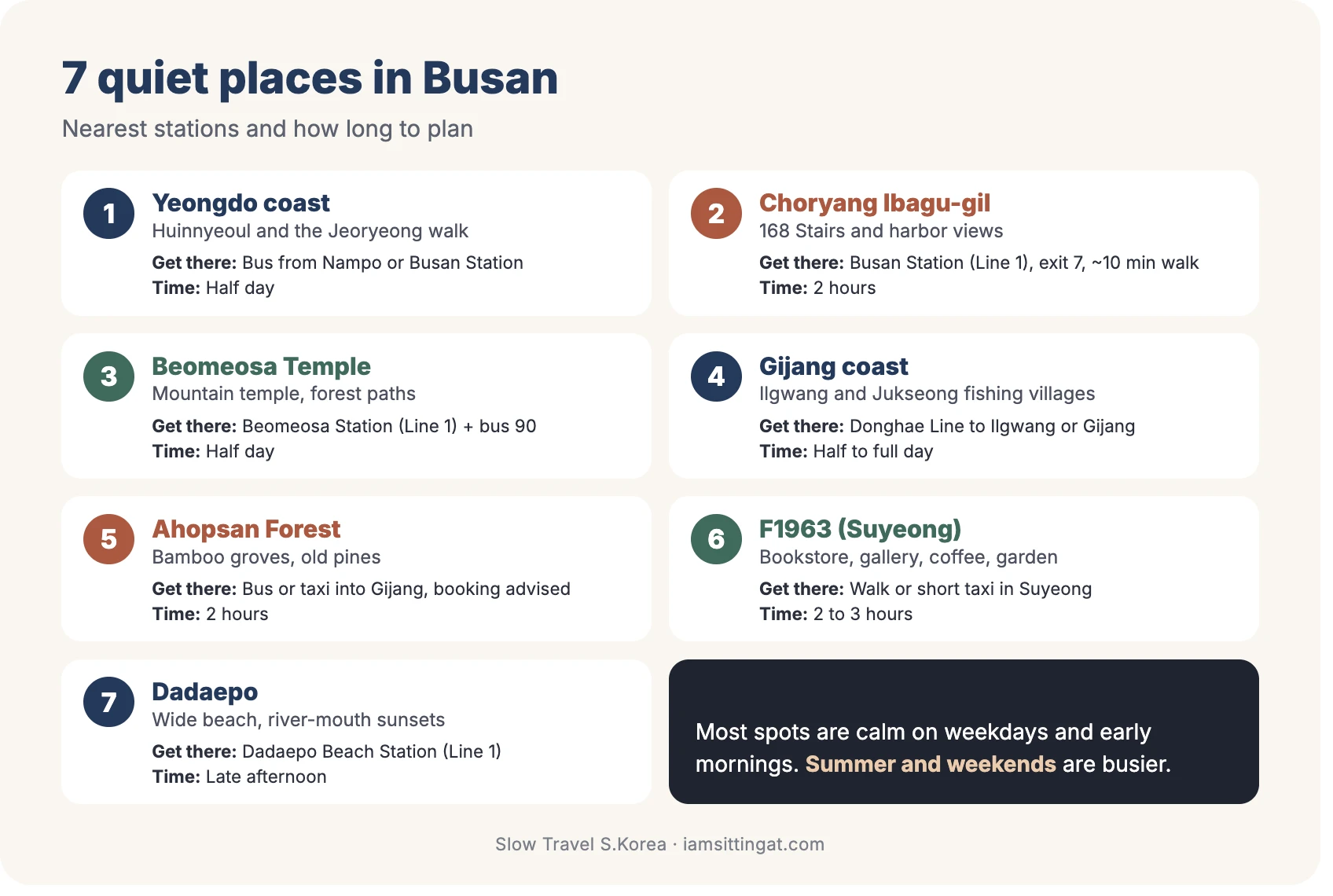
7 Quiet Places in Busan at a Glance
| Place | Best for | Getting there | Crowd level | Time needed |
|---|---|---|---|---|
| Yeongdo coast (Huinnyeoul & Jeoryeong walk) | Sea cliffs, a coastal path, small cafes | Bus from Nampo or Busan Station | Busy midday at the photo stairs, calm early | Half day |
| Choryang Ibagu-gil & 168 Stairs | Harbor views, refugee-era history | Busan Station (Line 1), exit 7, about 10 min walk | Low to medium | 2 hours |
| Beomeosa Temple | Mountain temple, forest paths | Beomeosa Station (Line 1) + bus 90 | Low on weekdays | Half day |
| Gijang coast (Ilgwang, Jukseong) | Fishing villages, a quieter beach | Donghae Line to Ilgwang or Gijang | Low outside summer | Half to full day |
| Ahopsan Forest | Bamboo groves, old pines | Bus or taxi into Gijang; booking advised | Low (capped entry) | 2 hours |
| F1963 (Suyeong) | Bookstore, gallery, coffee, a garden | Suyeong area, walk or short taxi | Low on weekdays | 2–3 hours |
| Dadaepo | Wide beach, river-mouth sunsets | Dadaepo Beach Station (Line 1) | Low to medium | Late afternoon |
1. Yeongdo: The Island Next to Downtown
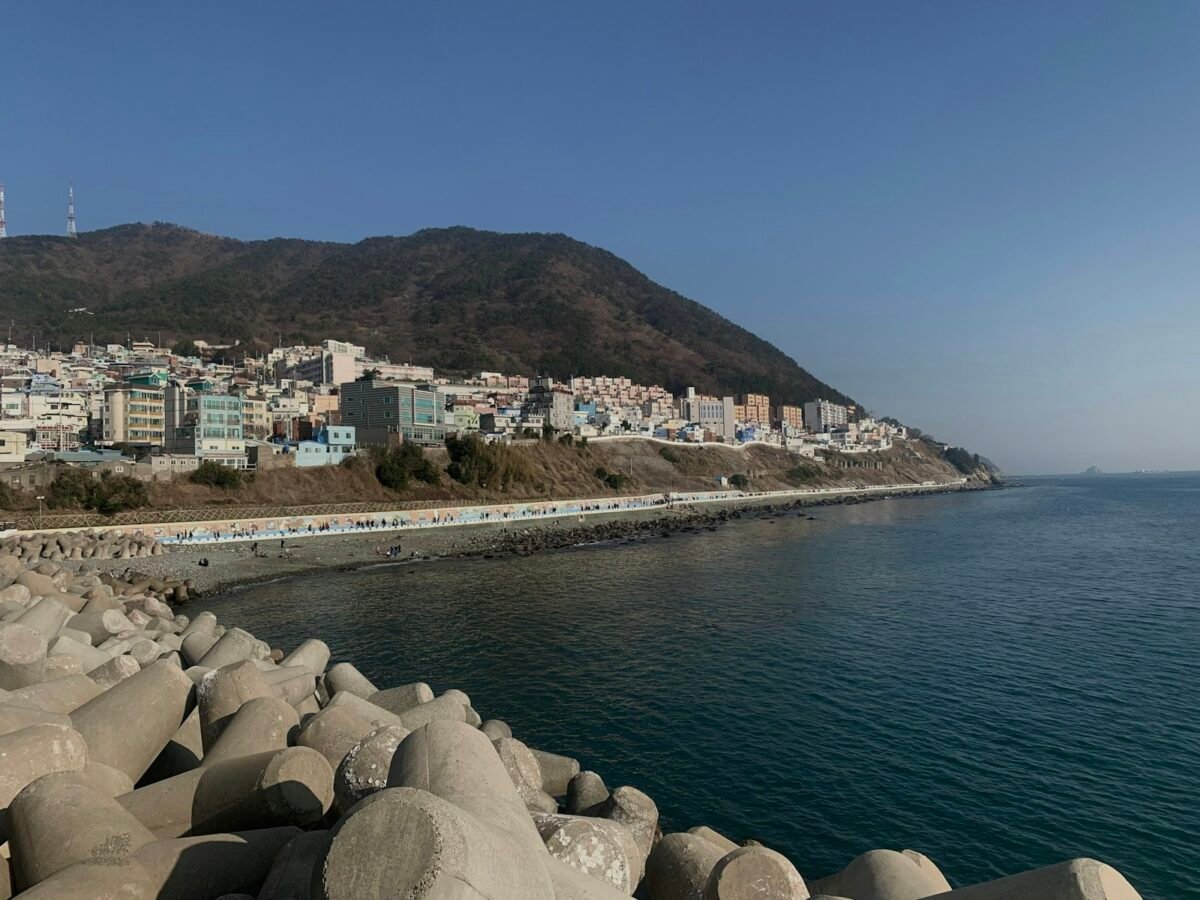
Yeongdo is an island district connected to the old downtown by bridges. It’s where I’d start if you only have one day for quiet places in Busan, because you get cliffs, the open sea, and working neighborhoods within a short ride of Nampo.
What to do:
- Huinnyeoul Culture Village. A strip of small houses on a cliff edge above the sea, first settled by war refugees and remodeled since 2011 into a mix of homes, small shops, and studios. Go early in the morning. By midday, people queue for photos at the staircase next to the Isongdo Observatory, and the narrow lane fills up. It’s free and open at all hours, but people live behind those doors, so keep your voice low.
- Jeoryeong Coastal Walk. A path along the water below the village. Be aware that slope-stabilization work has been going on here since 2021, and Yeongdo District is reviewing an extension to 2028. Some sections have been temporarily reopened while work continues, so expect detours and cranes.
- Taejongdae. A park of sea cliffs and pine forest at Yeongdo’s southern tip. The Danubi tour train that loops through the park was suspended in July 2026 after a second accident, and the operator brought in two free shuttle buses while it reviews whether the train should run at all. Walking the loop road is the slow-travel answer anyway. The park lists its winter hours (November to February) as 5 a.m. to midnight.
- Yeongdo Bridge. This 1930s drawbridge normally lifts every Saturday at 2 p.m. for 15 minutes. That event has been paused since October 10, 2026, after problems were found in the lifting machinery. Cars and pedestrians still cross normally.
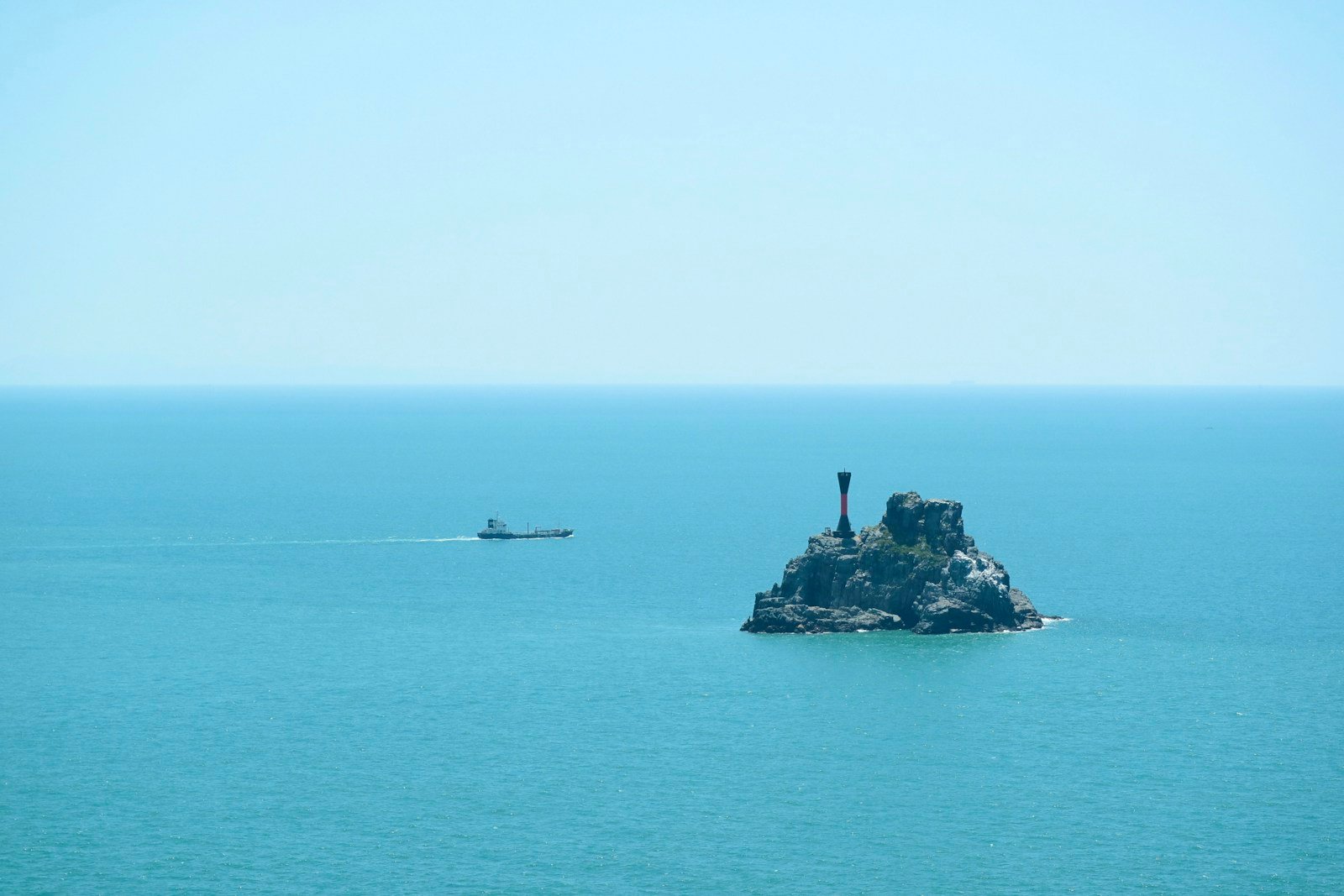
Why stay here: Yeongdo has a growing number of small guesthouses and hotels with sea views, and at night it’s much calmer than the beach districts. You’ll depend on buses and taxis, so check your route back from dinner.
2. Choryang Ibagu-gil and the 168 Stairs: History Above Busan Station
Ibagu means “story” in the Busan dialect, and Ibagu-gil is a 1.5 km walking route up the hillside behind Busan Station, through a neighborhood that grew during the 1950s and 60s. The centerpiece is the 168 Stairs, a staircase of exactly 168 steps at an incline of about 40 to 45 degrees. Residents once carried water up and down it.
What to do:
- Climb, or ride. An old monorail beside the stairs was removed after repeated breakdowns. Since March 11, 2025, a free inclined elevator called Choryang 168 Haneul-gil (about 12 passengers) runs alongside, with a stop at the Kim Min-bu Observatory halfway up.
- Look at the harbor. From the top, you see the North Port and the old downtown over ordinary rooftops. It’s one of the best free views in the city.
- Keep walking along the sanbok-doro. Follow the road along the hillside for small exhibition spaces, murals, and viewpoints.
Getting there: From Busan Station (Line 1), exit 7, it’s about a 10-minute walk. The route is open all year and free.
Why it’s quiet: most visitors arriving by KTX head straight to Haeundae or Nampo. This neighborhood is right next to the station, and few of them climb it. If you’re taking the train from Seoul, see my KTX guide.
3. Beomeosa Temple: A Mountain Temple at the End of Line 1
Beomeosa is one of the three major temples of the Yeongnam region (southeastern Korea), founded in 678. It sits on the slopes of Geumjeongsan, the mountain on Busan’s north side, and still functions as a working monastery and training center for monks.
What surprises people is how close it is to the city. You ride Line 1 almost to the end, take a short bus ride up the mountain, and the apartment towers disappear behind the trees.
What to do:
- Walk the approach slowly. The path from the One Pillar Gate (Iljumun) to the main hall is lined with trees and is especially beautiful in late October and November, when the leaves turn.
- See the museum. The temple opened a large Buddhist art museum in 2021. It holds about 30,000 objects, including roughly 70 Buddhist paintings from the late Joseon period.
- Continue up the mountain. Trails continue from the temple area toward the North Gate of Geumjeongsanseong, the old mountain fortress. Bring water and good shoes.
Getting there: Beomeosa Station (Line 1), exit 5 or 7, then bus 90, about 20 minutes uphill. Admission is free, and the temple lists hours of 8 a.m. to 5 p.m. A temple stay is possible here for an overnight version of Busan slow travel. [AFFILIATE: Korea temple stay booking]
4. The Gijang Coast: Fishing Villages on the Donghae Line
Gijang County is Busan’s northeastern edge, and it’s where the city starts to feel like a string of coastal towns. The Donghae Line, a commuter railway, runs up this coast from Bujeon and connects with the subway, so you can do it without a car.
What to do:
- Ilgwang Beach. A crescent of sand about 2 km long, shallow and calm, a short walk from Ilgwang Station. Outside July and August it’s mostly locals walking dogs. A path from the beach leads toward the breakwater at Hangni, a small fishing village.
- Jukseong. A small harbor village with very old pine trees and a white, red-roofed “cathedral” on the rocks. It isn’t a real church: it was built in 2009 as a drama set and rebuilt as a permanent structure after a typhoon. It’s popular for photos, but the village around it is quiet, especially in winter.
- Eat at a harbor. Gijang is known for seafood, especially anchovies and seaweed. Small harbor restaurants are a big part of the appeal.
Getting there: For Ilgwang, ride the Donghae Line to Ilgwang Station. For Jukseong, the closest station is Gijang; village bus Gijang 6 goes from exit 1, but it runs infrequently, so a short taxi ride is often easier. A taxi app like Kakao T helps here.
A note on Haeundae’s neighbors: Songjeong Beach, one Donghae Line stop beyond the Haeundae area, is a calmer, more local alternative to Haeundae Beach, especially on weekday mornings.
5. Ahopsan Forest: 400 Years of Bamboo and Pine
Ahopsan Forest is a private forest in Gijang that one family has protected for about 400 years. It covers about 52 hectares (520,000 square meters) of bamboo groves, planted forest, and natural pine woods with trees 100 to 300 years old. Several Korean films and the drama The King: Eternal Monarch used its bamboo groves for scenes.
The reason it’s quiet is that the owners keep it that way. Entry is limited to protect the forest, and the rules are strict: no food or alcohol, no speakers, no hiking poles, no strollers or bicycles, and no pets. The paths themselves are flat and easy, and a full loop takes one to two hours.
Practical details: Adult admission has been listed at 8,000 won, with free parking. It opens 9 a.m. to 6 p.m., with last entry at 5 p.m. Booking ahead (through Naver) is recommended.
Why go: if you want a walk where the main sound is wind in the bamboo, this is it. Combine it with the Gijang coast for a full day east of the city.
6. F1963: A Wire Factory Turned into a Slow Afternoon
F1963 is a cultural complex in Suyeong-gu, in a former factory where the company Kiswire made steel wire from 1963 to 2008. It reopened for the 2016 Busan Biennale and is now a mix of gallery, bookstore, cafe, and garden.
What to do:
- Browse the used bookstore. Yes24 runs a large secondhand bookstore here, with a reading-room feel.
- See a show. Kukje Gallery has a Busan branch inside, and the complex hosts exhibitions and performances.
- Sit in the garden. The outdoor garden, including a bamboo grove, was registered as Busan’s first private garden in 2024.
- Coffee and food. Terarosa, a Korean coffee roaster, has a large cafe in the old factory, and there’s a brewery restaurant and a makgeolli restaurant on site.
Practical details: Entry to the complex is free. Each shop and gallery sets its own hours and days off.
Why it’s on this list: it’s the best rainy-day answer I know for Busan slow travel. It’s a short ride from Gwangalli, but on a weekday morning it feels a world away from the beach strip.
7. Dadaepo: The Western End of Line 1
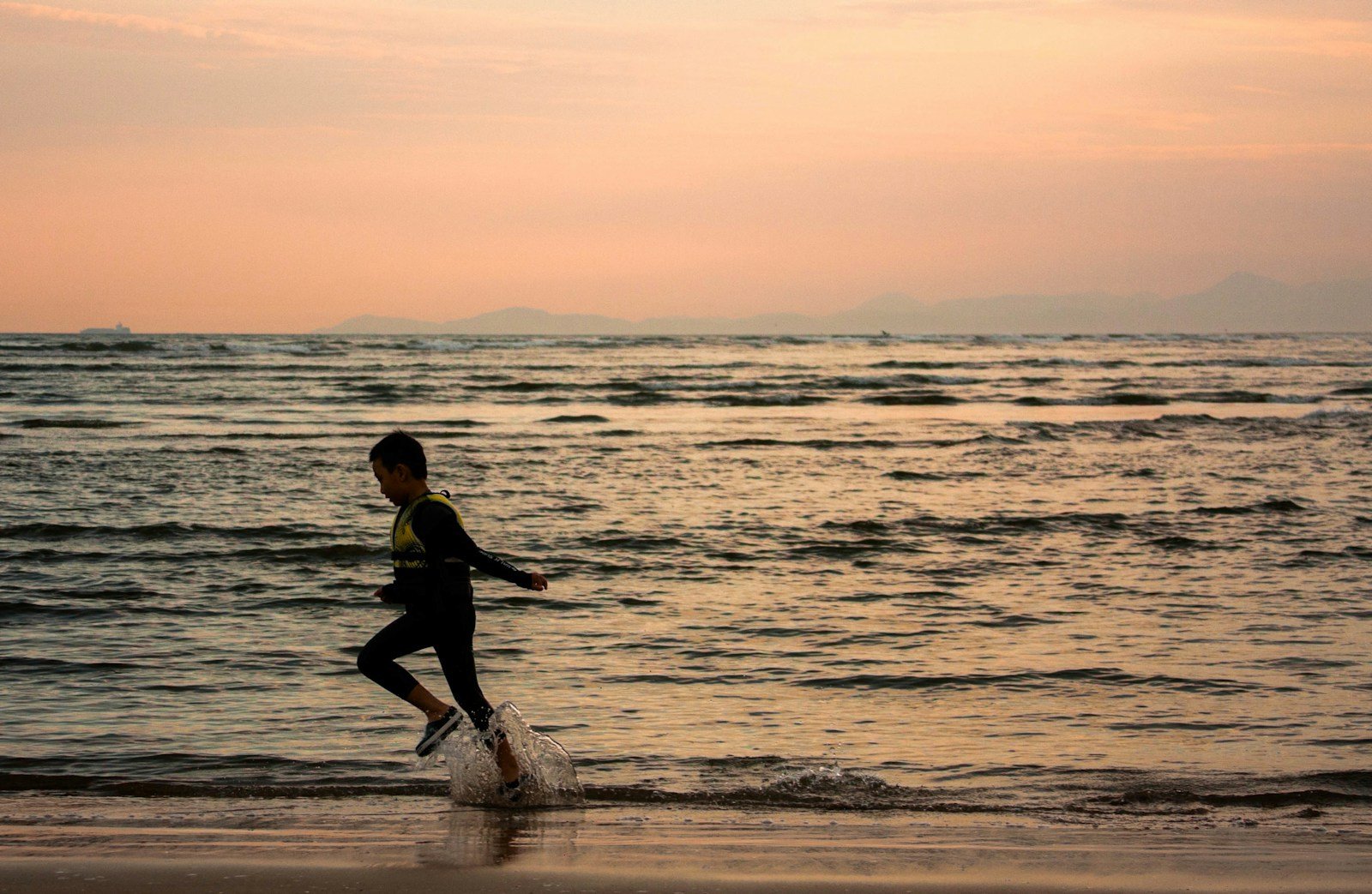
Dadaepo is at the far southwestern end of Line 1, where the Nakdong River meets the sea. The beach is wide and shallow, and because it faces west, it’s one of the better places in Busan to watch the sun go down. Busan has been promoting it as a newer destination, including evening events, but on an ordinary weekday it still has plenty of space.
What to do: walk the beach toward the river mouth in the late afternoon, then stay for sunset. The nearby headland of Molundae has forest trails if you want more walking.
Getting there: ride Line 1 to Dadaepo Beach Station. From Nampo, it’s a long but simple ride with no transfers.
What About Gamcheon Culture Village?
Gamcheon is on almost every Busan list, so it deserves a straight answer. It’s beautiful, and it’s also one of the clearest examples of overtourism in Korea: about 1,500 residents and roughly 3.12 million visitors in 2025.
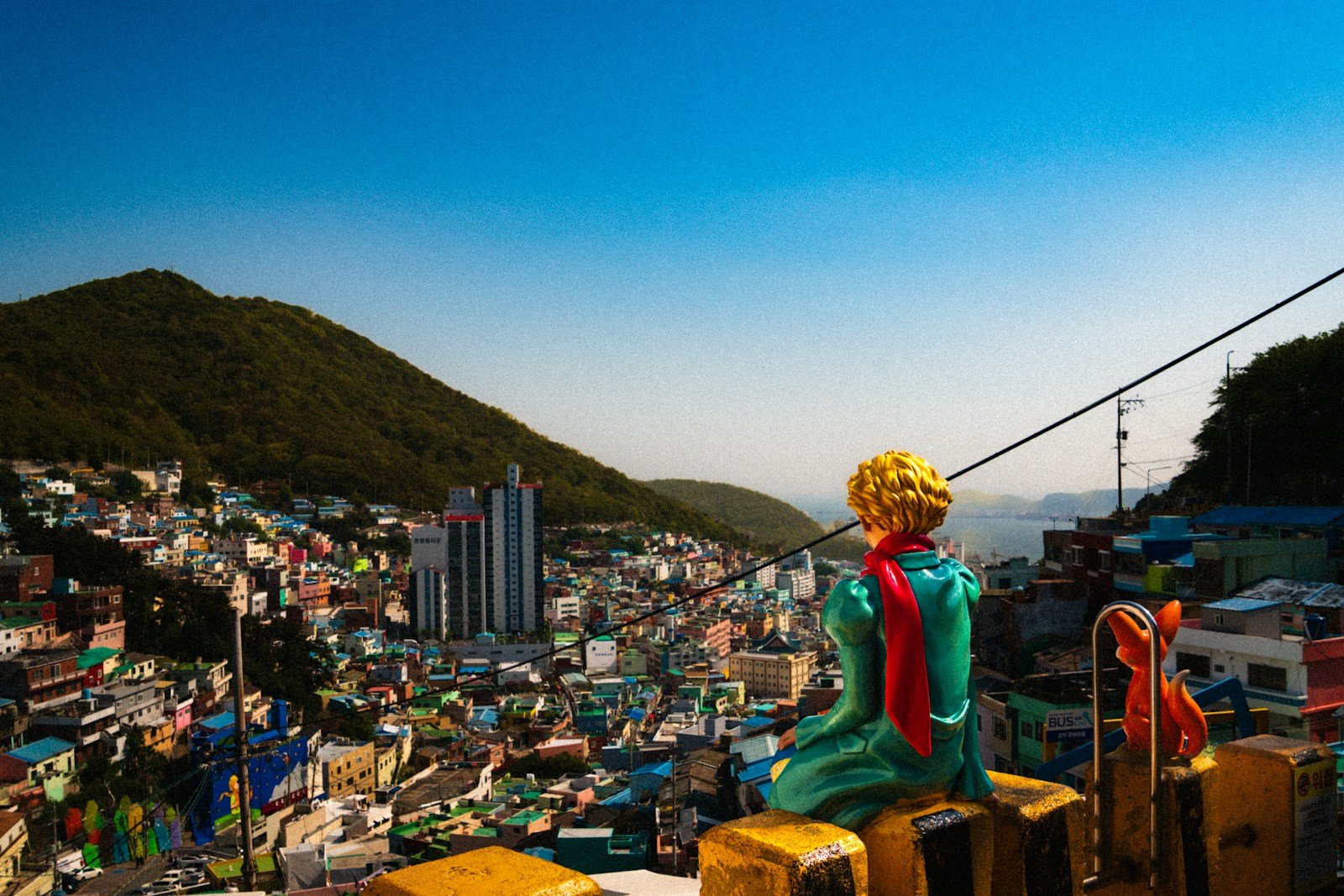
Here’s what changed in 2026. Saha District designated Gamcheon a special management area on August 1, 2026, under the same tourism law Seoul used for Bukchon. The village is divided into four zones:
- Dense residential zone: visitors may enter only from 9 a.m. to 6 p.m.
- Mixed residential-commercial zone: managed mainly through etiquette guidance and cleanup.
- Watch zone: monitored for problems.
- Vehicle-restricted section: part of Gamnae 2-ro is closed to tour vehicles during the same hours.
Groups of 10 or more must buy a village map. The rules are in a trial period now and take full effect January 1, 2027. Fines for the vehicle restriction begin January 1, 2028, after a guidance period through December 2027. The district also placed 35 “village keepers” on site.
My advice: if you go, go on a weekday morning, stay on the marked route, and leave before 6 p.m. And if what you want is a hillside refugee-era neighborhood with harbor views and fewer people, Choryang’s 168 Stairs gives you much of the same story.
Getting Around for Busan Slow Travel
| Option | Cost (adult, 2026) | Works on | Good for |
|---|---|---|---|
| Transit card (T-money etc.), subway | 1,600 won (zone 1), 1,800 won (zone 2) | Subway, buses, transfers | Most trips |
| Transit card, city bus | 1,550 won | City buses | Yeongdo, Taejongdae, Beomeosa |
| Mobile one-day subway pass | 6,000 won | Busan subway only (not buses, Donghae Line, or the Busan-Gimhae light rail) | Subway-heavy days |
| Busan City Tour Bus | 20,000 won | Hop-on routes from Busan Station | Families, Taejongdae and Dadaepo routes |
| Taxi | Metered | Anywhere | Jukseong, Ahopsan, late returns |
A few notes:
- Your transit card from Seoul works in Busan. If you already have one, see my T-money guide for top-ups.
- The day pass is subway only. Many quiet places in Busan (Yeongdo, Taejongdae, Gijang) need a bus or the Donghae Line, so the pass pays off only on subway-heavy days.
- Use Naver Map for buses. Bus routes on the hills are confusing, and Naver Map handles them well. See my Naver Map guide.
Where to Stay for a Quiet Base in Busan
| Your trip | Where I’d stay | Why |
|---|---|---|
| Arriving and leaving by KTX | Busan Station / Choryang | Next to the train, close to Ibagu-gil, Yeongdo is a short ride |
| Sea views without the beach crowds | Yeongdo | Calm at night, close to Nampo |
| Beach, but quieter | Songjeong | Smaller beach, on the Donghae Line |
| Long stay, very calm | Ilgwang (Gijang) | Small-town feel, beach, commuter rail to the city |
| Temple and mountains | Beomeosa temple stay | One night of real quiet |
Before you book, check three things: whether your place is on a main road (open street view), how steep the walk from the station or bus stop is, and when the last bus runs. [AFFILIATE: Busan hotel booking] [AFFILIATE: Yeongdo guesthouse booking]
Reality Check: The Downsides of Quiet Busan
- Hills and stairs are everywhere. Yeongdo, Choryang, and Gamcheon are built on slopes. Wear real shoes, and in summer, start early.
- Buses run on longer gaps. Village buses in Gijang can be infrequent. Build in time, or budget for taxis.
- Some attractions are paused or under construction. The Yeongdo Bridge lifting and the Danubi train are suspended as of November 2026, and parts of the Jeoryeong coastal walk are still under construction.
- Summer changes everything. Ilgwang, Songjeong, and Dadaepo are calm most of the year but busy in July and August.
- Fewer late options. Quiet neighborhoods close early. Plan dinner before you head back up a hill.
- Rules are new. Gamcheon’s visitor hours are in a trial phase, and details may change before full enforcement in 2027. See my Korean etiquette guide for the basics of being a good guest in residential areas.
FAQ
What are the most quiet places in Busan for tourists?
For an easy first day, try the Yeongdo coast early in the morning and the 168 Stairs near Busan Station. For real quiet, Beomeosa Temple and Ahopsan Forest are the calmest. The Gijang coast is good for a slower, small-town day.
Is Gamcheon Culture Village closed at night?
Not closed, but restricted. Since August 1, 2026, visitors may enter its dense residential zone only from 9 a.m. to 6 p.m. The system is in a trial period and takes full effect on January 1, 2027.
Is the Yeongdo Bridge still lifting in 2026?
The regular Saturday 2 p.m. lifting has been suspended since October 10, 2026, after problems were found in the lifting equipment. Traffic and walking across the bridge continue normally. Check Busan Infrastructure Corporation notices before you go.
Is the Taejongdae Danubi train running?
It was suspended in July 2026 after an accident, and free shuttle buses were brought in. You can still walk the park’s loop road. Check the latest status before you visit.
How many days do I need for Busan slow travel?
Three to four days lets you cover one area per day without rushing: Yeongdo and Choryang, Beomeosa, Gijang with Ahopsan, and a lighter day for F1963 and Dadaepo.
The Bottom Line
Busan rewards people who skip one famous stop and keep going. Walk Yeongdo before the photo lines form, ride the elevator up the 168 Stairs, take bus 90 up to Beomeosa, and spend a slow afternoon on the Gijang coast. You’ll see the city most visitors pass through on the way to the beach. And as with Seoul, the quiet belongs to the people who live there, so keep it that way.
If you’re visiting in winter, pair this with my Seoul in December guide, and if you’re splitting your trip between two cities, my quiet neighborhoods in Seoul guide covers the capital.