Last updated: November 6, 2026
A server sets down a plate of raw pork belly, a pair of tongs, and a pair of kitchen scissors, turns on the grill, and walks away. Your table looks at the meat, then at each other. Who’s supposed to cook this? Do you cut it now or later? And why are there scissors at dinner? That small moment of hesitation is what this guide on Korean BBQ etiquette is for.
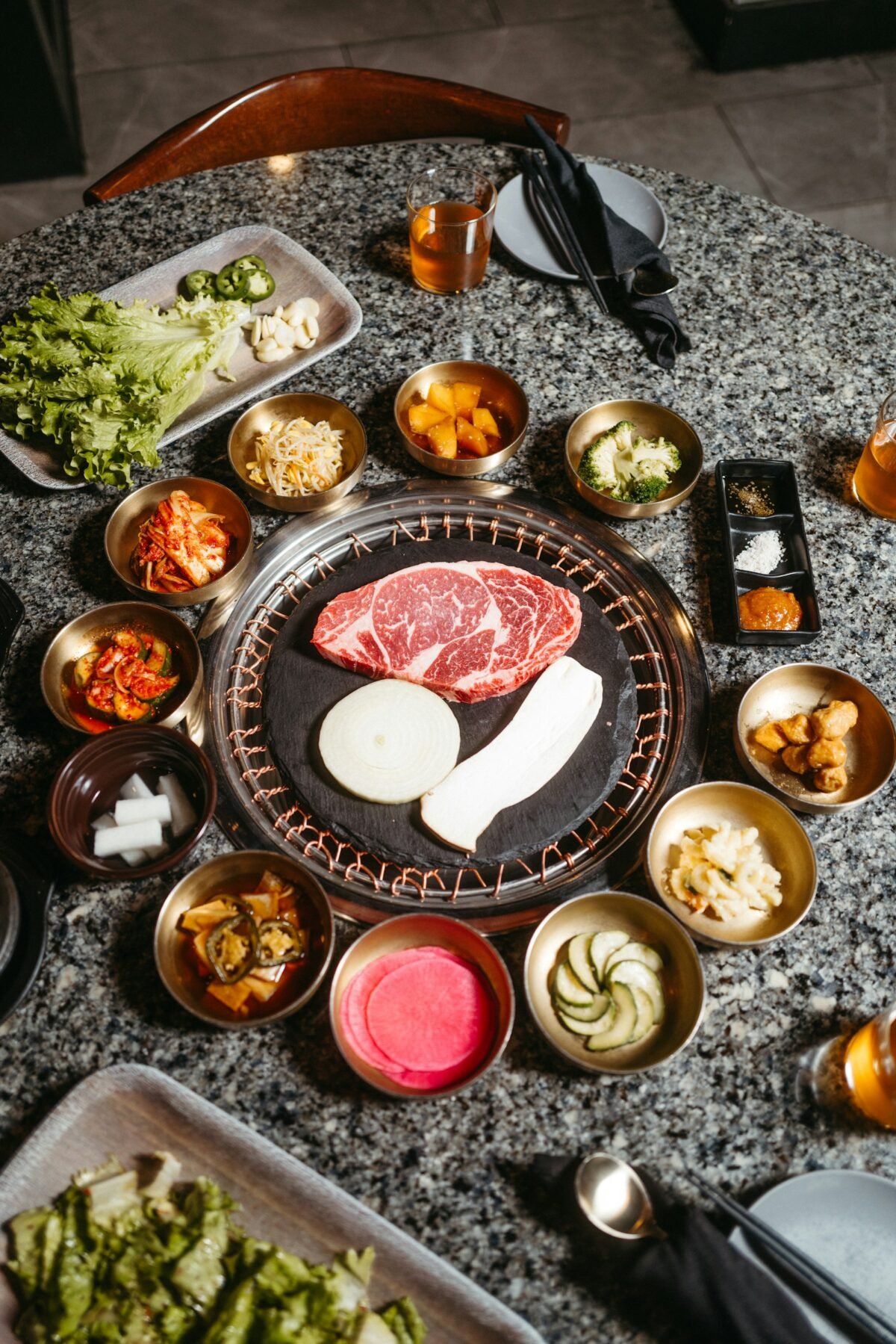
Korean BBQ in Korea is not quite the Korean BBQ you know from Koreatown in Manhattan or LA. The basics are the same: a grill in the middle of the table, side dishes, lettuce, and meat. But who does the grilling, how the meat is priced, and how much you’re expected to order all work a little differently. It also costs more than many visitors expect. In Seoul, pork belly averaged ₩21,321 per 200 grams in June 2026, according to the Korea Consumer Agency’s price tracker.
This guide covers who cooks, which cuts to order and how much, how to wrap and eat ssam, what to do if you’re eating alone, and what happens when the bill comes.
Quick Answer: Korean BBQ Etiquette in 60 Seconds
- At most everyday BBQ places in Korea, you grill the meat yourself. At pricier, thick-cut, or beef-focused restaurants, staff often grill it for you.
- If staff are grilling, let them. Don’t grab the tongs until they hand them over or walk away.
- The scissors are for cutting meat on the grill, not a sign that something is missing from your table.
- Meat is priced by weight. Restaurants must show the price per 100 grams, and one serving (1인분) is usually somewhere between 100 and 250 grams.
- Most places want you to order at least two servings, and many expect roughly one serving per person to start.
- Wrap it: a piece of meat in lettuce with a dab of ssamjang, maybe garlic or kimchi, eaten in one bite.
- Finish with carbs: rice, a stew, cold noodles, or fried rice made on the grill.
- No tip. Pay at the counter on the way out.
Korean BBQ in Korea vs. Korean BBQ in New York
If your Korean BBQ experience so far is mostly Koreatown in Manhattan, this is what changes when you sit down in Seoul.
| Korean BBQ in Korea | Korean BBQ in New York | |
|---|---|---|
| Who grills | Usually you; staff at premium and thick-cut places | Usually staff, at the table |
| How meat is priced | Per serving, with the price per 100g on the menu | Per order or per combo, weight rarely listed |
| Minimum order | Often 2 servings, sometimes more | Varies; combos built for 2 to 4 people |
| Side dishes | Free, refillable | Free, refillable at most places |
| Lettuce and garlic | Free, refillable, sometimes a self-serve bar | Usually included, refills vary |
| Ending the meal | Rice, stew, cold noodles, or fried rice on the grill | Less common, often ordered separately |
| Price for a dinner | Roughly ₩40,000 to ₩100,000+ for two, depending on cut and drinks | About $45 to $60 a person at a mid-range spot, plus tax and tip |
| Tip | None | Expected |
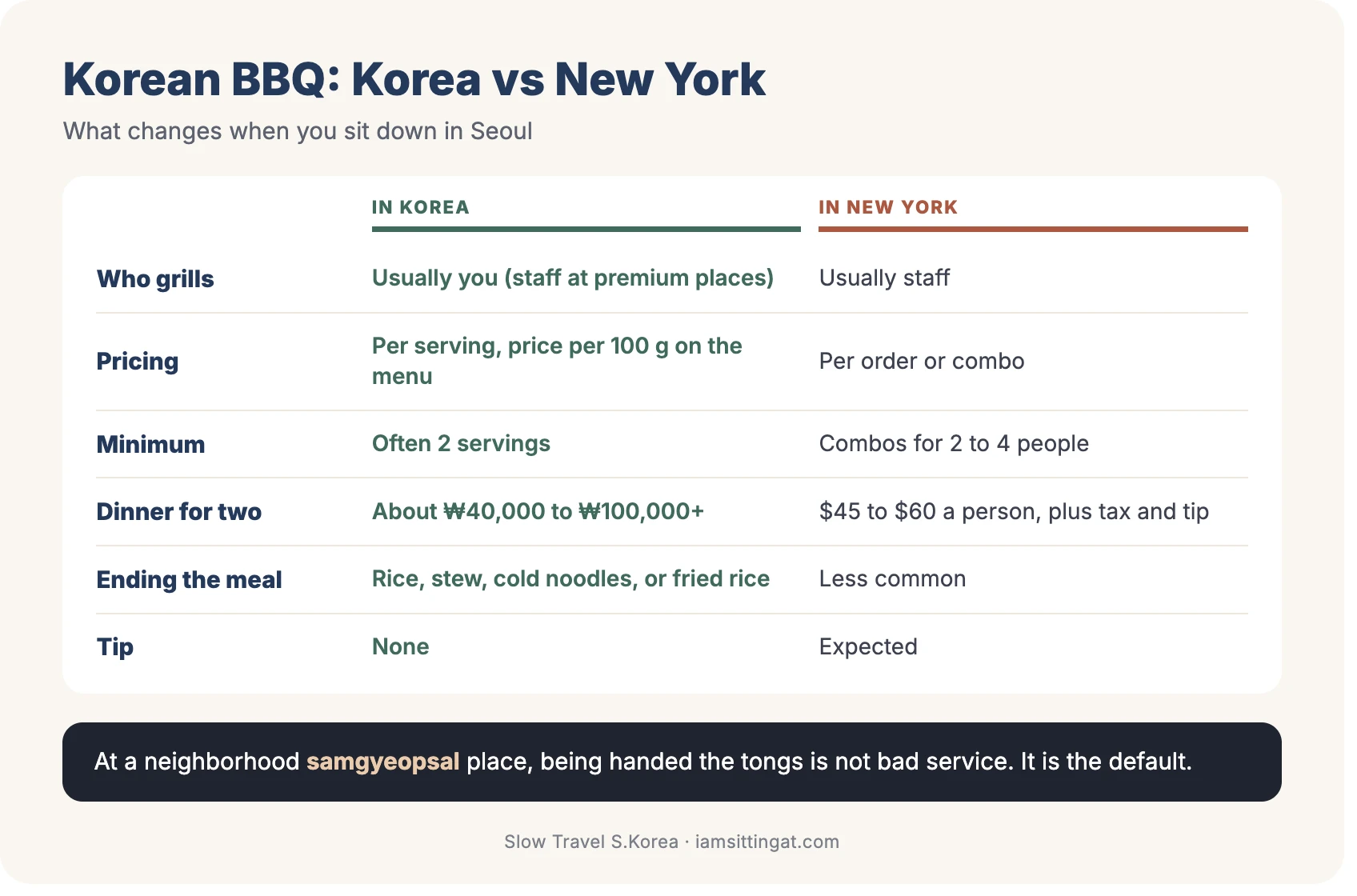
The biggest difference is the grilling. A lot of Korean BBQ restaurants in the US have staff cook at the table, partly because diners there don’t know the routine. In Korea, everyone grew up grilling their own pork belly, so at a neighborhood samgyeopsal place, the staff hand you the tongs and trust you. That’s not bad service. It’s the default.
Who Cooks at Korean BBQ?
This is the first question at almost every table, and the answer depends on the kind of restaurant you’re in.
Setup 1: You grill (most samgyeopsal and neighborhood places)
Staff light the grill, bring the meat, and leave. You cook, flip, cut, and serve. If you need help, press the call bell or say jeogiyo. Related: How to Order at a Korean Restaurant.
Setup 2: Staff grill for you (premium, thick-cut, and beef places)
Over the past several years, more Korean restaurants have started serving thick, aged cuts and having staff handle the grill: controlling the heat, deciding when to flip, and cutting the meat into bite-size pieces. A Korean daily, Segye Ilbo, described in October 2026 how grilling skill has become part of how restaurants show their expertise and service level. You’ll see this a lot at places popular with visitors, and it’s a good choice for a first night.
At these places, the polite move is to sit back. Moving the meat around while someone is grilling it for you is a bit like reaching over a waiter to pour your own wine.
Setup 3: Staff start, you finish
Some restaurants put the first round on and cut it, then leave the rest to you. Watch what they do and copy it.
Who holds the tongs at a Korean table?
Among Korean friends and coworkers, the person who grills is often the youngest or most junior, or simply whoever is best at it. You’ll sometimes hear someone joke that the person holding the tongs “controls the table.” As a visitor, nobody expects you to know any of this. If a Korean friend or host reaches for the tongs, let them. If you’d like to try, just ask.
A few grilling basics:
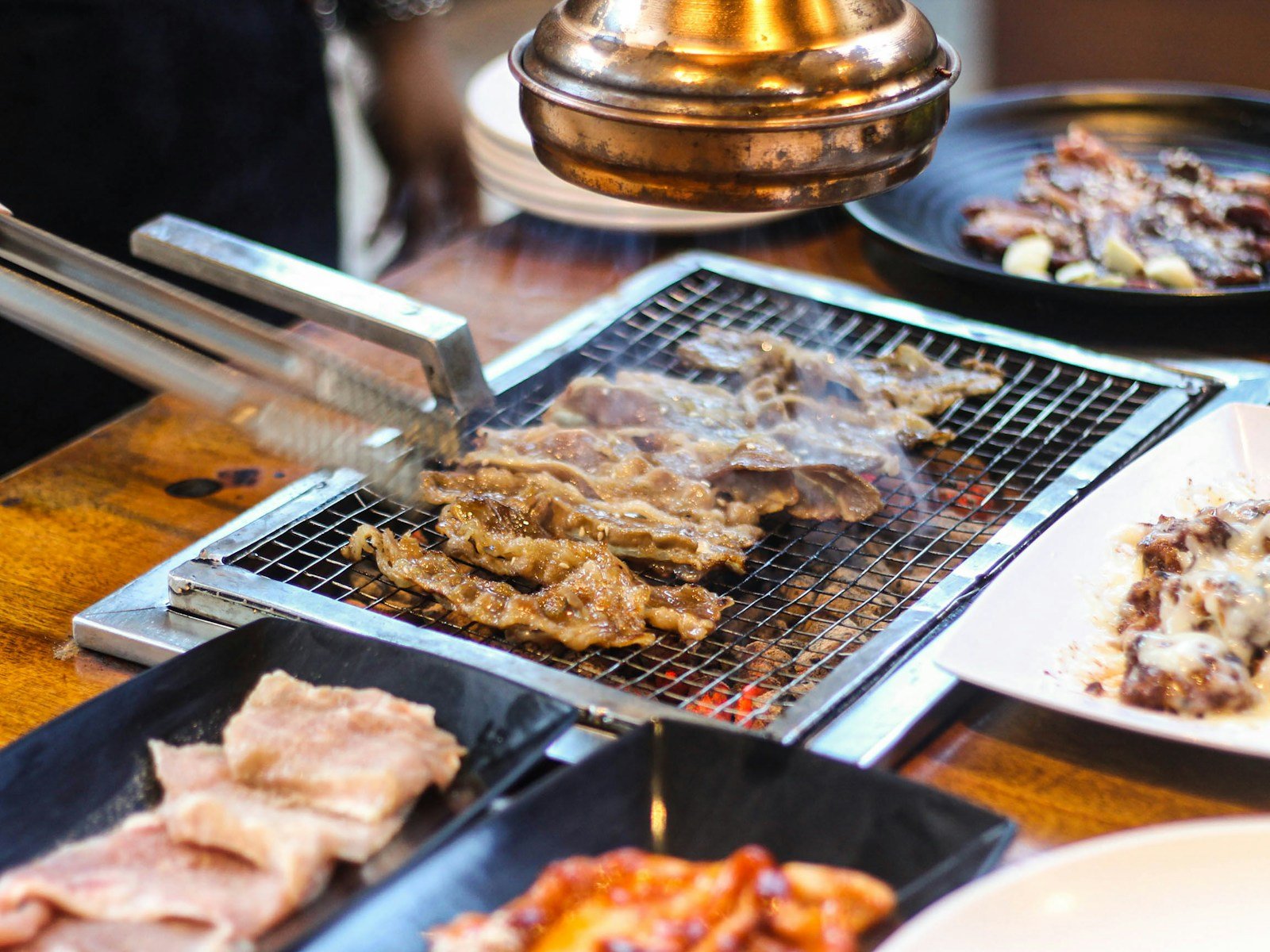
- Use the tongs, not your chopsticks, for raw meat. Chopsticks are for cooked pieces going to your mouth.
- Don’t flip too often. Let one side brown before you turn it.
- Cut when it’s mostly cooked. Grill pork belly in long strips, then snip it into bite-size pieces with the scissors and finish it.
- Move cooked pieces to the edge of the grill, where it’s cooler, so they don’t burn.
- Ask for a new grill plate when it gets charred: bulpan gara juseyo (불판 갈아 주세요). This is normal and free.
What to Order at Korean BBQ
Common cuts and what they’re like
| Korean | Romanized | What it is | Good to know |
|---|---|---|---|
| 삼겹살 | samgyeopsal | Pork belly | The classic. Fatty, crisp at the edges |
| 오겹살 | ogyeopsal | Pork belly with the skin on | Chewier, more texture |
| 목살 | moksal | Pork neck/shoulder | Leaner than belly, still juicy |
| 항정살 | hangjeongsal | Pork jowl | Small pieces, rich and springy |
| 돼지갈비 | dwaeji galbi | Marinated pork ribs | Sweet soy marinade, burns easily |
| 소갈비 / 갈비살 | so galbi / galbisal | Beef short rib / rib finger meat | Often marinated, more expensive |
| 차돌박이 | chadolbagi | Thin-sliced beef brisket | Cooks in seconds, don’t walk away |
| 등심 | deungsim | Beef sirloin/ribeye | Often Korean hanwoo beef, priced high |
Two things to check on the menu. First, where the meat comes from. Korean restaurants list the origin of the meat, and Korean beef (hanwoo, 한우) costs much more than imported beef. Second, whether the menu says saeng (생, fresh) or naengdong (냉동, frozen). Frozen, thin-sliced pork belly is a cheaper, old-school style some Koreans love, so frozen isn’t a red flag here.
How the price works
Since 2013, Korean restaurants have been required to show the price of grilled meat per 100 grams, so diners can compare places. Restaurants can also list their own serving size and price, and most do. Serving sizes vary, often between 100 and 250 grams, which is why a “cheap” menu can turn out to be a small portion. Compare the grams, not just the price.
For a reference point, the Korea Consumer Agency converts every restaurant’s serving to 200 grams and tracks the average. In Seoul, that figure for pork belly was ₩21,321 in June 2026, up 4.3% from a year earlier. That’s about $14.70 at ₩1,450 to the dollar.
How many servings to order
- Start with about one serving per person. You can always add more.
- Expect a two-serving minimum at most places, even if you’re only two people sharing.
- Order one cut first, then try another. Many Korean tables start with pork belly and add neck or a beef cut for the second round.
- Ordering on a tablet? If you can’t select one serving, there’s a minimum.
Sides and the “second course”
You don’t need to order the banchan, lettuce, or dipping sauces. They come free. What you might order:
- Gonggibap (공기밥): a bowl of rice, usually a small extra charge.
- Doenjang jjigae (된장찌개): soybean paste stew, the most common partner for pork belly.
- Gyeran jjim (계란찜): fluffy steamed egg in a hot stone pot, good for cooling your mouth.
- Naengmyeon (냉면): cold noodles, a very common way to finish. In Seoul, a bowl averaged ₩12,615 in spring 2026 by the Korea Consumer Agency’s count, though BBQ restaurants often sell a smaller “after-meal” size for less.
- Bokkeumbap (볶음밥): fried rice made on the grill with leftover meat, kimchi, and seaweed. Staff usually make it for you at the end.
How to Eat Ssam (the Lettuce Wrap)
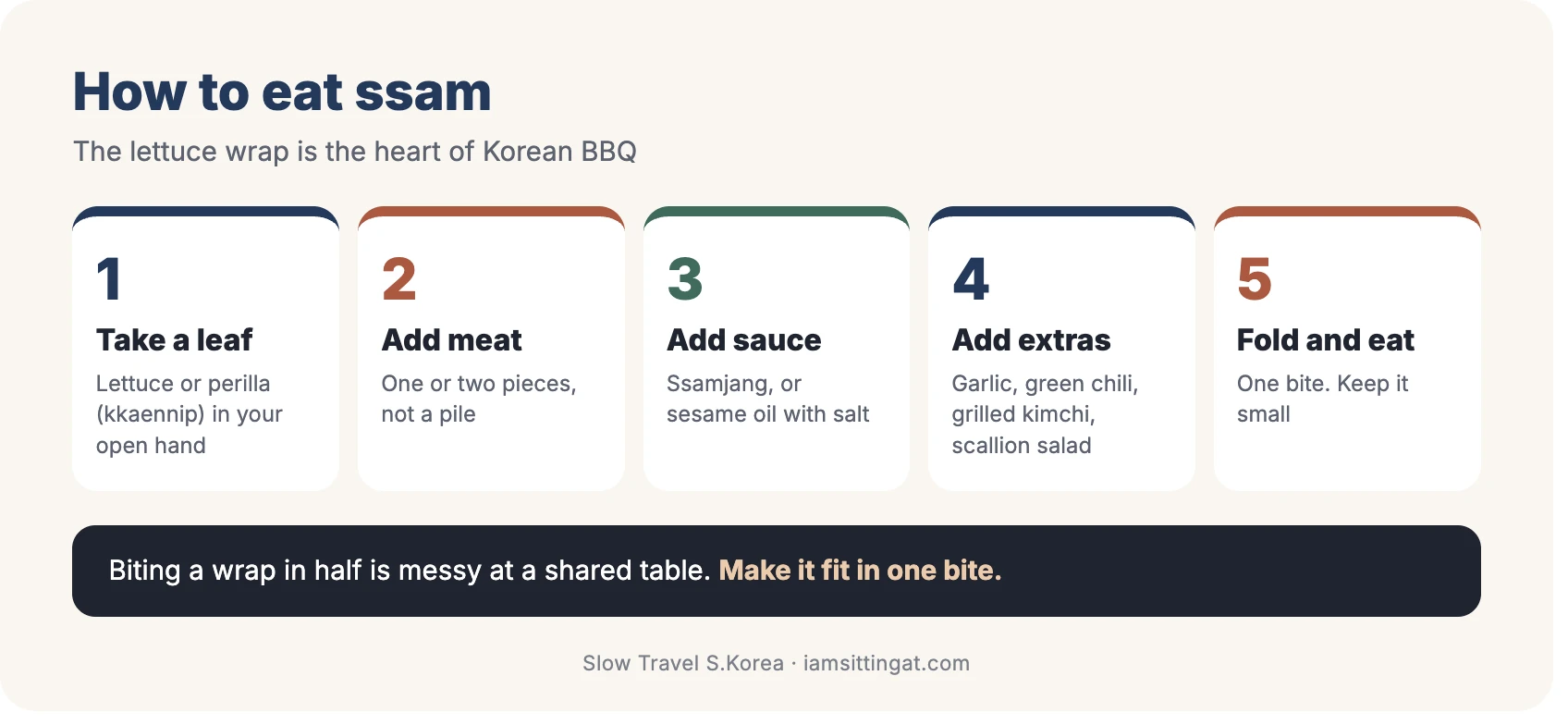
Ssam (쌈) means “wrapped,” and it’s the heart of eating Korean BBQ. Here’s the routine.
- Take a leaf of lettuce or perilla (kkaennip, 깻잎) in your open hand.
- Add a piece of meat. One or two pieces, not a pile.
- Add a little sauce. Ssamjang (쌈장), a thick soybean-chili paste, is the default. Sesame oil with salt is the other common dip, especially for unmarinated cuts.
- Add extras if you like: raw or grilled garlic, a slice of green chili, grilled kimchi, or pajeori (파절이), a scallion salad.
- Fold it up and eat it in one bite. Biting a wrap in half is messy and a little awkward at a shared table, so keep it small enough to fit.
A few things Koreans do that visitors often miss:
- Grill the garlic and kimchi. Put garlic slices in the small dish of oil on the grill, or lay kimchi along the edge where the pork fat runs off. Both turn sweet and soft.
- You don’t have to wrap every bite. Plenty of people eat some pieces straight with salt or sauce.
- Refill lettuce and banchan freely, but take only what you’ll eat.
Drinks at the Grill
Pork belly and soju is the stereotype for a reason. You don’t need to drink, and nobody will make a big deal of it if you say no. If you do drink with Koreans, the basics are simple: pour for others rather than yourself, hold your glass with two hands (or one hand supporting the other wrist) when someone older pours for you, and it’s polite to turn your head slightly away when you take a drink in front of an elder. That’s enough to look considerate. The full set of drinking customs deserves its own post. Related: Korean Drinking Etiquette.
Korean BBQ for One Person
Eating alone is the one place where Korean BBQ etiquette gets tricky. Korean BBQ for one person is possible, but the setup works against you: a grill table, a two-serving minimum, and owners who’d rather seat a group during the dinner rush.
Your options:
- Find a solo-friendly BBQ place. Seoul has a small number of restaurants built for single diners, with individual grills at a counter or in partitioned seats. One example is Hongojip (혼고집) in Mapo-gu, near Hongdae, which uses individual charcoal grills. Search Naver Map for 혼밥 고기 or 1인 고기.
- Ask at the door: Honja dwaeyo? (혼자 돼요?), “Is one person OK?” Then 1인분 돼요? (Can I order one serving?). A quick answer at the door beats an awkward moment after you sit.
- Go off-peak. Late lunch or before 6 p.m. owners are much more relaxed about one diner.
- Order two servings and take the leftovers. Some places will pack up leftovers if you ask: pojang dwaeyo? (포장 돼요?).
- Pick a lunch set. Some BBQ restaurants serve a single-person lunch set of grilled meat, rice, and stew, cooked in the kitchen.
- Try a meat buffet (gogi buffet, 고기 뷔페). These are priced per person, so one diner isn’t a problem, though the meat is often frozen and quality varies.
If none of that works, Korean food has many single-portion dishes that scratch a similar itch: jeyuk bokkeum (spicy stir-fried pork) set meals, bulgogi rice bowls, or dwaeji gukbap (pork and rice soup).
Do’s and Don’ts at a Korean BBQ Table
| Do | Don’t |
|---|---|
| Let staff grill if they’ve started | Take over the tongs while someone is cooking for you |
| Use tongs for raw meat | Put raw meat on the grill with your eating chopsticks |
| Cut meat with the scissors on the grill | Try to saw through pork belly with chopsticks |
| Ask for a new grill plate when it chars | Keep cooking on a black, smoking plate |
| Make wraps small enough for one bite | Build a wrap you have to bite in half |
| Put your coat in the bag or bench storage provided | Hang your coat on the chair next to the grill |
| Pay at the counter | Leave a tip on the table |
| Order from the restaurant | Bring your own meat or outside food |
That last one sounds obvious, but in August 2026 a Korean BBQ owner’s post about a group who ordered two packs of pork belly and then grilled meat they’d brought from home went viral in Korea. The restaurant’s free lettuce and banchan are part of the meat price, so bringing your own is seen as taking advantage.
Smell, Smoke, and What to Wear
Korean BBQ smoke gets into everything. Most restaurants have ventilation hoods over each grill, but charcoal places in particular leave you smelling like dinner for the rest of the night.
- Look for a storage bench or a plastic bag. Many restaurants have seats that open up for storing coats and bags, or they’ll hand you a large plastic bag. Use it.
- Ask for an apron if you’re wearing something you care about: apchima juseyo (앞치마 주세요). Many places keep them by the door or will bring one.
- Some places have a fabric deodorizer spray by the exit. Help yourself on the way out.
- Skip the nice wool coat. On a December trip, a puffer that can go in a bag works better. Related: Seoul in December.
Useful Phrases at Korean BBQ
| English | Korean | Say it like |
|---|---|---|
| Two servings of pork belly, please | 삼겹살 2인분 주세요 | sam-gyeop-sal i-in-bun ju-se-yo |
| Can one person eat here? | 혼자 돼요? | hon-ja dwae-yo? |
| Can I order one serving? | 1인분 돼요? | il-in-bun dwae-yo? |
| Could you change the grill plate? | 불판 갈아 주세요 | bul-pan ga-ra ju-se-yo |
| More lettuce, please | 상추 더 주세요 | sang-chu deo ju-se-yo |
| An apron, please | 앞치마 주세요 | ap-chi-ma ju-se-yo |
| A bowl of rice, please | 공기밥 하나 주세요 | gong-gi-bap ha-na ju-se-yo |
| The check, please | 계산해 주세요 | gye-san-hae ju-se-yo |
Paying the Bill
Korean BBQ follows the same rules as any casual Korean restaurant. Walk to the counter when you’re done, the menu prices already include tax, and there’s no tip. Related: Tipping in Korea.
- Pay in won if the card terminal offers you a choice. Related: Best Credit Card to Use in South Korea. [AFFILIATE: no-foreign-transaction-fee credit card]
- Splitting is fine: ttaro gyesanhalgeyo (따로 계산할게요), “we’ll pay separately.” Among Korean friends, one person often pays and someone else covers the next round or the coffee.
- A prepaid travel card works at terminals that don’t like US cards. Related: WOWPASS Review.
Reality Check: What Korean BBQ in Korea Really Costs (and Other Catches)
- It’s not a cheap meal anymore. A Korean newspaper worked out in August 2026 that two people ordering four 200-gram servings of pork belly in Seoul would pay about ₩85,000 for the meat alone, and over ₩100,000 with three bottles of soju. Beef, especially hanwoo, costs far more. Budget for the whole table, not the per-serving price. Related: Korea Trip Cost Calculator.
- Minimums add up for small groups. Two-serving minimums mean a solo diner or a couple pays more per person than a group of four.
- You might be turned away alone, especially on Friday and Saturday nights.
- English is uneven. Chains near tourist areas usually have English or photo menus. Neighborhood places may have a handwritten wall menu in Korean only. A translation app helps. [AFFILIATE: Korea eSIM] Related: Best eSIM for Korea.
- Your clothes will smell. Plan dinner for the end of the day, not before a show or a nice cafe.
- Allergies are hard to manage. Marinades often contain soy, sesame, and wheat, and grills are shared. If you have a serious allergy, carry a written note in Korean.
- Lingering has limits. Neighborhood BBQ places are fine with long dinners, but at busy spots with a waitlist, finishing your drinks and heading to a second spot is normal.
FAQ
Do you cook your own meat at Korean BBQ in Korea?
At most everyday places, yes. Staff light the grill and bring the meat, and you cook it yourself. At premium, thick-cut, and many beef restaurants, staff grill it at your table. If someone from the restaurant starts cooking, let them finish.
What is basic Korean BBQ etiquette?
Let staff grill if they’ve started, use tongs for raw meat and chopsticks for cooked meat, cut meat with the scissors on the grill, make lettuce wraps small enough for one bite, and ask for a new grill plate when it chars. Pay at the counter, and don’t tip.
How much meat should I order at Korean BBQ?
Start with about one serving per person, then add more. Most places require at least two servings per table. Check the weight on the menu, since one serving can be anywhere from about 100 to 250 grams.
Can you get Korean BBQ for one person in Korea?
Yes, but it takes a little planning. Look for solo-friendly restaurants with individual grills, go at off-peak hours, or ask “honja dwaeyo?” at the door. Many regular BBQ restaurants require two servings, so a lunch set or a meat buffet can be easier for one person.
Why do Korean BBQ restaurants give you scissors?
Korean pork belly and other cuts are grilled in large strips and then cut into bite-size pieces on the grill. Scissors are faster and safer than a knife at a hot table, so they’re standard in Korean kitchens and restaurants.
The Bottom Line
Most Korean BBQ etiquette comes down to reading the table. If staff are grilling, sit back and eat. If they hand you the tongs, it’s your grill. Order a serving per person to start, build small wraps, refill the lettuce, finish with cold noodles or fried rice, and pay at the counter on your way out. And if you’re traveling solo, a little planning gets you a grill of your own.