
Last updated: November 6, 2026
In 2025, about 65,000 foreign patients went to a health screening center in Korea, and that number doesn’t include the many more who booked a checkup through a hospital’s internal medicine department. If you’ve seen the “I flew to Seoul for a full-body checkup” videos, you’ve probably wondered whether a health checkup in Korea for foreigners is a smart use of vacation time or just a good piece of content.
The honest answer is that it depends on your age, your US insurance, and how you plan the trip around it. This guide covers what a Korean checkup includes, what packages cost in 2026, how checkup centers differ from university hospitals, and the prep rules that catch travelers off guard. I’ll also explain why this whole industry exists in Korea in the first place, because it works very differently from an annual physical in New York.
This post is general travel information, not medical advice. Talk to your own doctor about which screenings make sense for you.
Quick Answer: Health Checkups in Korea in 2026
- A Korean “health checkup” is a one-day screening package, usually blood work, ultrasound, and optional endoscopy, CT, or MRI, with results reviewed by a doctor.
- Packages for foreigners run from about $300 to well over $10,000. Screening centers sit at the lower end. University hospitals and premium centers cost several times more.
- Booking lead time ranges from a few days to several months. Screening centers can often fit you in within a week. Big-name hospitals can be booked out for months.
- Sedated endoscopy means no driving that day and, at many places, a companion. If a polyp is removed, you may be told to avoid flying for a week.
- US insurance almost never pays for a checkup abroad. HSA funds may be usable for qualified medical care overseas. Ask your HSA administrator first.
- Medical checkups were never part of the cosmetic VAT refund, so that program’s end in 2025 doesn’t change your bill.
Why Korea Has a Whole Industry Built Around Checkups
In the US, preventive care usually means a yearly physical with your primary care doctor, then separate referrals for a colonoscopy, a mammogram, or an ultrasound, each with its own appointment and its own insurance conversation. It can take months to get everything done.
In Korea, the checkup (geongang geomjin, 건강검진) is its own category of medicine. You book one package, show up fasting in the morning, change into a gown, and move from station to station: blood draw, eye exam, ultrasound, X-ray, endoscopy. By early afternoon you’re done.
A few things explain this:
- The national system made it normal. Everyone enrolled in Korea’s National Health Insurance is offered a basic checkup, roughly every two years, plus cancer screenings at certain ages. Most Koreans grow up treating a checkup as a routine adult task.
- Employers pay for upgraded packages. Many Korean companies send employees for a fuller private checkup each year, so hospitals built large, efficient screening centers to handle the volume.
- Stomach cancer screening is a priority. Korea has high stomach cancer rates by global standards, which is why upper endoscopy is a standard part of many packages in a way it isn’t in the US.
That national checkup is for people enrolled in Korean health insurance. As a visitor, you’ll book a private package and pay out of pocket.
What a Korean Health Checkup Includes
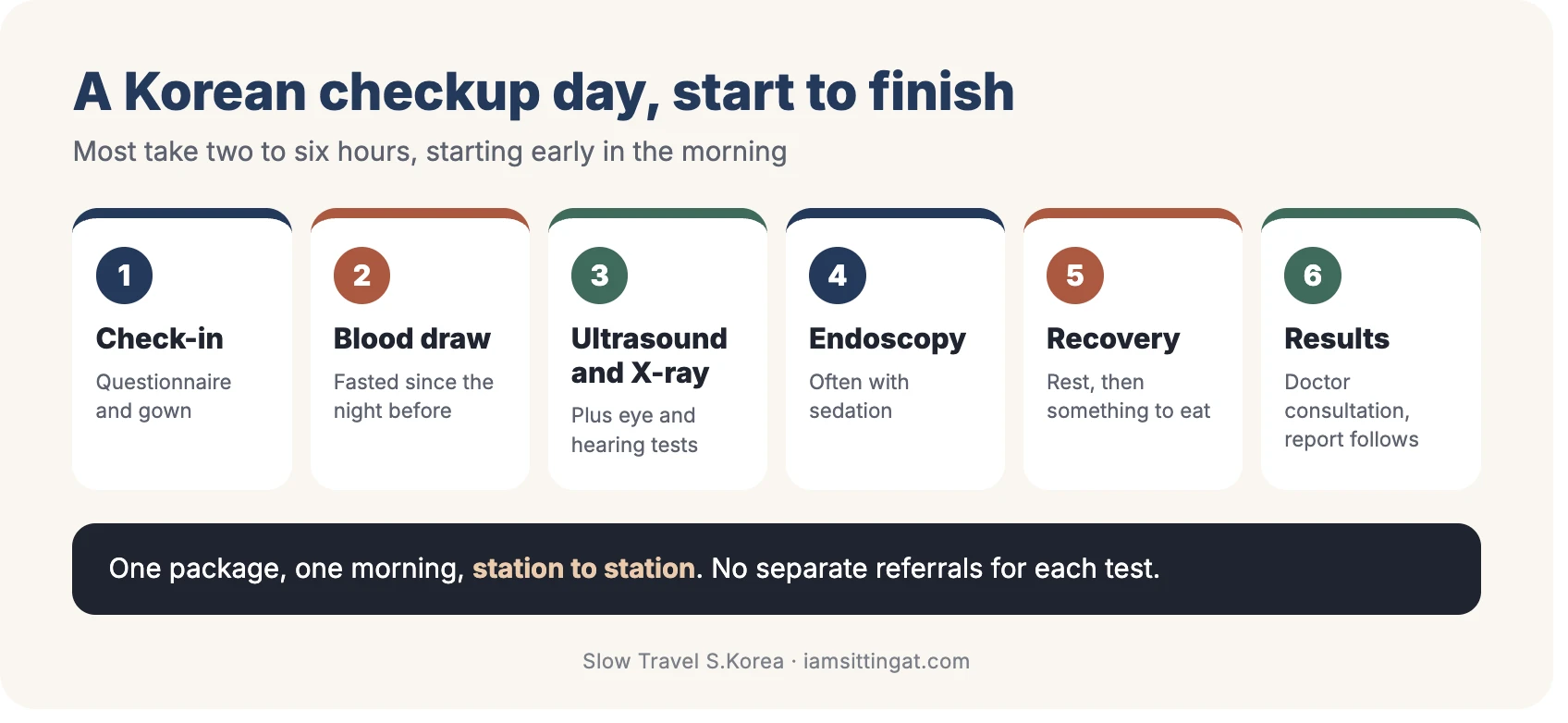
Every package is different, but most are built in layers. A basic package covers the essentials, and each step up adds more imaging and more specialized tests.
- Basic exam: height, weight, blood pressure, body composition, vision, hearing, and a doctor’s consultation
- Lab work: a full blood panel (liver, kidney, thyroid, lipids, blood sugar, hepatitis markers), urine test, and often tumor markers
- Imaging: chest X-ray and abdominal ultrasound, plus thyroid or breast ultrasound in mid-level packages
- Endoscopy: upper endoscopy (gastroscopy) is common, and colonoscopy is often an option or included at higher tiers
- Advanced imaging: low-dose chest CT, coronary calcium CT, brain MRI and MRA, or PET-CT at premium levels
- Women’s health: Pap smear, HPV test, pelvic ultrasound, mammogram
Most centers ask you to fill out a medical questionnaire before your visit, which affects which tests the doctor recommends on the day.
Korea Health Checkup Cost in 2026: Centers vs. Hospitals
When Koreans book a checkup, the real choice is usually between a dedicated screening center and a university hospital. You’ll face the same choice. Here’s how they compare.
| Screening center | University hospital | Premium wellness center | |
|---|---|---|---|
| Examples | KMI, Hanaro Medical Foundation, IMC | Severance, Samsung Medical Center, Asan Medical Center, SNUH Gangnam Center | Chaum |
| Typical price range | About $300 to $2,000 | About $600 to $15,000+ | About $1,700 to $9,000+ |
| Booking lead time | Often days to a few weeks | One month to several months | Around a month |
| English support | English reports, English-friendly flow | English reports, often a 1:1 interpreter | English reports, 1:1 interpreter |
| If something is found | Referral to a hospital | Follow-up visit in the same hospital | Varies |
| Best for | Short trips and a straightforward screening | Specific health concerns, complex history | Longer, more personal experience |
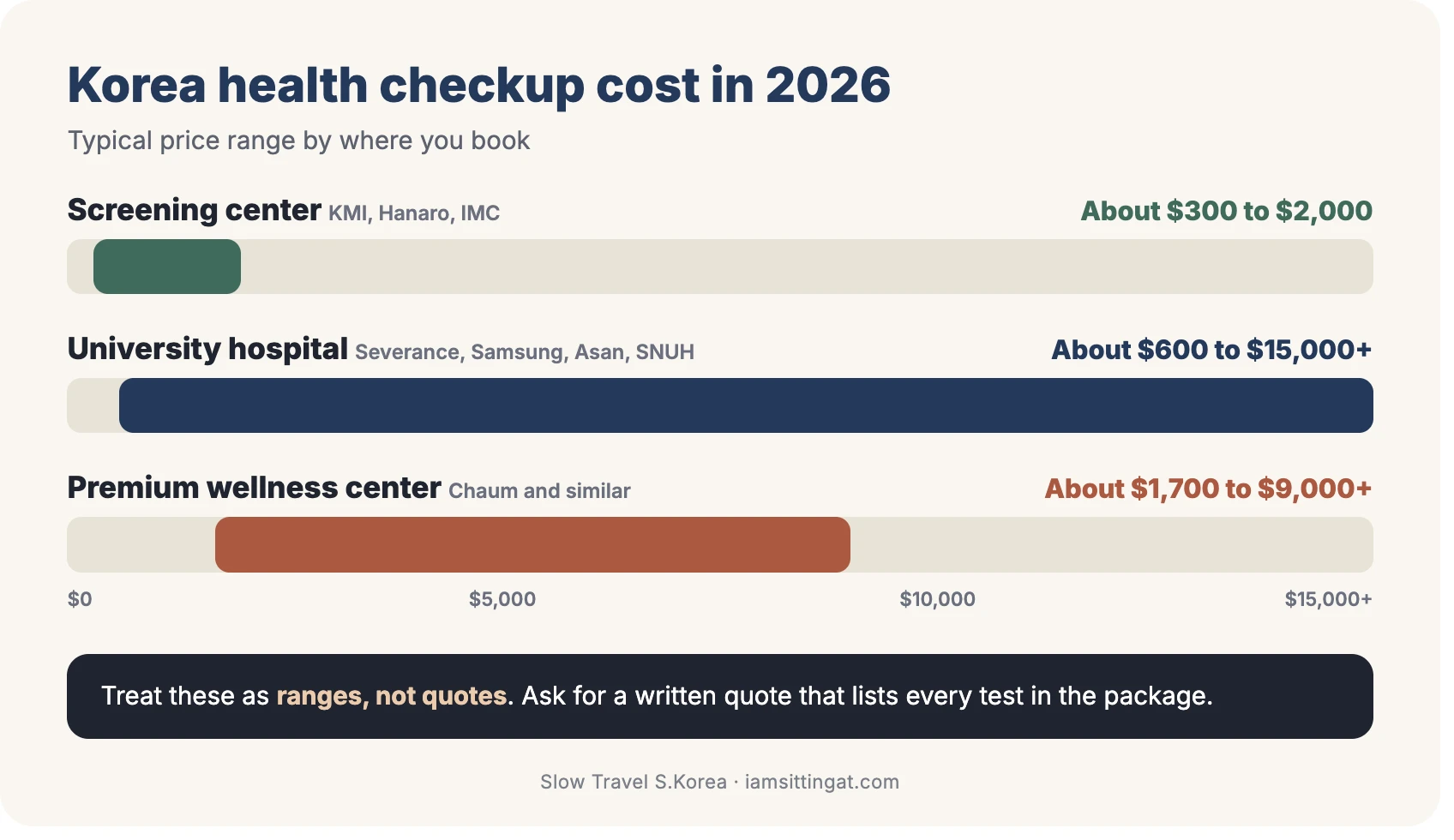
Treat these numbers as ranges, not quotes. They come from providers’ own listings and English-language booking platforms checked in mid-2026, and they change often.
Sample package prices for international visitors
Here are examples of what specific providers charge foreign patients. Dollar figures are converted at roughly 1,500 won to the dollar.
| Provider | Type | Example package | Approx. price | Time on the day |
|---|---|---|---|---|
| KMI | Screening center | Standard / Signature | About $350 / about $650 (≈1,000,000 won) | 2 to 4 hours |
| IMC (Sinsa) | Screening center | Classic program | About $465 (men) / $530 (women) | About 3 hours |
| Severance Hospital | University hospital | Premium | About $1,910 (men) / $2,344 (women) | Half day |
| Samsung Medical Center | University hospital | Executive Women | About $2,280 | About 5 hours |
| SNUH Gangnam Center | Hospital-run center | Intensive cancer screening | About $2,920 to $2,970 | Half day |
| Asan Medical Center | University hospital | Intensive | About $3,205 (men) / $3,497 (women) | About 6 hours |
Notice the pattern. A mid-tier package at a screening center can cost less than the facility fee for a single colonoscopy at many US hospitals billed without insurance, which is the comparison that gets people’s attention. But the right comparison for you depends on what your US plan already covers (more on that in the Reality Check).
[AFFILIATE: Korea health checkup booking platform (English-supported packages)]
Where to Get a Health Checkup in Korea as a Foreigner
You don’t need a “best hospital” ranking. You need a place that fits your trip, your budget, and how much hand-holding you want.
Screening centers (KMI, Hanaro, IMC). These are checkup-only facilities with several branches, many in central Seoul near Gwanghwamun, Jongno, Yeouido, and Gangnam. They’re efficient, cheaper, and easier to book on short notice. KMI runs a separate global checkup program with packages just for foreign nationals and overseas Koreans, and its global line has an English phone menu (+82-1551-7070) and an email address for international patients (kmiglobal@kmi.or.kr). If something abnormal turns up, these centers refer you to a hospital for treatment.

University hospitals (Severance, Samsung, Asan, SNUH, Seoul St. Mary’s). These have international healthcare centers with English-speaking coordinators, and many assign a 1:1 interpreter on checkup day. Severance’s international clinic opened in 1962 and was the first in Korea. The big advantage: if your checkup finds something, you can see a specialist in the same building. The downsides are price and wait times. Asan’s checkup slots for international patients can be booked months ahead.
Premium centers (Chaum and similar). These sell a longer, more personal day with extras like anti-aging consultations. They cost the most, and much of what you’re paying for is comfort, not extra diagnostic value.
A note for Korean Americans
This one matters if you, like many of my readers, have Korean roots. Some centers price packages based on your status. KMI, for example, separates foreigner-only packages from overseas Korean packages, and it checks documents at reception. A US citizen needs a passport, while an overseas Korean with permanent residency abroad needs a passport plus proof of residence, such as a green card or driver’s license. Without the right documents, the center may not proceed with your checkup. Ask which category you fall under before you book.
How to Book: A Simple Plan
Most international programs book by email, an online form, or a messaging app, and many don’t require a Korean phone number. If a Korean booking site does ask you to verify a Korean number, my guide to Korean phone number verification for foreigners walks through the workarounds.
- Decide what you actually need. Bring your US records and family history to a quick call with your doctor at home. Note which screenings you’re already due for.
- Shortlist two or three providers that match your budget and trip dates. For a hospital, contact the international healthcare center, not the general appointment line.
- Ask for a written quote listing every test in the package, the price, add-on prices, and whether sedation is included.
- Confirm the report format. Ask whether you’ll get a full English report, how long it takes, and how it’s delivered. KMI, for example, typically emails results within about 10 to 15 days.
- Schedule early in your trip. Do the checkup in your first few days so you have time for a follow-up visit if needed.
- Request your images and records (CT or MRI files on a disc or download link) before you leave Korea.
Prep Rules That Catch Travelers Off Guard
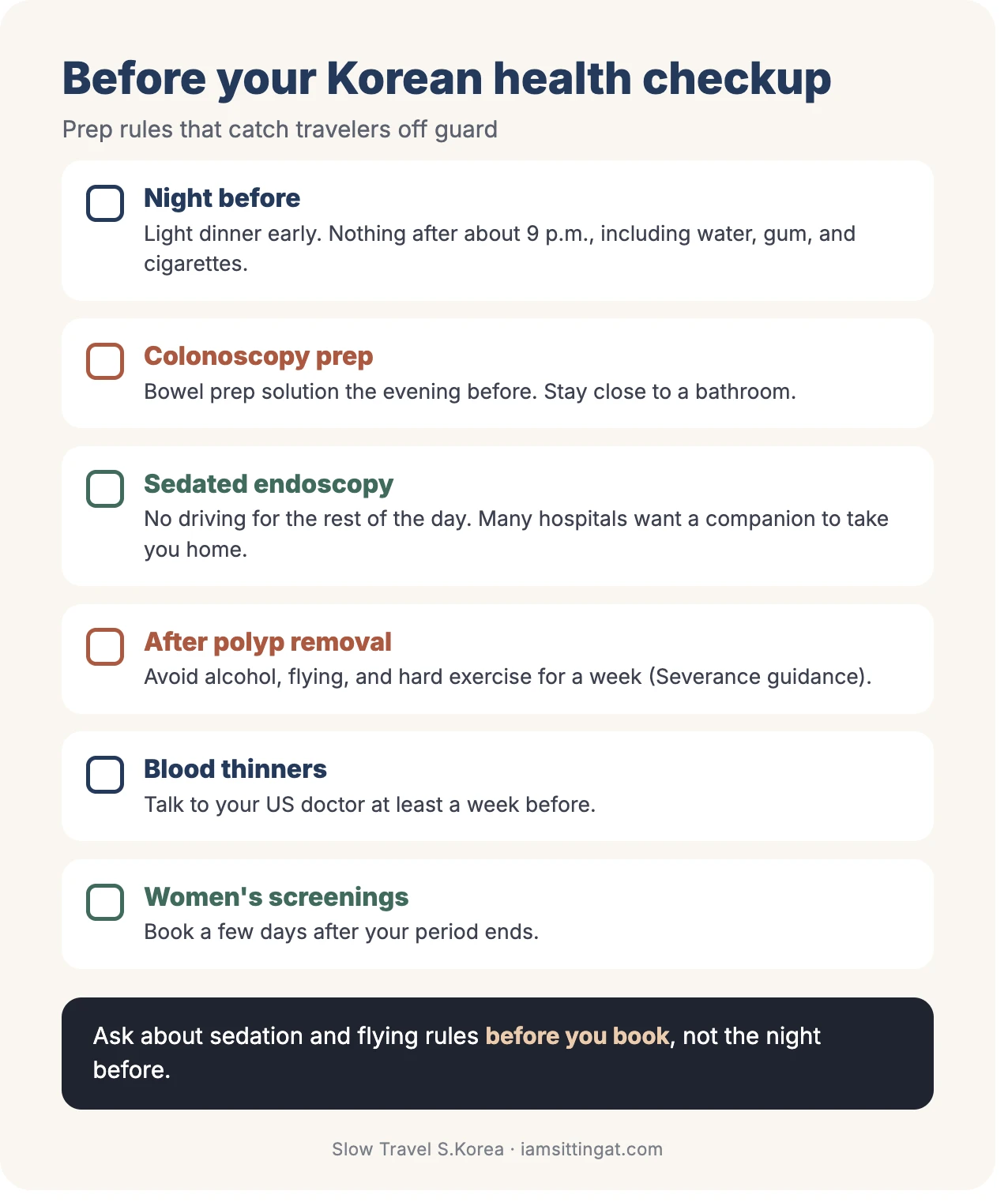
This is where planning around a vacation gets real. A checkup isn’t just a morning appointment; it shapes the day before and the day after.
- Fasting starts the night before. Many centers ask you to eat a light dinner early and have nothing after about 9 p.m., including water, gum, and cigarettes. Your Korean barbecue dinner plans move to another night.
- Colonoscopy prep takes over the evening. You’ll drink a bowel prep solution at your hotel or Airbnb and stay close to a bathroom. Pick lodging accordingly. My guide to quiet neighborhoods in Seoul has a few ideas.
- Sedated endoscopy means no driving for the rest of the day. Korea’s drug safety ministry warns that propofol, one of the common sedatives, can impair normal function for up to 12 hours. Many hospitals require someone to accompany you home. Severance, for instance, asks for a companion and tells patients not to drive all day. If you’re traveling solo, ask about this before booking.
- Polyp removal can ground you. Severance’s checkup guide tells patients to avoid alcohol, flying, and hard exercise for a week after a polyp is removed during colonoscopy. If your flight home is two days later, raise this with the center up front.
- Blood thinners need a plan. If you take anticoagulants, talk to your US doctor at least a week before. Biopsies and polyp removal carry bleeding risk.
- Women’s screenings have timing rules. Many centers recommend booking a few days after your period ends. Severance doesn’t do mammograms for women under 35 or anyone who had one within the past year.
Paying for Your Checkup
Most hospitals and centers in Seoul accept foreign Visa and Mastercard cards. On a $2,000 package, a card with no foreign transaction fee saves you about $60. See my guide to the best credit card to use in South Korea.
About VAT. Medically necessary care in Korea, including standard health screening, is generally exempt from VAT. That’s different from cosmetic procedures, which are taxed. So the end of the foreigner VAT refund on cosmetic treatments in 2025 doesn’t affect checkup prices. I cover that program in Korea Cosmetic Surgery Tax Refund 2026.
About your HSA. IRS rules on qualified medical expenses don’t exclude care received abroad, as long as the care is legal both in that country and in the US. Physical exams and diagnostic tests generally qualify. Keep itemized receipts in English, and confirm with your HSA administrator or a tax professional before you count on it. I’m not a tax advisor.
Reality Check: Costs, Limits, and Downsides
- Your US plan may already cover much of this for free. Most ACA-compliant US plans cover recommended preventive screenings, such as a colonoscopy starting at age 45, with no out-of-pocket cost in network. Paying for the same test in Seoul only makes sense if it’s not covered, you’re uninsured, or you want screenings your plan won’t pay for.
- More tests aren’t always better. Full-body CT and MRI can find harmless spots that lead to more scans, worry, and cost. CT scans also add radiation exposure. A good doctor will help you pick tests based on your risk, not the package tier.
- Follow-up happens back home. If the checkup finds something, your US doctor may want to repeat tests rather than rely on a foreign report. Budget time and money for that possibility.
- Language gaps still exist. A coordinator may speak fluent English while the radiologist doesn’t. Ask for the full English report, not just a summary.
- Booking-platform perks aren’t free. Free add-ons and gifts are marketing. Compare the full test list, not just the price.
- Travel insurance won’t help. Standard travel medical policies cover emergencies, not elective screenings. If a checkup leads to treatment in Korea, that usually isn’t covered either. See my guide to travel insurance for South Korea.
- Medicare generally doesn’t cover care outside the US. Retirees should plan to pay in full.
If You Need Help in Korea
- Medical Korea call center: 1577-7129. Government-run help line for foreign patients, with English support, for questions about medical institutions and complaints.
- Korea Travel Hotline: 1330. Useful for general interpretation if you need to talk to hospital staff.
- Check registration. Hospitals and clinics that actively recruit foreign patients must register with the Ministry of Health and Welfare. You can search on the government’s Medical Korea site (medicalkorea.or.kr).
FAQ
How much does a health checkup in Korea cost for foreigners?
In 2026, basic packages at screening centers start around $300 to $400. Mid-range packages with endoscopy run about $500 to $1,500. University hospital and premium packages often cost $2,000 to $5,000, and the most extensive programs exceed $10,000.
Can foreigners get a health checkup in Korea without living there?
Yes. Private checkup packages are open to tourists, and many centers run programs specifically for international patients. The free national checkup is only for people enrolled in Korea’s National Health Insurance.
How long does a Korean health checkup take?
Most checkups take two to six hours on the day, starting early in the morning after an overnight fast. Full English results usually follow within one to three weeks, depending on the provider.
Do I need a companion for a sedated endoscopy in Korea?
Often, yes. Many hospitals require a companion to take you home after sedation, and you shouldn’t drive for the rest of the day. Some smaller centers allow solo patients with a signed waiver, so ask when you book.
Is the Korea health checkup cost worth it for Americans?
It can be, especially if you’re uninsured, have a high deductible, or want screenings your plan doesn’t cover. If your insurance already covers routine preventive screening at no cost, the value is mostly in the speed and convenience of a one-day package.
The Bottom Line
A health checkup in Korea for foreigners can be fast, well organized, and much cheaper than paying cash for the same tests in the US. It works best when you treat it as a medical appointment with a trip around it, not a tourist activity. Start with what your doctor at home recommends, compare the Korea health checkup cost at a screening center against a hospital, book early in your stay, and take the prep rules seriously, especially sedation and flying after a polyp removal. Do that, and you’ll come home with useful answers instead of a stack of reports nobody can read.