Last updated: November 1, 2026
In 2025, foreign visitors filed 1,721,095 claims under the Korea cosmetic surgery tax refund and got back about 196.4 billion won, roughly $135 million. Then, on December 31, 2025, the program ended. If you booked a nose job or a double eyelid surgery in Seoul for 2026 based on a blog post that promised “10% back at the airport,” that money isn’t coming.
This post explains what the Korea cosmetic surgery tax refund was, what its end actually does to your bill, how plastic surgery cost in Korea for foreigners compares with the US now, and where the two bills to revive the refund stand as of November 2026. I read the Korean-language coverage and National Assembly records so you don’t have to.
This post is general travel and tax information, not medical, legal, or tax advice.
Key Takeaways
- The refund is gone for now. Foreign tourists can’t get VAT back on cosmetic surgery or skin treatments done on or after January 1, 2026.
- What you lose is about 9.1% of the total you pay, not 10%. VAT is 10% of the pre-tax price, so on a 1,100,000 won bill, the VAT part is 100,000 won.
- Two bills would bring it back, one through 2027 and one through 2029. Neither has passed as of this update.
- Korea is still much cheaper than the US for most procedures, even with VAT. The refund was a discount on top, not the reason prices were low.
- The shopping tax refund still exists. Cosmetics, clothes, and souvenirs bought at tax-free stores still qualify. Only the medical refund ended.
- Be skeptical of any clinic or agency that still advertises a “medical tax refund” in 2026.
What the Korea Cosmetic Surgery Tax Refund Was
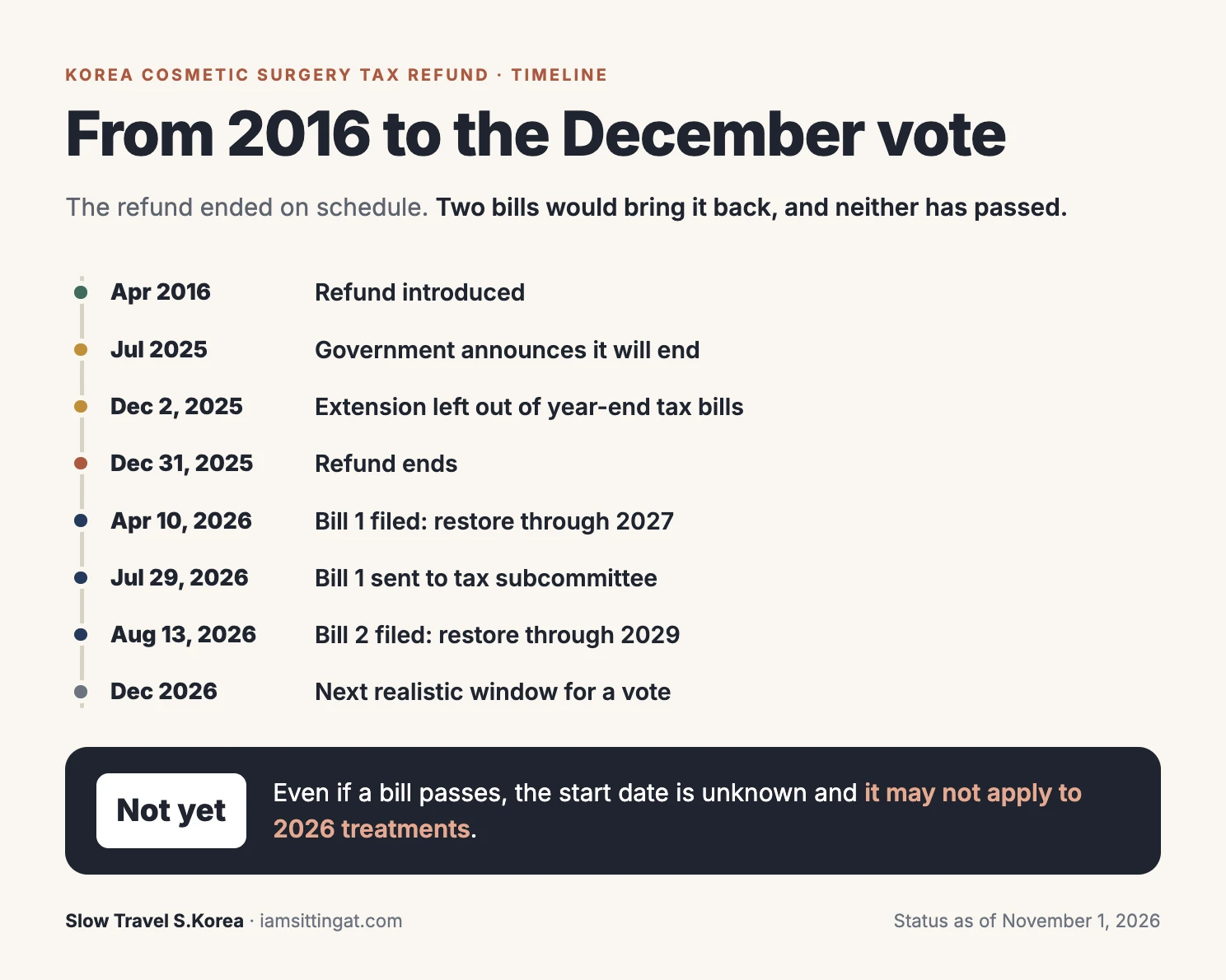
Korea added the refund in April 2016 to grow medical tourism and, just as important, to pull cosmetic clinics’ income into the open. Before then, some clinics took cash from foreign patients through brokers and under-reported it. A refund that needed an official receipt gave patients a reason to ask for one.
Here’s how it worked, in short:
- You got a cosmetic procedure at a clinic registered with the Ministry of Health and Welfare to treat foreign patients and approved for the refund.
- You paid the full price, including 10% VAT.
- The clinic gave you a refund slip (a medical service supply confirmation).
- Within three months, you handed the slip in at a refund counter at the airport or seaport when you left Korea. Smaller bills, up to 2 million won, could also be refunded at some city refund counters.
It covered more than surgery. Eligible services included double eyelid surgery, rhinoplasty, breast augmentation and reduction, liposuction, facelifts, facial contouring, fat grafting, removal of moles, freckles and melasma, teeth whitening and laminates, and a long list of skin treatments like skin rejuvenation, whitening, anti-aging, and pore treatments.
That last group is the big story. In 2025, most refunds came from lighter skin treatments, not surgery. The average refund that year was about 110,000 won (roughly $76), which tells you most claims were for clinic visits, not a new jawline. About 93% of 2025 refunds were for treatments in Seoul.
Why the Refund Ended
In July 2025, the Korean government’s annual tax reform plan said the refund had done its job. Foreign medical tourism had grown from about 364,000 patients in 2016 to over 2 million in 2025, and the refund’s cost had exploded. The government’s view was that a tax break meant to start an industry didn’t need to keep subsidizing one that was booming.
The Ministry of Health and Welfare pushed for a three-year extension, and some lawmakers in the tax subcommittee looked at extending it. But when the National Assembly passed its year-end tax bills on December 2, 2025, the extension wasn’t in them. The refund expired on December 31.
If you’re American, a useful comparison is a federal tax credit that’s allowed to “sunset.” Nobody repeals it with a big vote. Congress just doesn’t renew it, and it disappears on schedule. That’s what happened here.
What the End of the Refund Means for Your Bill
Here’s the part most English guides get slightly wrong. The refund was the VAT you paid, and VAT in Korea is 10% of the pre-tax price. So if a clinic quotes a price that already includes VAT, the tax inside it is 1/11 of the total, about 9.1%.
| Total you pay (VAT included) | VAT inside that price | Rough USD you no longer get back |
|---|---|---|
| 330,000 won (a laser or skin booster session) | 30,000 won | About $21 |
| 1,100,000 won (non-incisional double eyelid surgery at a mid-range clinic) | 100,000 won | About $69 |
| 5,500,000 won (rhinoplasty at a Gangnam clinic) | 500,000 won | About $345 |
| 11,000,000 won (combined facial surgery) | 1,000,000 won | About $690 |
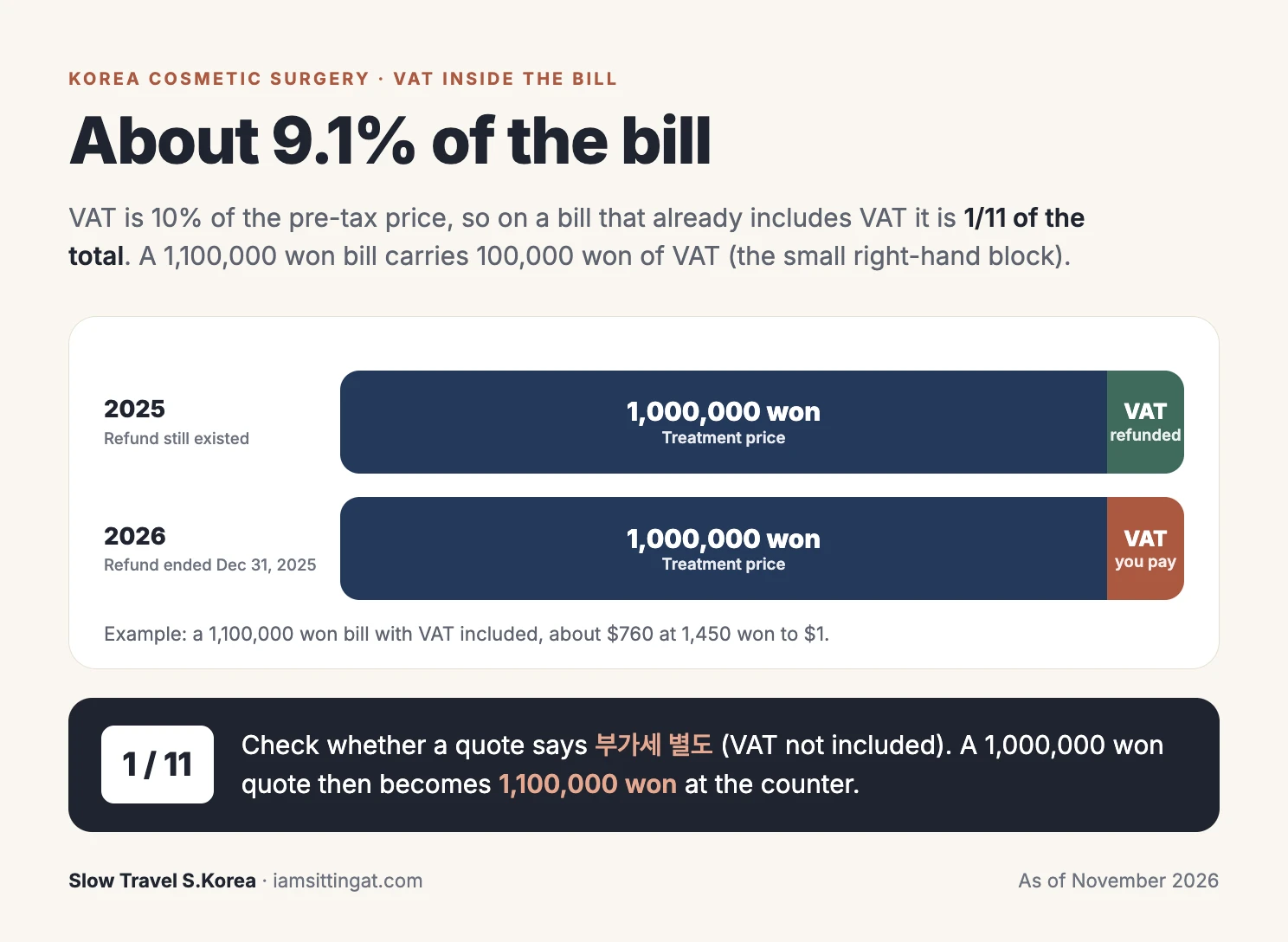
Dollar figures use about 1,450 won to the dollar.
Two things to watch on top of the math:
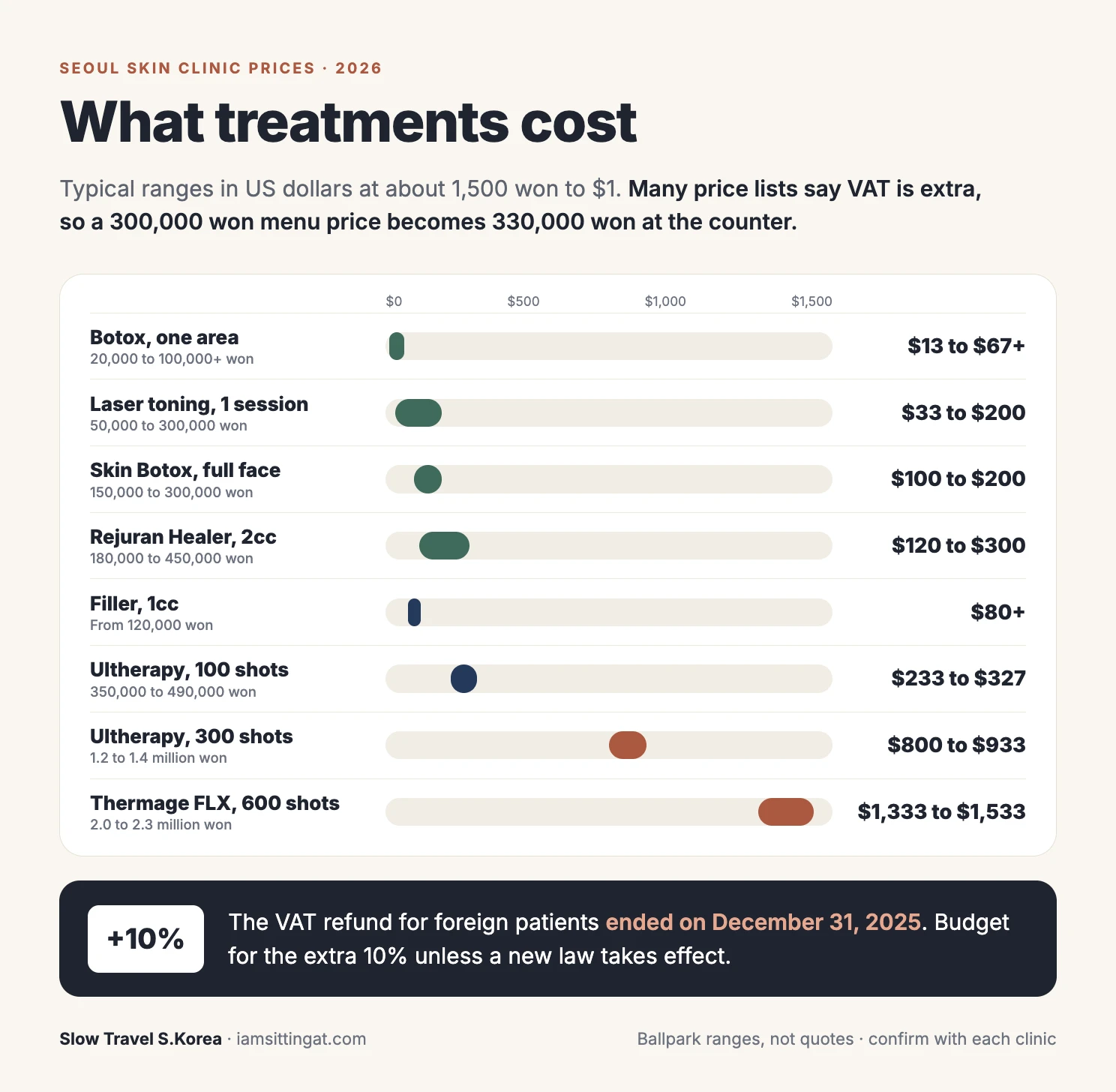
- Check whether the quote includes VAT. Many Korean price lists say bugase byeoldo (부가세 별도), “VAT not included.” A 1,000,000 won quote then becomes 1,100,000 won at the counter.
- Ask whether the price changed after January 1. Some clinics absorbed part of the lost refund with lower foreign-patient prices or promotions. Others didn’t. It’s worth asking directly.
Plastic Surgery Cost in Korea for Foreigners vs. the US (2026)
Losing roughly 9% hurts, but it doesn’t change the big picture. For most common procedures, plastic surgery cost in Korea for foreigners is still a fraction of US prices.
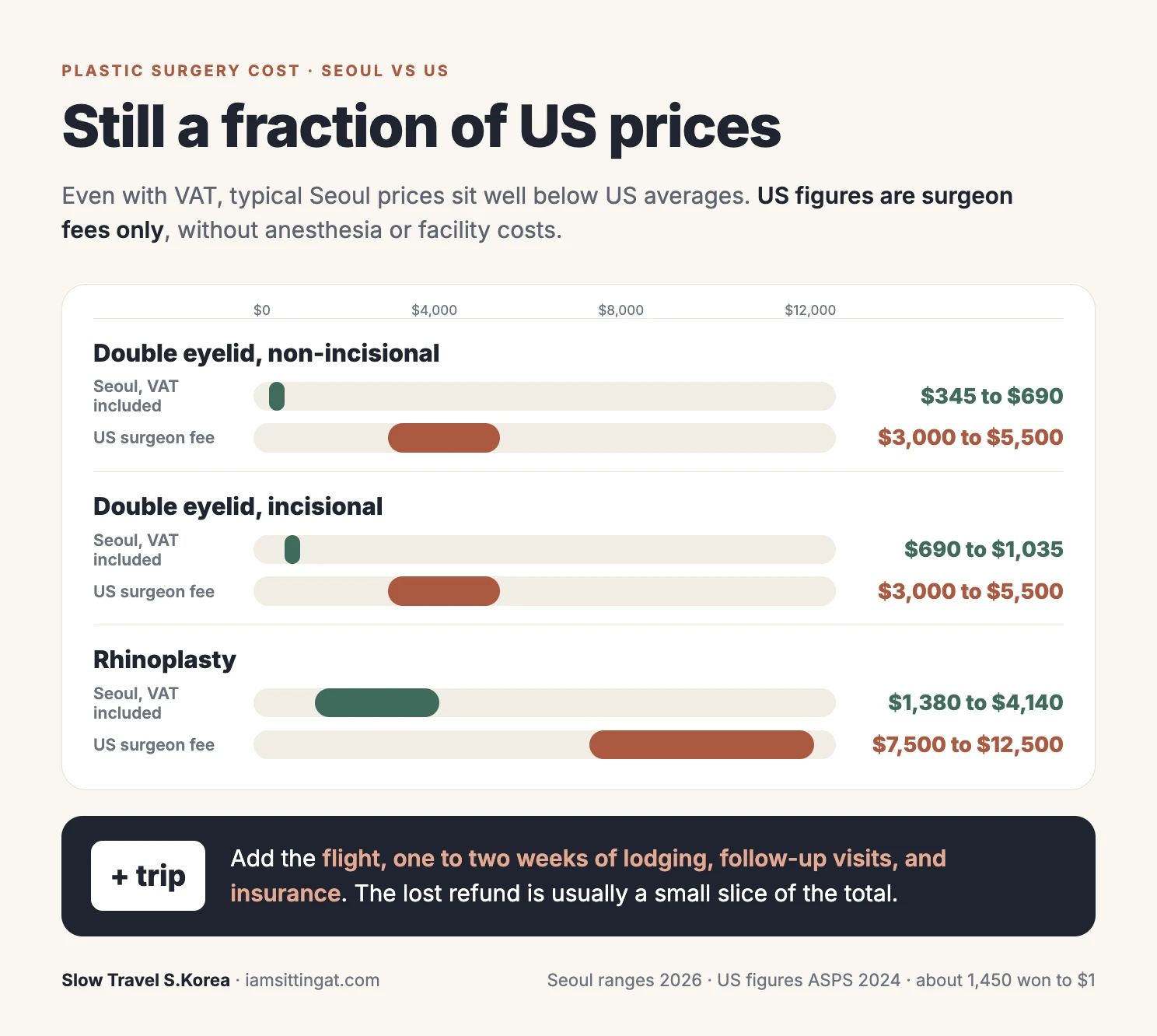
| Procedure | Typical Seoul price, 2026 (KRW, VAT included) | Rough USD | US average surgeon fee, 2024 (ASPS) |
|---|---|---|---|
| Double eyelid, non-incisional | About 500,000 to 1,000,000 | $345 to $690 | Upper eyelid surgery: $3,000 to $5,500 |
| Double eyelid, incisional | About 1,000,000 to 1,500,000 | $690 to $1,035 | Upper eyelid surgery: $3,000 to $5,500 |
| Rhinoplasty | About 2,000,000 to 6,000,000 | $1,380 to $4,140 | $7,500 to $12,500 |
| Chin liposuction | Varies widely by clinic | — | $3,000 to $5,500 |
| Facelift | Varies widely by clinic | — | $12,000 to $19,000 |
Keep two caveats in mind when you read that table:
- The US numbers are surgeon fees only. The American Society of Plastic Surgeons says its averages don’t include anesthesia, the operating room, or other costs. Your real US bill is often much higher.
- The Korean numbers often look lower than what foreigners are quoted. Some clinics and agencies quote foreigners more than locals, and agency commissions can be built into the price. My guide to Seoul dermatology clinics for foreigners covers how to spot foreigner pricing and how commissions work.
Then add the costs that don’t show up on a clinic’s price list: a round-trip flight from New York (see business class to Seoul with points), one to two weeks of lodging for surgery recovery, follow-up visits, and travel insurance. Once you count all of that, the lost VAT refund is usually a small slice of the total.
Where the Bills to Bring Back the Korea Cosmetic Surgery Tax Refund Stand
Two bills to restore the Korea cosmetic surgery tax refund are in the National Assembly. Interestingly, they come from both major parties.
| Bill 1 | Bill 2 | |
|---|---|---|
| Lead sponsor | Rep. Cho Kye-won (Democratic Party) | Rep. Lee Dal-hee (People Power Party) |
| Filed | April 10, 2026 | August 13, 2026 |
| Would restore the refund through | December 31, 2027 | December 31, 2029 |
| Status as of November 1, 2026 | Sent to the tax subcommittee on July 29, 2026 | Filed; no committee vote reported |
| Passed? | No | No |
Arguments for bringing it back: Plastic surgeons’ groups say foreign patient numbers dropped 20% to 30% after the refund ended. One dermatology clinic owner told a Korean TV outlet in August that his foreign patients fell by around 10%. Supporters also argue the refund kept payments on the books and kept unregistered brokers out.
Arguments against: The refund was getting expensive fast. Refund payouts roughly doubled from 2024 to 2025. During the October 2026 parliamentary audit, a ruling party lawmaker pointed out that more than 80% of the growth in foreign patients went to dermatology and plastic surgery, and suggested reviewing whether the tax break was worth it. The government also hasn’t publicly backed bringing it back.
When could it change?
Korea usually passes its tax law changes in December, along with the national budget. That’s the next realistic window. If a bill passes, a few things are still unknown:
- The start date. It could start January 1, 2027, or on a later date set by the law.
- Whether it’s retroactive. I wouldn’t count on getting VAT back for 2026 treatments. Tax breaks like this usually apply from the effective date forward.
- The rules. A revived refund could come with new conditions, like a narrower list of treatments or a cap.
I’ll update this post after the December vote.
The Shopping Tax Refund Still Works
This trips people up, because both programs were called “tax refund” in English and used the same airport counters and companies.
| Medical (cosmetic) VAT refund | Shopping tax refund | |
|---|---|---|
| What it covered | Cosmetic surgery and skin treatments at registered clinics | Goods bought at tax-free stores (cosmetics, clothing, electronics) |
| Status in 2026 | Ended December 31, 2025 | Still available |
| How you claimed it | Refund slip from the clinic, submitted when leaving Korea | Instant refund in store, or kiosk at the airport |
So yes, you can still get a refund on the sheet masks and sunscreen you buy after your appointment. You just can’t get one on the appointment itself. For the details, see my Korea tax refund 2026 guide.
How to Plan Cosmetic Treatment in Korea Without the Refund
- Budget with VAT included. Assume every price is VAT-exclusive until a clinic tells you otherwise in writing.
- Compare at least three clinics. Ask each for a total that includes VAT, anesthesia, and follow-up visits.
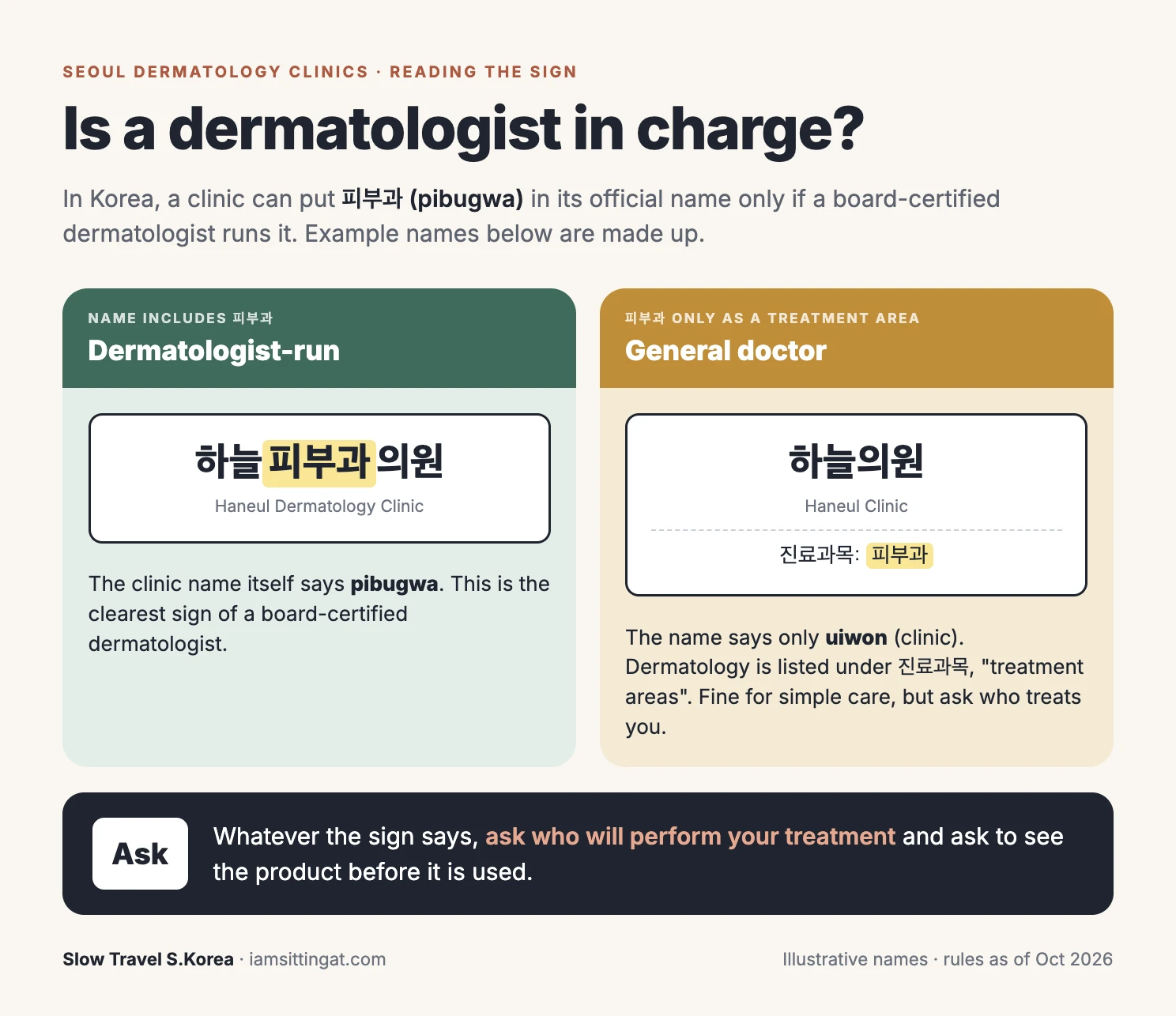
- Check registration. Clinics that actively bring in foreign patients must register with the government. You can search a clinic by name on Medical Korea (medicalkorea.or.kr).
- Pay with the right card. A card with no foreign transaction fees saves about 3% on every bill, which on a big surgery bill can be worth more than you’d think. See my guide to the best credit card to use in South Korea. [AFFILIATE: no foreign transaction fee credit card]
- Don’t let a “refund” sweetener decide for you. In 2026, a clinic or agency promising a government medical tax refund is either out of date or not being straight with you. A clinic discount is fine; just call it what it is.
- Get insurance that fits. Regular travel insurance generally excludes elective procedures and their complications. Some insurers sell separate medical tourism complication coverage. [AFFILIATE: medical tourism complication insurance] More in my travel insurance for South Korea guide.
Reality Check: Costs, Limits, and Downsides
- No refund means about 9.1% more in real terms compared with 2025, unless a clinic cuts prices to make up for it.
- A revived refund may not help your trip. Even if a bill passes in December, it may start later and may not be retroactive.
- Low advertised prices don’t always hold. Quotes for foreigners can be higher than the Korean price, and agency commissions are often built in.
- Recovery takes time and money. Surgery usually means extra nights in Seoul, follow-up visits, and a buffer before a 14-hour flight home.
- Follow-up care is hard from New York. If something needs fixing, you may need another trip, and your US surgeon may be reluctant to take over someone else’s work.
- Complications aren’t covered by standard travel insurance. Read the policy wording, not just the summary.
FAQ
Can foreigners still get a tax refund on cosmetic surgery in Korea?
Not as of November 2026. The Korea cosmetic surgery tax refund ended on December 31, 2025, and treatments done since January 1, 2026 don’t qualify. Two bills to restore it are pending in the National Assembly.
How much was the Korea cosmetic surgery tax refund worth?
It refunded the VAT you paid, which is about 9.1% of a VAT-inclusive price. In 2025, the average refund was around 110,000 won, roughly $76, because most claims were for skin treatments rather than surgery.
Is plastic surgery cost in Korea for foreigners still cheaper than in the US?
For most common procedures, yes. Even with VAT, typical Seoul prices for double eyelid surgery or rhinoplasty are well below average US surgeon fees, which don’t include anesthesia or facility costs. Flights, lodging, and recovery time narrow the gap.
Will the refund come back in 2027?
Possibly, but nothing is decided. One bill would restore it through 2027 and another through 2029. Korea usually passes tax changes in December, so check back after the year-end vote.
Can I still get a tax refund on cosmetics and shopping in Korea?
Yes. The shopping tax refund for goods bought at tax-free stores still works in 2026. Only the refund on medical and cosmetic procedures ended.
The Bottom Line
The Korea cosmetic surgery tax refund was a nice extra for ten years, and it’s gone for now. In practice, you’re paying about 9% more on a VAT-inclusive bill than a visitor in 2025 would have, and that’s the honest number to plan around. Plastic surgery cost in Korea for foreigners is still lower than in the US for most procedures, but flights, recovery days, and follow-up care matter more to your final total than the lost refund does. Budget with VAT included, get every quote in writing, ignore anyone still promising a medical tax refund, and check back here after December, when I’ll update this post with what the National Assembly decides.