Last updated: October 25, 2026
In 2025, 173,363 Americans received medical care in South Korea, up 70% from the year before. Most of them weren’t there for surgery or a health emergency. Across all foreign patients, 62.9% went to a dermatology clinic. If you’ve watched someone on TikTok get a laser and a skin booster in Gangnam for less than a facial in SoHo, you already know why.
This guide is for anyone looking at Seoul dermatology clinics for foreigners and wondering what things really cost, how to book without a Korean phone number, and how not to overpay. I’ll also explain the parts that surprise Americans: why prices are posted like a restaurant menu, why the same treatment can cost three times more two blocks away, and what changed in 2026 now that the tax refund on cosmetic procedures is gone.
This post is general travel information, not medical advice. Talk to a doctor about what’s right for your skin.
Quick Answer: Seoul Skin Clinics in 2026
- Most visits are walk-in style outpatient care at small clinics. In 2025, 87.7% of foreign patients in Korea were seen at clinic-level facilities, not hospitals, and 87.2% were treated in Seoul.
- Prices are lower than in the US, but they vary a lot. A budget Gangnam chain may list a Rejuran Healer session from about 180,000 won, while premium clinics charge two to four times that.
- The 10% VAT refund for foreigners ended on December 31, 2025. Two bills to bring it back are in the National Assembly, but neither has passed as of this update.
- Check that a clinic is registered to treat foreign patients. Registered clinics must have at least one specialist per department and carry malpractice insurance.
- Ask for a written quote that includes VAT, the product brand, and the dose or shot count before you pay.
- Travel insurance won’t cover elective treatments or their complications.
Why Seoul Skin Clinics Feel So Different from Your Dermatologist in New York
In New York, seeing a dermatologist usually means a referral, a wait of weeks, and an insurance conversation before anyone mentions a laser. Cosmetic work happens at a med spa or a specialist’s private practice, and the price often comes up at the end.
Seoul works almost the other way around. Skin clinics (pibugwa, 피부과) sit on nearly every commercial block, often stacked several to a building near subway stations. Most are small private clinics (uiwon, 의원), and many run like retail: a posted price list, same-week or same-day appointments, a consultation with a coordinator, then a short meeting with the doctor.
A few reasons explain this:
- Competition. Gangnam, Sinsa, and Apgujeong have one of the densest clusters of skin and plastic surgery clinics anywhere. Clinics compete hard on price and equipment.
- Maintenance culture. Many Koreans treat a laser toning session or a skin booster the way New Yorkers treat a haircut: routine upkeep, not a big decision.
- Cash-pay medicine. Cosmetic treatments aren’t covered by Korea’s national health insurance, so clinics set their own prices and advertise them openly.
Skin Clinic Prices in Seoul: What Common Treatments Cost in 2026
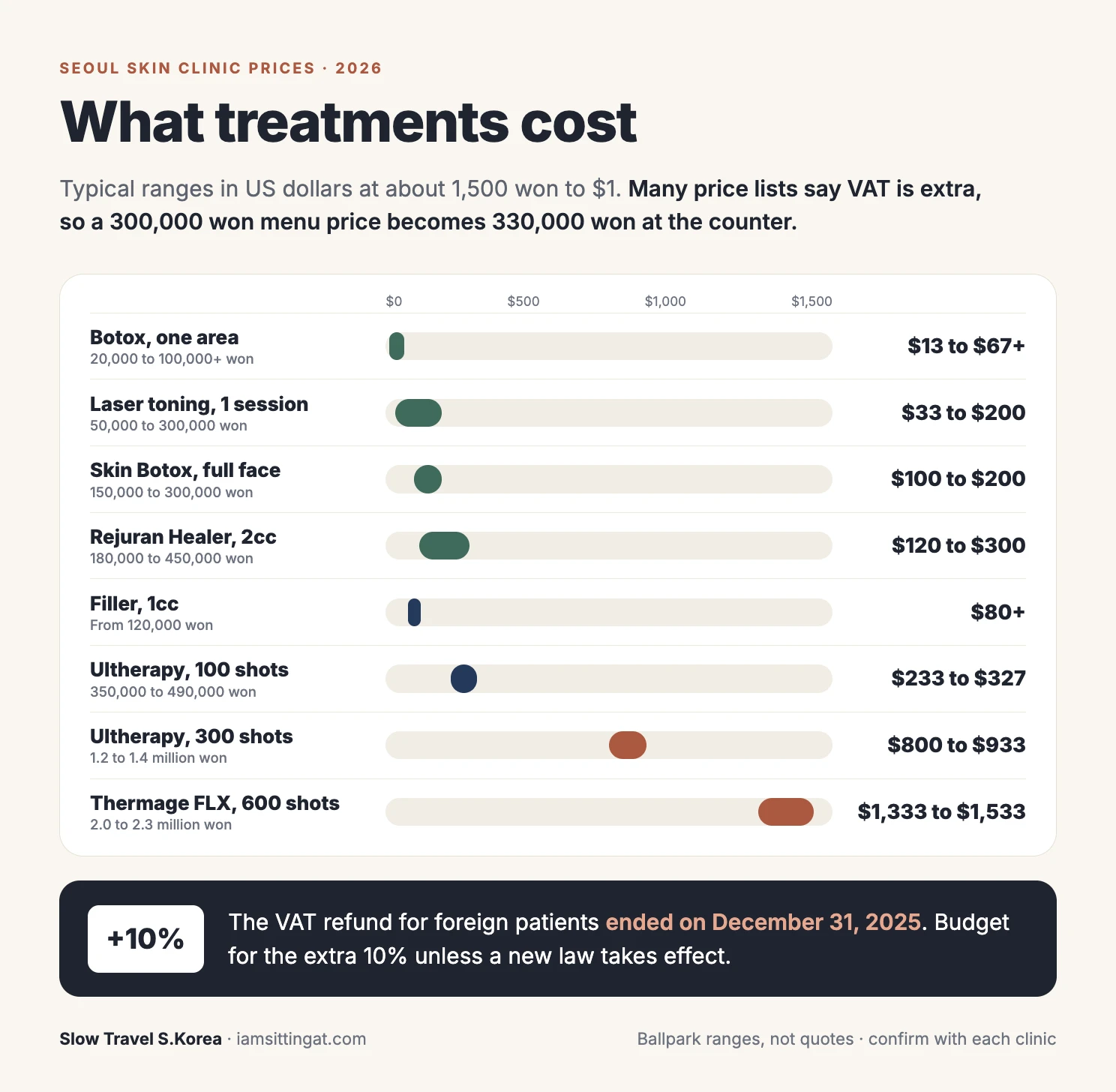
Here are typical skin clinic prices in Seoul for the treatments foreigners ask about most. I pulled these from clinics’ own 2026 Korean-language price lists and from English-language price surveys, then rounded them into ranges. Dollar figures use roughly 1,500 won to the dollar.
| Treatment | What it’s for | Typical Seoul price (KRW) | Rough USD | Typical downtime |
|---|---|---|---|---|
| Botox, one wrinkle area | Forehead, frown lines, crow’s feet | About 20,000 to 100,000+ | $13 to $67+ | Little to none |
| Laser toning (one session) | Uneven tone, dullness, pigmentation | About 50,000 to 300,000 | $33 to $200 | Mild redness for a few hours |
| Skin Botox (full face) | Pores, oil, fine texture | About 150,000 to 300,000 | $100 to $200 | Small bumps for a day or so |
| Rejuran Healer (2cc) | Skin texture, fine lines, scars | About 180,000 to 450,000 | $120 to $300 | Bumps and redness for 1 to 3 days |
| Filler (1cc) | Volume, contour | From about 120,000 | From $80 | Swelling, possible bruising |
| Ultherapy (100 shots) | Lifting and tightening | From about 350,000 to 490,000 | $233 to $327 | Mild swelling or tenderness |
| Ultherapy (300 shots) | Full-face lifting | About 1.2 to 1.4 million | $800 to $933 | Mild swelling or tenderness |
| Thermage FLX (600 shots) | Tightening | About 2.0 to 2.3 million | $1,333 to $1,533 | Mild redness |
Treat these numbers as a starting point, not a quote.
Why the same treatment can cost three times more
Two clinics on the same street can quote wildly different prices for what sounds like the same thing. This summer, a Korean celebrity’s clinic visit went viral at home partly because the price for 2cc of Rejuran was about 770,000 won, several times what many Gangnam clinics list. Here’s what usually drives the gap:
- VAT. Cosmetic treatments in Korea carry 10% VAT, and many price lists say bugase byeoldo (부가세 별도), meaning “VAT not included.” A 300,000 won menu price becomes 330,000 won at the counter.
- Dose and shot count. “Ultherapy” can mean 100 shots or 600. “Botox” can mean a Korean-made toxin or an imported brand at a different price. Always ask for numbers.
- Who does the treatment. Some high-volume clinics keep prices low by moving patients through quickly. Boutique clinics charge more for longer consultations and the same doctor every time.
- Agency commissions. Korean law lets registered agencies earn a commission from clinics for bringing in foreign patients, capped at 30% of the medical fee for small clinics and 20% for hospitals. That cost often ends up in your price.
- Foreigner pricing. Charging foreigners more than locals has been a known problem in Korea’s cosmetic market, enough that one major platform now runs an “equal price” policy (more on that below).
The VAT Refund Ended in 2025. Here’s What That Means for You
From 2016 through 2025, foreign tourists could get the 10% VAT back on cosmetic and dermatology treatments at registered clinics. It was popular. In 2025 alone, there were about 1.72 million refunds, averaging roughly 110,000 won (about $73) each.
That program ended on December 31, 2025, after the National Assembly left it out of the year-end tax bill. So in 2026, the VAT you pay on a skin treatment stays paid.
Two bills would bring it back. One, filed in April 2026, would restore it through the end of 2027 and went to a tax subcommittee in late July. Another, filed in August, would extend it through 2029. Neither has passed as of this update, and even if one does, the start date isn’t set. Be careful with any clinic or agency website that still advertises a medical tax refund.
Don’t confuse this with the shopping tax refund, which still exists for things like cosmetics and clothing. I cover that in my guide to the Korea tax refund in 2026. I’ll track the medical VAT bills in Korea Cosmetic Surgery Tax Refund 2026.
How to Choose a Seoul Dermatology Clinic for Foreigners
A slick English website and a lot of Instagram followers tell you a clinic is good at marketing. These checks tell you more.
1. Check that it’s registered to treat foreign patients. Korea requires clinics that actively bring in foreign patients to register with the Ministry of Health and Welfare. To register, a clinic needs at least one specialist for each department it lists and malpractice insurance. You can search a clinic by name on the government’s Medical Korea site (medicalkorea.or.kr). As of early 2026, about 4,000 medical institutions were registered nationwide.
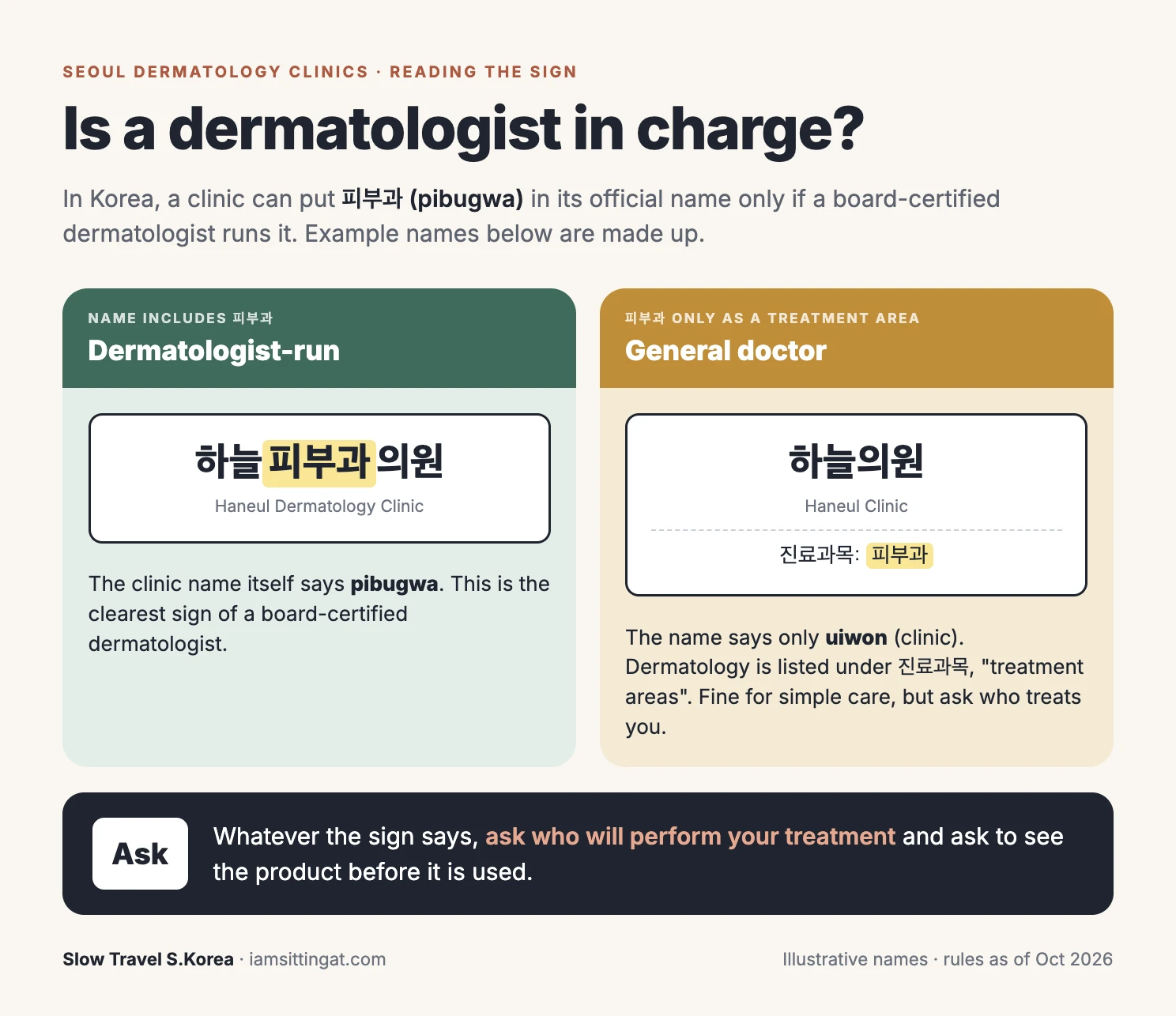
2. Read the clinic’s Korean name. This is a local trick most English guides miss. In Korea, a clinic can put pibugwa (피부과) in its official name only if it’s run by a board-certified dermatologist. Clinics run by general doctors usually show a name like “OO Clinic” with “dermatology” listed as a treatment area (진료과목 피부과). Plenty of those clinics are fine for simple treatments, but if you want a dermatologist, the name tells you.
3. Ask who performs the treatment. In Korea, injections and lasers are medical procedures that should be done by a doctor. Ask directly whether the doctor will do yours.
4. Ask to see the product. Good clinics show you the sealed vial or the device cartridge before they start. For Botox, ask which brand and how many units.
5. Get the full price in writing. Ask for the total with VAT, numbing cream, and any aftercare included. Screenshots of a chat message are fine.
How to Book: Four Routes Compared
There’s no single right way to book. It depends on how much help you want and how much you want to compare.
| Booking route | Best for | Price transparency | English help | Watch out for |
|---|---|---|---|---|
| Contact the clinic directly (website, WhatsApp, Instagram, KakaoTalk) | People who already know which clinic they want | Medium; depends on the clinic | Varies widely | A separate “international” price list |
| UNNI app (global version of Gangnam Unni) | Comparing many clinics and reviews | High; prices listed side by side | In-app English, plus an offline center | Event prices may have conditions |
| Travel booking platforms | First-timers who want a fixed package | High for the package | Usually good | Packages may not fit your skin; add-ons cost extra |
| Medical tourism agency or coordinator | Complex or multi-day plans | Low to medium | Strong | Commissions built into the price |
[AFFILIATE: Seoul skin clinic booking platform (fixed-price K-beauty treatment packages)]
About UNNI. Gangnam Unni (강남언니) is the app many Koreans use to compare cosmetic clinics. Its global app, UNNI, covers about 4,900 clinics in Korea and Japan in six languages. In March 2026 it opened an offline help center for foreign visitors in Nonhyeon-dong, Gangnam, with skin analysis, booking help, and interpretation. Its main pitch is an “equal price” policy: it focuses on clinics that show foreigners the same prices as locals.
About the Korean phone number problem. Some Korean booking apps ask for a Korean phone number to verify your identity. If you hit that wall, my guide to Korean phone number verification for foreigners walks through the workarounds. An eSIM with a Korean number can help too: [AFFILIATE: Korea eSIM with Korean phone number] See Best eSIM for Korea.
A simple booking plan
- Two to four weeks before your trip, shortlist three clinics. Check each one’s registration and Korean name.
- Message each clinic with a photo of your skin in daylight, your skin concerns, your travel dates, and any medications you take. Ask for a recommended plan and a total price with VAT.
- Compare the answers. A clinic that pushes a long list of treatments before seeing you in person is telling you something.
- Book a consultation early in your trip, not the day before you fly home.
- Keep everything in writing, including the final price and aftercare instructions.
Planning Treatments Around Your Trip
This is where a little planning saves a lot of stress. A treatment that’s “no downtime” in a brochure can still mean a red face in a dinner reservation photo.
- Front-load the trip. Do your consultation and treatments in the first few days. If something looks off, you still have time to go back.
- Leave space before your flight. Swelling, bruising, and bumps from injections usually settle within a few days, but you’ll want that buffer before a 14-hour flight back to JFK.
- Plan around the sun. After lasers, you’ll be told to avoid strong sun. That matters more in summer than on a winter trip to Seoul.
- Don’t stack too much. Clinics often suggest combining several treatments in one visit. More isn’t always better for skin that has to travel the next day.
- Bring the details home. Ask for the names of products and doses in English so your dermatologist in New York knows what was done.
Paying at a Seoul Skin Clinic
Most clinics in Gangnam and Myeongdong take foreign Visa and Mastercard cards. A card with no foreign transaction fees saves you about 3% on every bill, which adds up on a 1 million won treatment plan. See my guide to the best credit card to use in South Korea.
Some clinics offer a discount for cash. If you plan to pay that way, know where to get won at a good rate: Where to Exchange Money in Seoul. Whatever you pay with, get an itemized receipt.
Reality Check: Costs, Limits, and Downsides
- Cheap can be cheap for a reason. Very low event prices sometimes mean a fast, crowded experience, a smaller dose, or upselling once you’re in the chair.
- The language gap is real. A coordinator may speak good English while the doctor speaks very little. Important details about risks can get lost.
- Pressure to add treatments is common. It’s fine to say you’ll think about it and come back.
- No VAT refund in 2026. Budget for the extra 10% unless a law change takes effect.
- Insurance won’t help with elective work. Standard travel insurance excludes cosmetic treatments and their complications. Read more in my guide to travel insurance for South Korea. [AFFILIATE: medical tourism complication coverage]
- Follow-up is hard from 7,000 miles away. If something needs adjusting, you may not be in Seoul to get it done.
- Some treatments popular in Korea aren’t approved in the US. Your US dermatologist may not be familiar with them or able to repeat them.
If Something Goes Wrong
Korea has an official support system for foreign patients, and it’s worth saving the numbers before your appointment.
- Medical Korea call center: 1577-7129. It offers help in English, Chinese, Japanese, and Russian, including information about clinics, complaints, and medical disputes.
- Medical Korea support centers. There’s a desk in the arrivals hall of Incheon Airport Terminal 1, next to Exit 7, and a center in Seoul Station on the airport railroad level.
- Medical dispute mediation. The Korea Medical Dispute Mediation and Arbitration Agency handles disputes between patients and clinics, and Medical Korea can help you start the process.
- Korea Travel Hotline: 1330. Useful for general interpretation if you need help talking to clinic staff.
Before you leave Korea, ask the clinic for your treatment record and itemized receipt. These are much harder to get once you’re home.
FAQ
Are Seoul dermatology clinics safe for foreigners?
Most are well equipped, and Korea’s dermatology market is mature. Safety still varies by clinic. Check that the clinic is registered to treat foreign patients, that a doctor will perform your treatment, and that you can see the product before it’s used.
How much do skin clinic prices in Seoul cost compared to the US?
Common treatments are often much cheaper in Seoul. Laser toning may start around 50,000 won per session, and Rejuran Healer often runs about 180,000 to 450,000 won. Premium clinics can charge several times more, and VAT may not be included in listed prices.
Can foreigners still get a VAT refund on dermatology treatments in Korea?
Not as of October 2026. The refund for foreign tourists ended on December 31, 2025. Lawmakers have proposed bringing it back, but no bill has passed yet.
Do I need a Korean phone number to book a Seoul skin clinic?
Not always. Many clinics that see foreign patients book through WhatsApp, Instagram, email, or global apps like UNNI. Some Korean-only apps do require a Korean number for verification.
Is it OK to walk into a Seoul dermatology clinic without an appointment?
Many neighborhood clinics accept walk-ins for consultations, especially on weekdays. Popular clinics in Gangnam often book up, so an appointment is safer if you have a short trip.
The Bottom Line
Seoul dermatology clinics for foreigners can be a good value and a genuinely interesting part of a Korea trip, as long as you treat them like the medical visit they are. Check registration, read the clinic’s Korean name, get the price with VAT in writing, and plan treatments early in your stay. Expect skin clinic prices in Seoul to vary a lot, and remember that in 2026 there’s no VAT refund to soften the bill. Do that, and you’ll come home with better skin and no surprises on your credit card statement.