Last updated: November 1, 2026
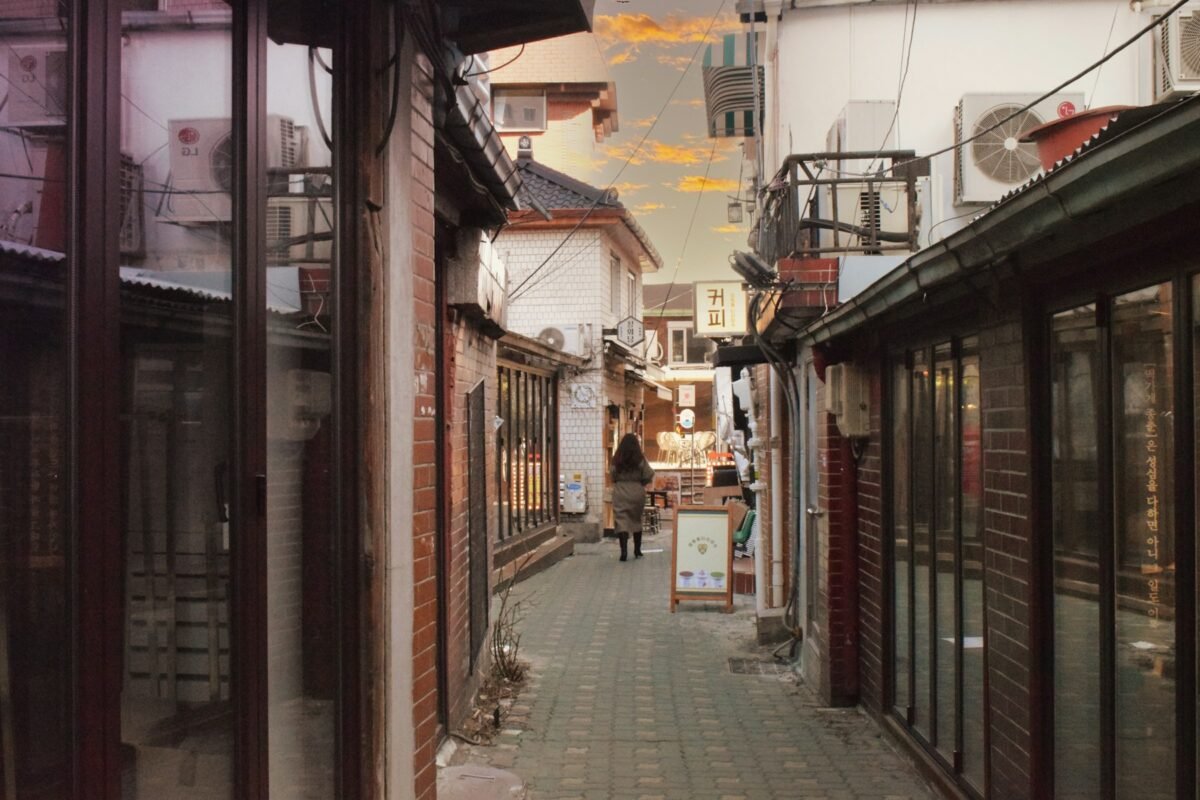
About 6,000 people live in Bukchon Hanok Village. In 2023, roughly 6.6 million visitors walked through it. That ratio explains a lot about Seoul in 2026: the places on every first-timer’s list are crowded enough that the city now limits when tourists can enter some alleys. But Seoul is a city of almost 10 million people, and most of them live on quiet streets you’ll never see on a top-ten list. This guide is about those quiet neighborhoods in Seoul: where to walk slowly, where to sit, and how to pick a quiet area to stay in Seoul without giving up easy subway access.
Key Takeaways
- Quiet in Seoul usually means residential, not remote. The calm streets are often one subway stop or one hill away from the busy ones.
- My shortlist: Seochon, Seongbuk-dong, Buam-dong, Huam-dong, Yeonhui-dong, Mangwon-dong, and Bukchon (as a place to sleep, not a place to wander at night).
- Bukchon has tourist hours. In the “red zone” around Bukchon-ro 11-gil, visitors may enter only from 10 a.m. to 5 p.m. Outside those hours, sightseeing there can bring a 100,000-won fine. Guests staying in the zone are exempt.
- For a quiet area to stay in Seoul, Seochon is the easiest all-around pick for first-timers. Mangwon-dong and Huam-dong are good for longer, more local stays.
- Book licensed stays. Since October 2025, Airbnb Korea removes listings that don’t submit a business registration, and the government runs a list of registered guesthouses and hanok stays called Seoul Stay.
- The trade-off: quiet areas mean hills, fewer late-night options, and sometimes a bus instead of the subway.
What “Quiet” Means in Seoul (and Why It’s Different from New York)
In New York, a quiet neighborhood usually means fewer people per block. In Seoul, density is everywhere, so quiet comes from something else: the type of street.
Seoul’s big roads are loud, bright, and lined with chain stores. But behind almost every one of them is a grid of narrow alleys called golmok (골목), where people actually live. These alleys are often too narrow for buses, and many are on hills. Once you turn off the main road, the volume drops fast. A five-minute walk can take you from eight lanes of traffic to a lane where you hear someone’s TV through a window.
That’s why I tell friends not to judge a Seoul neighborhood by its subway exit. Judge it by what’s two turns back from the exit.
The other difference is the hours. A residential Seoul neighborhood goes quiet earlier than a busy part of Manhattan. Small shops close in the evening, older residents are up early, and people expect the alleys to be calm at night. If you stay in one of these areas, you’re a guest on someone’s street, which is a big part of why they’re pleasant.
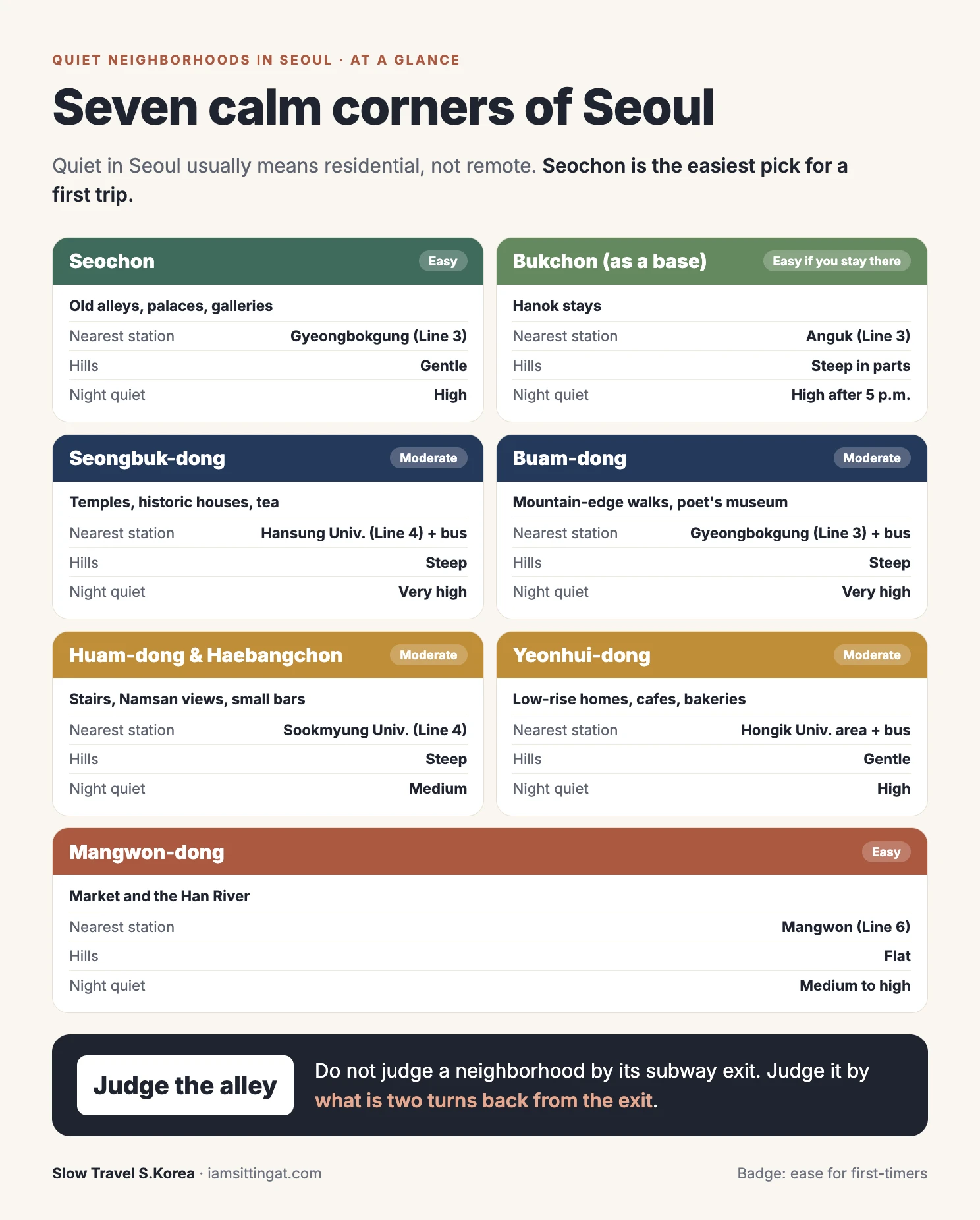
7 Quiet Neighborhoods in Seoul at a Glance
1. Seochon: The Easiest Quiet Neighborhood in Seoul
Seochon means “west village,” and it’s the area just west of Gyeongbokgung Palace. If you only have room for one quiet neighborhood in Seoul, I’d pick this one, because it combines calm alleys with everything a first-timer wants nearby: the palace, Gwanghwamun, and Line 3.
What makes Seochon work is that it’s still a neighborhood first. Old hanok sit next to small brick houses from the 1970s, and the shops are small: bookstores, galleries, tiny restaurants with a few tables.
What to do:
- Tongin Market. A small traditional market dating to 1941. Its dosirak (lunchbox) cafe program lets you buy old-style brass tokens and trade them at food stalls for small portions, building your own lunch tray. The lunchbox program has been listed as running from 11 a.m. to 3 p.m.
- Walk up toward Inwangsan. The streets climb gradually toward the mountain on Seochon’s west side. Suseong-dong Valley, at the top of the neighborhood, is a short stream valley where the city ends and the trail begins.
- Pair it with a palace morning. Gyeongbokgung is a few minutes away on foot. See it early, then drift into Seochon for lunch.
Why stay here: Seochon is central, walkable, and on a subway line that runs straight to Express Bus Terminal and Gangnam. It’s the best balance of quiet and convenience I know in Seoul.
2. Bukchon: Quiet After 5 p.m., If You’re Staying There
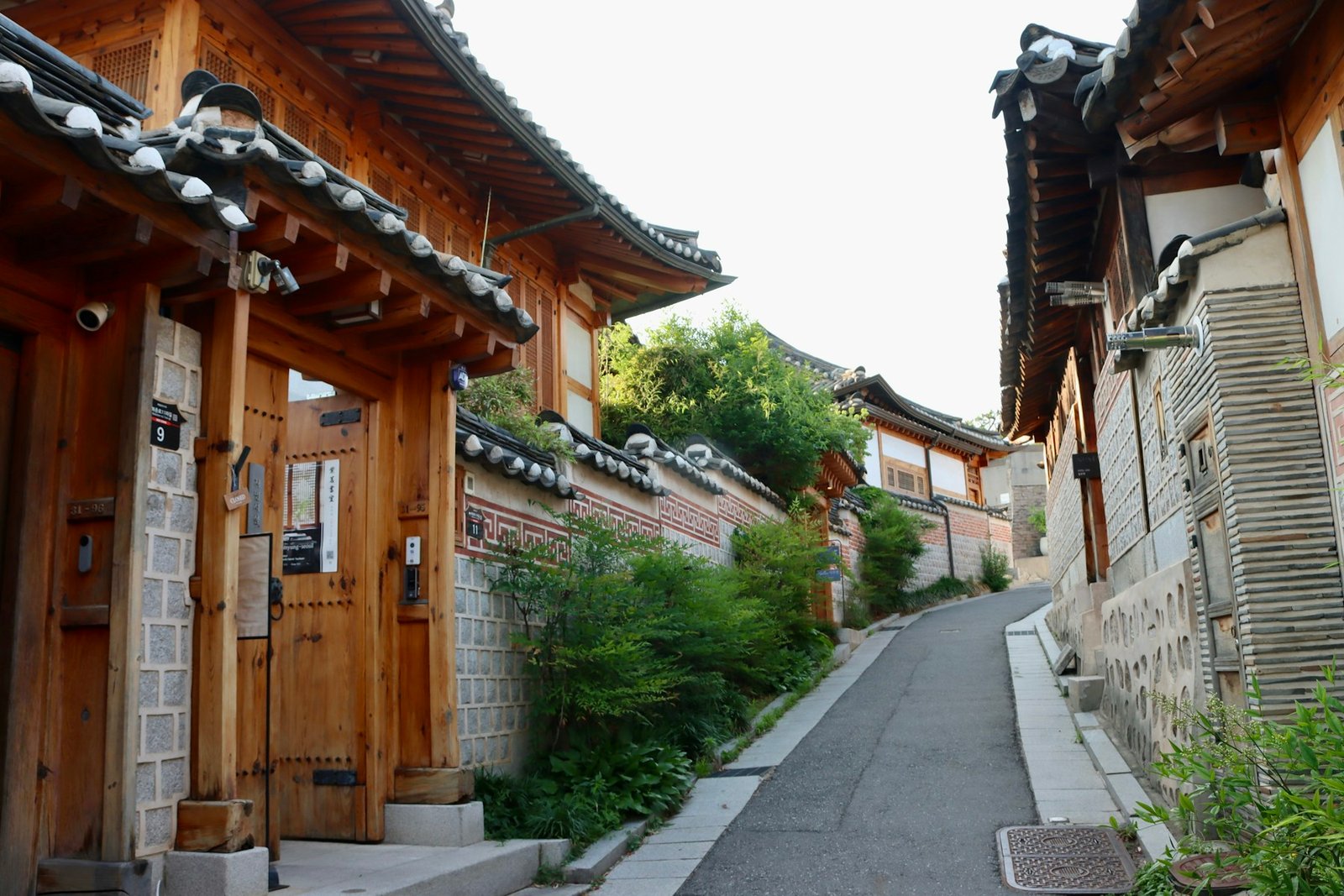
Bukchon is on every list, so it may seem odd to include it here. But it belongs on a list of quiet neighborhoods in Seoul for one specific reason: after tourist hours, the main alleys go back to being residential.
Here’s how the rule works. Jongno District designated part of Bukchon as a special management area. In the busiest section, the “red zone” around Bukchon-ro 11-gil, tourists may visit only between 10 a.m. and 5 p.m. Fines of 100,000 won (about $70) began on March 1, 2025, for anyone entering to sightsee outside those hours. Residents, their guests, customers of shops inside the zone, people simply passing through, and people staying overnight in the zone are exempt, but the district has said it can still fine people in exempt groups if they’re clearly sightseeing. Since January 2026, charter tour buses have also been restricted on the main road through the area.
What that means for you:
- Visiting for the day: go between 10 a.m. and 5 p.m., keep your voice down, and don’t sit on doorsteps for photos. Those doors are people’s front doors.
- Staying overnight: a hanok stay in Bukchon gives you the alleys in the early morning and evening, when they’re at their most peaceful. Just be a quiet guest, and don’t treat your exemption as a pass to shoot photos at 8 p.m.
One more thing to know: the number of hanok stays in Bukchon has grown fast, from 47 in 2020 to 168 by mid-2026, and Jongno District is reviewing new rules to manage them. If you book here, choose a licensed stay and check its house rules on noise and check-in times.
3. Seongbuk-dong: Old Houses Below the City Wall
Seongbuk-dong sits on the north side of the old Seoul city wall, on a slope with large embassy residences at the top and older, much smaller homes below. It’s quiet in a way that feels almost out of the city, partly because it’s hard to get to by subway.
How to get there: take Line 4 to Hansung University Station, then a green village bus (Seongbuk 02) or a regular bus up the hill. Plan on a fair amount of walking uphill once you’re there.
What to do:
- Gilsangsa. A Buddhist temple with a complicated history: the property was once a high-end restaurant and entertainment house before its owner donated it to become a temple. It’s spread over a wooded slope and is one of the calmest places in the city. It has opened from 6:30 a.m., closing at 7 p.m. in winter and 8 p.m. in summer.
- Suyeon Sanbang. The 1930s hanok home of writer Lee Tae-jun, now a traditional tea house run by his family. It has been closed on Mondays and Tuesdays.
- Simujang. The small hanok where independence activist and poet Han Yong-un lived. It faces north, unusual for a Korean house, and the traditional explanation is that he refused to face the colonial government building to the south. Admission has been free, daily from 9 a.m. to 6 p.m.
Why stay here (or not): Seongbuk-dong has very few places to stay and limited transit at night. I’d treat it as a half-day trip rather than a base.
4. Buam-dong: Where the City Meets the Mountains
Buam-dong is tucked into the valley behind the presidential compound area, between Inwangsan and Bugaksan mountains. It feels like a small town that happens to be ten minutes by bus from downtown.
How to get there: from Gyeongbokgung Station exit 3, take bus 1020, 7022, or 7212 and get off at the Jahamun Gogae / Yun Dong-ju Literary Museum stop.
What to do:
- Yun Dong-ju Literary Museum. A small museum for one of Korea’s most loved poets, built inside two old water tanks. One of the rooms is open to the sky, the other is closed and dark. It’s an unusual, thoughtful space, and it takes about half an hour. It has been open Tuesday through Sunday, 10 a.m. to 6 p.m.
- Cheongun Literary Library. A public library with a hanok reading room, a short walk from the museum. It’s a real neighborhood library, so treat it like one.
- The city wall trail. Paths from the museum area connect to sections of the Seoul city wall. Even a short walk gives you views over the rooftops.
Why stay here (or not): like Seongbuk-dong, it’s better for a slow morning or afternoon than as a place to sleep. Combine it with Seochon: bus up to Buam-dong, then walk or ride back down for dinner.
5. Huam-dong and Haebangchon: Stairs Below Namsan
On the south slope of Namsan, Huam-dong is a hillside neighborhood with layers of history: Japanese colonial-era houses, postwar homes, and the long shadow of the former U.S. military base in Yongsan. Next door, Haebangchon (“liberation village”) was settled by refugees after 1945 and later became a neighborhood with many foreign residents and small bars.
What to do:
- Walk the 108 Steps. A long public staircase in Huam-dong, now with a small inclined lift for residents. The view of Namsan Tower from the neighborhood is one of the better ones in the city because you see it over ordinary rooftops, not a tourist plaza.
- Sinheung Market. A small, partly covered market in Haebangchon that has been reborn with cafes and restaurants inside.
- Bookshops and galleries. The area has independent bookstores and small galleries that change shows often.
Why stay here: Huam-dong is a good quiet area to stay in Seoul if you want to be close to Seoul Station (for the KTX and the airport train) without staying next to it. Haebangchon is livelier at night, so check where exactly your place is.
6. Yeonhui-dong: A Calm Street Next to the College Crowds
Yeonhui-dong sits between the university areas of Sinchon and Hongdae, two of the busiest nightlife districts in Seoul. It’s a short ride from both and feels completely different: mostly low-rise houses with small gardens, quiet streets, and a scattering of cafes, bakeries, and restaurants.
There’s no subway station in the middle of Yeonhui-dong, which is exactly why it stays calm. Most visitors arrive by bus or walk over from the Hongdae side.
Who it suits: people who want Hongdae within reach without hearing it at night. It’s a good choice for a second trip, when you already know your way around.
7. Mangwon-dong: A Market, the River, and Flat Streets
Mangwon-dong is a residential neighborhood near the Han River, one stop past Hapjeong on Line 6. It’s not silent; the market street gets busy. But it’s an everyday kind of busy, people shopping for dinner rather than crowds taking photos.
What to do:
- Mangwon Market. A traditional market where locals shop for produce, side dishes, and snacks. Go in the late afternoon and you’ll see the neighborhood at its most normal.
- Mangwon Hangang Park. A short walk from the market, with paths along the river. Pick up something at the market and eat by the water.
- Walk the side streets. The blocks between the station and the river are full of small cafes and shops.
Why stay here: Mangwon-dong is one of my favorite answers for a quiet area to stay in Seoul on a longer trip. It’s flat, it has a real grocery market, and the river is your backyard. You’re on Line 6 rather than one of the main lines, so trips to Gangnam or Myeongdong take a transfer.
How to Choose a Quiet Area to Stay in Seoul
Here’s the short version of what I tell friends, based on the kind of trip they’re taking.
| Your trip | Where I’d stay | Why |
|---|---|---|
| First trip, 4–6 nights | Seochon | Central, near palaces, Line 3, calm at night |
| Want a hanok experience | Bukchon or Seochon hanok stay | Traditional rooms; the alleys are yours after 5 p.m. |
| Lots of train trips (KTX, airport) | Huam-dong | Short ride to Seoul Station |
| Long stay, 1–2 weeks or more | Mangwon-dong | Market, river, flat streets, everyday life |
| Second trip, likes cafes | Yeonhui-dong | Quiet but close to Hongdae |
| Day trips only | Seongbuk-dong, Buam-dong | Few places to stay, but great for half days |
A few practical filters that matter more than the neighborhood name:
- Check the street, not just the area. Open the map on street view. A place on a main road in a quiet neighborhood will still be noisy.
- Count the hill. Many quiet alleys are steep. If you’re hauling a large suitcase from the airport, a flat walk from the station is worth a lot. My AREX vs airport bus guide covers how to get into the city with luggage.
- Look at the last bus and train. If your place depends on a bus, note when service ends. A late taxi is easy with Kakao T, but it adds up.
- Use Naver Map for walking times. Google Maps has improved in Korea, but walking directions in narrow alleys are still more reliable on Naver. See my Naver Map guide.
Hanok stays, guesthouses, and hotels: what’s the difference?
Korean rules split small lodgings into categories, and knowing them helps you book a legal, comfortable place.
| Type | What it is | Good to know |
|---|---|---|
| Hanok stay (한옥체험업) | Traditional house licensed for overnight stays | Often floor bedding; thin walls; quiet hours |
| Foreign tourist urban homestay (외국인관광 도시민박업) | A resident rents rooms in the home they live in, to foreign guests | The host is required to live there; feels like a homestay |
| Hotel | Standard hotel | Easiest check-in and luggage storage; fewer in quiet alleys |
The homestay category is meant for foreign visitors specifically, and the host is supposed to live in the house. The city’s Seoul Stay program lists registered homestays and hanok stays, around 800 of them, and picks a small group of “excellent” ones each year after inspections that weigh safety and how well the stay gets along with neighbors.
When you book on a platform, look for a listing that shows its business registration. [AFFILIATE: Seoul hanok stay booking] [AFFILIATE: Seoul hotel booking]
Reality Check: The Downsides of Quiet Neighborhoods
Quiet comes with trade-offs, and I’d rather you know them before you book.
- Hills are real. Seongbuk-dong, Buam-dong, and Huam-dong involve steep streets and stairs. In summer heat or winter ice, a ten-minute walk feels longer.
- Fewer late-night options. Restaurants and shops in residential areas close earlier. Convenience stores are everywhere, but a late sit-down dinner may mean a trip to a busier area.
- Transit can mean buses. Several of these neighborhoods depend on buses or village buses. They’re cheap and frequent, but less intuitive than the subway at first. A T-money card makes transfers easy.
- Hanok are beautiful and not always comfortable. Expect floor bedding in many rooms, compact bathrooms, and walls that carry sound. Winter floors are warm, but drafts happen. Some places aren’t suitable for travelers with limited mobility.
- Rules can change. Bukchon’s visitor hours and Jongno District’s hanok stay rules are recent and still evolving. Check before you go.
- You’re in people’s homes. The quiet only exists because residents keep it. Keep your voice low at night, don’t photograph into windows or open gates, and take your trash with you.
FAQ
What is the quietest neighborhood in Seoul for tourists?
For a mix of quiet and convenience, Seochon is the easiest choice. It’s next to Gyeongbokgung Palace and Line 3 but stays calm at night. For true quiet, Seongbuk-dong and Buam-dong are calmer, though they’re better as half-day trips than places to stay.
Is Bukchon Hanok Village closed at night?
Not closed, but restricted. In the red zone around Bukchon-ro 11-gil, tourists can visit only from 10 a.m. to 5 p.m., and sightseeing outside those hours can bring a 100,000-won fine. Residents, overnight guests in the zone, shop customers, and people passing through are exempt.
Where should I stay in Seoul if I want a quiet area?
Seochon for a first trip, Huam-dong if you’ll take many trains from Seoul Station, and Mangwon-dong for a longer stay. Whatever area you choose, check that your place isn’t on a main road, and how steep the walk from the station is.
Are hanok stays in Seoul worth it?
Yes, for a night or two, if you’re comfortable with floor bedding and simple bathrooms. You get a traditional house and quiet alleys in the evening. For a long stay, many people prefer a homestay or hotel for comfort.
Is it safe to walk in residential Seoul neighborhoods at night?
Seoul is generally considered very safe for walking at night, including in residential alleys. The bigger practical issues are steep streets, poor lighting on some stairs, and fewer open businesses late. Use normal city sense and keep your phone charged for maps.
The Bottom Line
Seoul’s quiet side isn’t hidden; it’s just behind the main roads. Spend a morning in Seochon, ride a bus up to Buam-dong, have tea in Seongbuk-dong, and you’ll see a city that most tourists walk past. If you can, sleep in one of these neighborhoods, too. Waking up to an alley where the only sound is a shopkeeper rolling up a metal shutter is one of the best ways to understand how people in Seoul actually live. Just remember the deal: the quiet is a gift from the people who live there, so return it.
For a winter visit, pair this guide with Seoul in December. If Busan is next on your list, I’m writing a companion guide to its quieter corners.