Last updated: October 24, 2026
From the arrivals hall at Incheon Airport, the cheapest ride into Seoul costs ₩4,750. The most comfortable bus costs ₩17,000. Both take roughly an hour. What separates them is where they drop you, how many stairs and transfers sit between you and your hotel, and whether you spend that hour standing next to a 28-inch suitcase after a flight of 14 hours or more from New York.
That’s the real AREX vs airport bus question, and the answer depends less on price than on your hotel’s neighborhood. This guide compares the two AREX trains, the airport limousine buses, and taxis, then gives you a pick for each part of Seoul.
Quick Answer: AREX vs Airport Bus in 60 Seconds
- Cheapest: the AREX all-stop train. About ₩4,750 to Seoul Station from Terminal 1 and ₩5,350 from Terminal 2 with a T-money card. It stops at Hongik University (Hongdae), Gongdeok, and Seoul Station.
- Fastest to Seoul Station: the AREX Express. ₩13,000, nonstop, a reserved seat, 43 minutes from Terminal 1 and 51 from Terminal 2. It only goes to Seoul Station.
- Easiest with heavy bags: the airport limousine bus. Usually ₩17,000 to ₩18,000, someone loads your luggage underneath, and many routes stop near major hotels. Plan on 60 to 90 minutes, depending on traffic.
- Landing after about 11 p.m.: the last AREX trains leave around 11:30 p.m. After that, you’re choosing between a night bus and a taxi.
- Going back to the airport: an Express ticket lets you check in, drop bags, and clear immigration at Seoul Station for many airlines, then ride to the airport with empty hands.
AREX vs Airport Bus vs Taxi: The Full Comparison
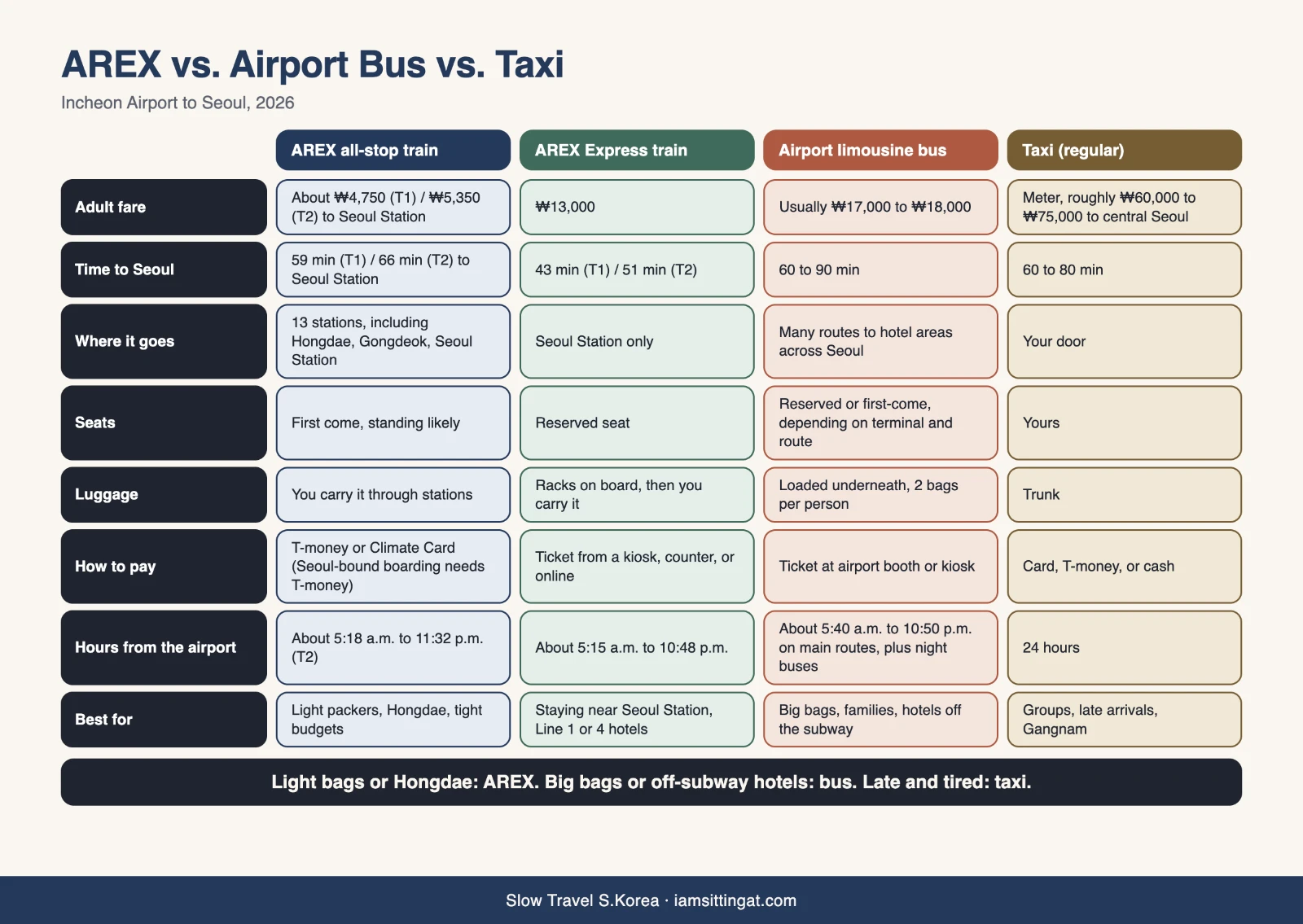
Times and fares come from AREX and the bus operators’ published information as of October 2026. Check before you fly, because schedules shift.
AREX Express vs All-Stop: Two Very Different Trains
AREX is the Airport Railroad, and it runs two kinds of trains on the same tracks. People mix them up all the time, partly because the signs at the airport point to “AREX” for both. The difference matters more than the name suggests, so here is the AREX Express vs All-Stop comparison in plain terms.
The all-stop train: a subway with a long first leg
The all-stop train is a commuter train. It’s part of the Seoul area’s subway network, so you tap a T-money card at the gate, same as any subway ride, and you can transfer to other lines at stations like Hongik University (Line 2), Gongdeok (Lines 5 and 6), and Seoul Station (Lines 1 and 4). The fare follows distance, which is why it’s so cheap.
The trade-off is comfort. The seats are side benches, and after the train passes Gimpo Airport, commuters pack in. If you board at the airport, you’ll usually get a seat. You’ll also be guarding your suitcase from people trying to get past it.
If you don’t have a T-money card yet, the convenience stores near the AREX station sell them. I explain how to buy and load one in my T-money card guide.
One more thing for Climate Card users: Seoul’s unlimited pass lets you ride the all-stop train from a Seoul station and tap out at Incheon Airport Terminal 1 or 2. It doesn’t work in the other direction, so you can’t board at the airport with it on arrival day.
The Express: nonstop to Seoul Station, with a seat
The Express is a separate train with forward-facing reserved seats and luggage racks. It makes no stops between the airport and Seoul Station. You need a ticket for a specific departure, and T-money won’t open its gates.
Here’s what to know:
- Fare: ₩13,000 for adults and ₩9,500 for children.
- Frequency: every 30 to 40 minutes, so you might wait at the platform for a while.
- From the airport: the first train leaves Terminal 2 around 5:15 a.m. and Terminal 1 around 5:23 a.m. The last ones leave around 10:40 p.m. and 10:48 p.m.
- Buying tickets: at the orange Express kiosks and counters in the airport’s transportation center, or online in advance. You can change your departure up to three times until five minutes before the train leaves. Refund fees run from ₩1,000 to ₩3,200 depending on timing.
- Discounts: travel booking sites often sell Express tickets below the counter price, and you swap the voucher for a ticket at a kiosk. [AFFILIATE: AREX Express train ticket]
Which train should you take?
Take the Express if your hotel is near Seoul Station or one easy stop away on Line 1 or 4, like Myeongdong or Hoehyeon. Take the all-stop if you’re going to Hongdae, Yeonnam-dong, Mangwon, or Gongdeok, since the Express skips those stations entirely. Riding the Express to Seoul Station and backtracking to Hongdae wastes time and money.
Coming from New York, it helps to think of the Express like the LIRR and the all-stop like the subway. Both run toward the city. One is built for comfort and the other for coverage.
The Airport Limousine Bus: Slower, but It Brings You Closer
In Korea, “limousine bus” just means a comfortable coach with big seats and space for luggage underneath. Plenty of Korean families heading to or from the airport take one, because it removes the hardest part of airport travel: dragging bags up and down subway stairs. Many Seoul stations do have elevators, but finding the right exit with luggage at the end of a long flight can take longer than the ride itself.
The bus stops sit outside the arrivals hall on the first floor, each marked with route numbers. Some routes that visitors use often, run by Airport Limousine:
- 6001: Dongdaemun, Myeongdong, Seoul Station, Sinyongsan
- 6002: Cheongnyangni, Dongdaemun, Jongno, Sinchon, Hapjeong
- 6005: Gwanghwamun, City Hall, Hongje, Digital Media City
- 6007: Yeouido IFC, Yeongdeungpo, Dangsan
- 6015: Myeongdong area
Other companies run routes to Gangnam, Jamsil, and other parts of the city. Search the Incheon Airport website’s bus finder by your hotel’s area before you land.
How buying a ticket works
At Terminal 2, buy a ticket for every route at the ticket booth or kiosk before boarding. At Terminal 1, ticket holders board first. On routes 6001, 6002, and 6015, Terminal 1 boarding is first come, first served, and you can pay with T-money or cash too.
Fares run about ₩17,000 for most Seoul routes, ₩16,000 on routes that go through Gimpo Airport, and ₩18,000 on some other operators’ routes. Children pay less.
Luggage rules
Each passenger can bring two bags. Each one should be under 28 inches and under 20 kg (about 44 pounds), with one oversized bag allowed per person. Extra pieces cost ₩8,000 each. Your carry-on backpack counts toward the limit.
Going back to the airport by bus
From Seoul to the airport, you pay when you board, and the major operator takes only cash or a transit card like T-money. Credit cards and the Climate Card don’t work for the fare. Tell the driver whether you’re going to Terminal 1 or 2 when you load your bags.
Pick by Neighborhood: The Short Version
This is where the AREX vs airport bus decision actually gets made. Find your hotel’s area:
| Where you’re staying | My pick | Why |
|---|---|---|
| Seoul Station, Namdaemun | AREX Express | Nonstop, seat, you arrive at your stop |
| Myeongdong, Euljiro | Bus 6001 or 6015 with bags; Express plus Line 4 if light | The bus stops close to many hotels |
| Hongdae, Yeonnam, Mangwon, Hapjeong | AREX all-stop | Direct to Hongik University, no transfer |
| Gongdeok, Mapo | AREX all-stop | Direct to Gongdeok |
| Gwanghwamun, City Hall, Seochon | Bus 6005 | Avoids two transfers with luggage |
| Jongno, Insadong, Dongdaemun | Bus 6002 or 6001 | Stops in the area |
| Yongsan | Bus 6001 (Sinyongsan) | Direct |
| Yeouido | Bus 6007 | Direct |
| Gangnam, COEX, Jamsil | Airport bus or taxi | Long subway trip with several transfers |
If you’re choosing a hotel and haven’t booked yet, this table is worth a look before you do. A quiet area that’s an easy airport ride can make the first and last day of a trip much calmer. [AFFILIATE: Seoul hotel booking]
Landing Late at Night
Some flights from the U.S. land late in the evening, and delays at immigration or baggage claim can push you past the last train. Here’s the timing to keep in mind:
- Last Express trains: around 10:40 p.m. (Terminal 2) and 10:48 p.m. (Terminal 1).
- Last all-stop train to Seoul Station: around 11:32 p.m. from Terminal 2. A few later trains run only partway into the city.
- Night buses: after the trains stop, late-night routes like N6000 (Express Bus Terminal area) and N6001 (Seoul Station, Sinyongsan) run from the airport, with fares around ₩17,000 to ₩18,000. They run only a few times a night, so check the schedule first.
- Taxis: always there, but late-night surcharges apply (see below).
My advice: if your flight is scheduled to land after about 9:30 p.m., don’t plan on the train. Look up the night bus that serves your area, and keep a taxi as backup.
When a Taxi Makes Sense
Coming from New York, where a JFK cab ride is a flat fare plus tolls, surcharges, and a tip, Seoul’s airport taxis can feel reasonable, especially for two or three people. Korean taxis use the meter, and you don’t tip. I wrote about why in Tipping in Korea.
A few things to know:
- Use the official taxi stands outside arrivals. The airport warns about people offering rides inside the terminal, often in unofficial call vans.
- The fare is the meter plus tolls. The bridge toll into Seoul is ₩3,200 on the Airport Expressway, after a cut in 2023. Regular Seoul taxis don’t add an out-of-city surcharge for trips from the airport into Seoul.
- Night surcharges add 20% from 10 to 11 p.m. and 2 to 4 a.m., and 40% from 11 p.m. to 2 a.m.
- International Taxi has its own stand (4C at Terminal 1, 3C at Terminal 2), with drivers who speak English and zone-based fares within Seoul.
- Calling one by app can show you an estimated fare upfront. See my guide to Kakao T for foreigners.
Going Back: The Seoul Station City Airport Terminal
This is the best reason to buy an Express ticket on your way out, even if you used the bus coming in.
On the second basement level of the AREX section at Seoul Station, you can check in, drop your bags, and clear immigration before you ever get on the train. At the airport, you skip the check-in lines and use a separate departure entrance for City Airport Terminal passengers. It reopened after a renovation in summer 2026, with numbered queue tickets and a larger waiting area.
The rules:
- You need an Express ticket for the same day.
- It’s for same-day international flights from Incheon.
- Check-in runs from 5:20 a.m. to 7 p.m. and closes three hours before departure for Terminal 1 flights and three hours and 20 minutes before for Terminal 2.
- Only some airlines take part, mainly Korean carriers like Korean Air, Asiana, Jeju Air, Jin Air, and T’way, and some routes are excluded.
If you’re flying Korean Air or Asiana back to New York, confirm your flight is eligible before you count on it.
Reality Check: What Can Go Wrong
- AREX staff are in a labor dispute. The railroad’s union began a work-to-rule action on October 12, 2026, and AREX says it is monitoring for delays. Check AREX’s website or station announcements around your travel dates.
- The Express goes to one place. If Seoul Station isn’t close to your hotel, the time you save on the train disappears on the transfer.
- The all-stop train gets crowded. During weekday rush hours, the ride from Gimpo Airport to Seoul Station is packed, and big suitcases make it worse.
- Buses depend on traffic. A Friday evening or holiday weekend can turn a 60-minute ride into 90 or more.
- Payment is still Korean-first. T-money handles the all-stop train and buses back to the airport, but not the Express. Foreign credit cards can be hit or miss at kiosks. Carry some won and a card with no foreign transaction fees. [AFFILIATE: no-foreign-transaction-fee credit card]
- You’ll want data before you walk out. Bus stops, transfers, and taxi apps all go easier with a map open. Set up your eSIM before you leave New York. [AFFILIATE: Korea eSIM]
- Terminal mix-ups happen. Terminals 1 and 2 are far apart. Check which one your airline uses before you buy any ticket or tell a driver where to go.
My Arrival-Day Checklist
- ☐ Check your arrival terminal (T1 or T2) and departure terminal
- ☐ Look up your hotel’s area in the table above
- ☐ Have an eSIM working or plan to connect to airport Wi-Fi
- ☐ Get some won at the airport, and buy and load a T-money card
- ☐ If taking the Express, buy a ticket in advance or at the orange kiosks
- ☐ If taking the bus, buy a ticket at the booth before you queue (required at T2)
- ☐ Landing after 9:30 p.m.? Look up your night bus and save the taxi stand number
- ☐ For your flight home, check whether your airline uses the Seoul Station City Airport Terminal
FAQ
Is AREX or the airport bus better for first-time visitors?
It depends on your hotel. AREX is cheaper and more predictable on time, and it’s the better choice for Hongdae, Gongdeok, and Seoul Station. The airport bus costs more but brings you closer to hotels in Myeongdong, Gwanghwamun, Jongno, and Yeouido without carrying bags through subway stations.
Can I use T-money on the AREX Express train?
No. The Express needs a ticket for a specific departure, bought at a kiosk, a counter, or online. T-money works on the all-stop train and as payment on many airport buses going to the airport.
How much does the AREX Express cost in 2026?
The adult fare is ₩13,000, and children pay ₩9,500. It runs nonstop between Seoul Station and Incheon Airport in 43 minutes to Terminal 1 and 51 minutes to Terminal 2. Booking sites often sell it for less.
What time does the last AREX train leave Incheon Airport?
The last Express trains leave around 10:40 p.m. from Terminal 2 and 10:48 p.m. from Terminal 1. The last all-stop train to Seoul Station leaves Terminal 2 around 11:32 p.m. Check AREX’s website for the current schedule.
Do airport buses in Seoul take credit cards?
On the way into Seoul, you usually buy a ticket at an airport booth or kiosk. On the way back to the airport, the major operator takes only cash or a transit card like T-money on board. Credit cards and the Climate Card aren’t accepted for the fare.
The Bottom Line
The AREX vs airport bus decision comes down to one question: where are you sleeping tonight? Near Seoul Station, take the Express. In Hongdae or Gongdeok, take the all-stop train. Anywhere else with real luggage, look for the limousine bus that stops near your hotel, and buy the ticket before you get in line. Save the Express for the trip home, when checking in at Seoul Station can make your last morning in Korea a slow one.