Last updated: October 25, 2026
Westbound, New York to Seoul is close to 16 hours in the air. That is a full workday and a night’s sleep, folded into one seat. It’s also why so many people who never cared about miles start reading about them the moment they book a trip to Korea. A lie-flat seat turns a brutal day into a manageable one, and paying cash for it on a new route like United’s Newark–Seoul flight can run close to $10,000 round trip.
This guide is about flying business class to Seoul with points from the New York area. It covers which programs actually work for New York to Seoul award flights in 2026, what each one charges, and what changes on December 17, 2026, when Asiana disappears into Korean Air.
Quick Answer: Business Class to Seoul with Points
- Cheapest by miles: Korean Air’s own SKYPASS program. A one-way Prestige (business) seat between the US and Korea is 62,500 miles off-peak and 92,500 at peak.
- The catch: SKYPASS has no credit card transfer partners. You earn it by flying or with a U.S. Bank SKYPASS card, and you can only book for yourself and registered family members.
- If you have Amex, Chase, Citi, or Bilt points: look at Virgin Atlantic Flying Club or Air France-KLM Flying Blue to book Korean Air seats. Check that a seat is available before you transfer.
- New option: United has flown Newark–Seoul nonstop daily since September 4, 2026, with 48 Polaris business seats. Award prices have been high so far.
- Delta: no nonstop from New York, and Delta One award prices to Seoul often run well into six figures one way.
- Asiana miles: they move into your Korean Air account on December 17, 2026, and stay usable for 10 years. Flight-earned miles convert 1:1; credit-card-earned miles convert at 1:0.82.
- Book early: Korean Air opens award seats 361 days before departure.
What Changed in 2026 (and Why Older Guides Are Wrong)
If you read a points guide to Korea from a year or two ago, a lot of it no longer applies.
1. Asiana is leaving Star Alliance and merging into Korean Air. Asiana officially leaves Star Alliance at 11:59 p.m. Korea time on December 16, 2026, and the combined Korean Air launches the next day. Using Asiana miles on Star Alliance partners was being phased out airline by airline. Bookings on United, Air Canada, and Singapore Airlines with Asiana miles run through December 16, while Lufthansa, Swiss, and Austrian ended October 31.
2. Korea’s Fair Trade Commission approved the mileage merger plan in September. The approval came on September 14 and was announced September 15. I’ll cover the details in the Asiana section below, because if your parents are anything like mine, someone in your family has a pile of Asiana miles.
3. United now flies Newark to Seoul. Before September, the New York area had only Korean Air and Asiana nonstop from JFK and Air Premia from Newark. United is the first US airline flying the New York–Seoul market nonstop.
4. SKYPASS lost partners. Marriott Bonvoy points stopped converting to SKYPASS in June 2024, and Chase dropped Korean Air back in 2018. In 2026, Korean Air also stopped letting members earn miles on Alaska and Hawaiian flights and cut back award bookings on them.
Who Flies Nonstop Between New York and Seoul
Before you pick a program, know which seats you are trying to get. Here’s the nonstop picture as of late October 2026.
| Airline | Route | Frequency | Business class | Alliance after Dec 17, 2026 |
|---|---|---|---|---|
| Korean Air | JFK–ICN | Twice daily | Lie-flat Prestige seats (product varies by aircraft) | SkyTeam |
| Asiana | JFK–ICN | Twice daily until the merger | Lie-flat business | Becomes part of Korean Air (SkyTeam) |
| United | EWR–ICN | Daily since Sept 4, 2026 | 48 Polaris seats on a Boeing 787-9 | Star Alliance |
| Air Premia | EWR–ICN | Daily | No lie-flat business; premium economy only | None |
Delta doesn’t fly New York to Seoul nonstop. You’d connect through a hub like Detroit, Atlanta, or Minneapolis. That matters more than it sounds: a connection adds hours, and a domestic first class seat is not the same as a lie-flat bed.
Korean Air’s product depends on the plane. Its newer cabins have doors and direct aisle access, while some older configurations don’t. Check the seat map for your specific flight number before you burn miles.
Ways to Book New York to Seoul Award Flights, Compared
This is the core of it. Here’s what each realistic program charges for one-way business class between New York and Seoul.
| Program | Flies you on | One-way business, NYC–Seoul | How you get the points | Main drawback |
|---|---|---|---|---|
| Korean Air SKYPASS | Korean Air | 62,500 off-peak / 92,500 peak | Flying, U.S. Bank SKYPASS cards | No transfer partners; family-only bookings |
| Virgin Atlantic Flying Club | Korean Air | About 100,000 (6,001–7,000 mile band) | Transfers from Amex, Chase, Citi, Bilt | Limited partner seat release |
| Air France-KLM Flying Blue | Korean Air | Dynamic; varies widely | Transfers from all major US programs | Price swings and blackout dates on Korean Air |
| Delta SkyMiles | Delta (with connection) or Korean Air | Dynamic; often 130,000+ and sometimes far more | Amex transfers, Delta cards | Expensive; no NYC nonstop on Delta |
| United MileagePlus | United Polaris, EWR–ICN | 250,000 seen at launch; dynamic | Chase transfers, United cards | Saver seats are scarce and often go to cardholders first |
| Asiana Club (existing balances) | Korean Air, from Dec 17 | Asiana’s own chart | Miles you already have | No new earning after the merger |
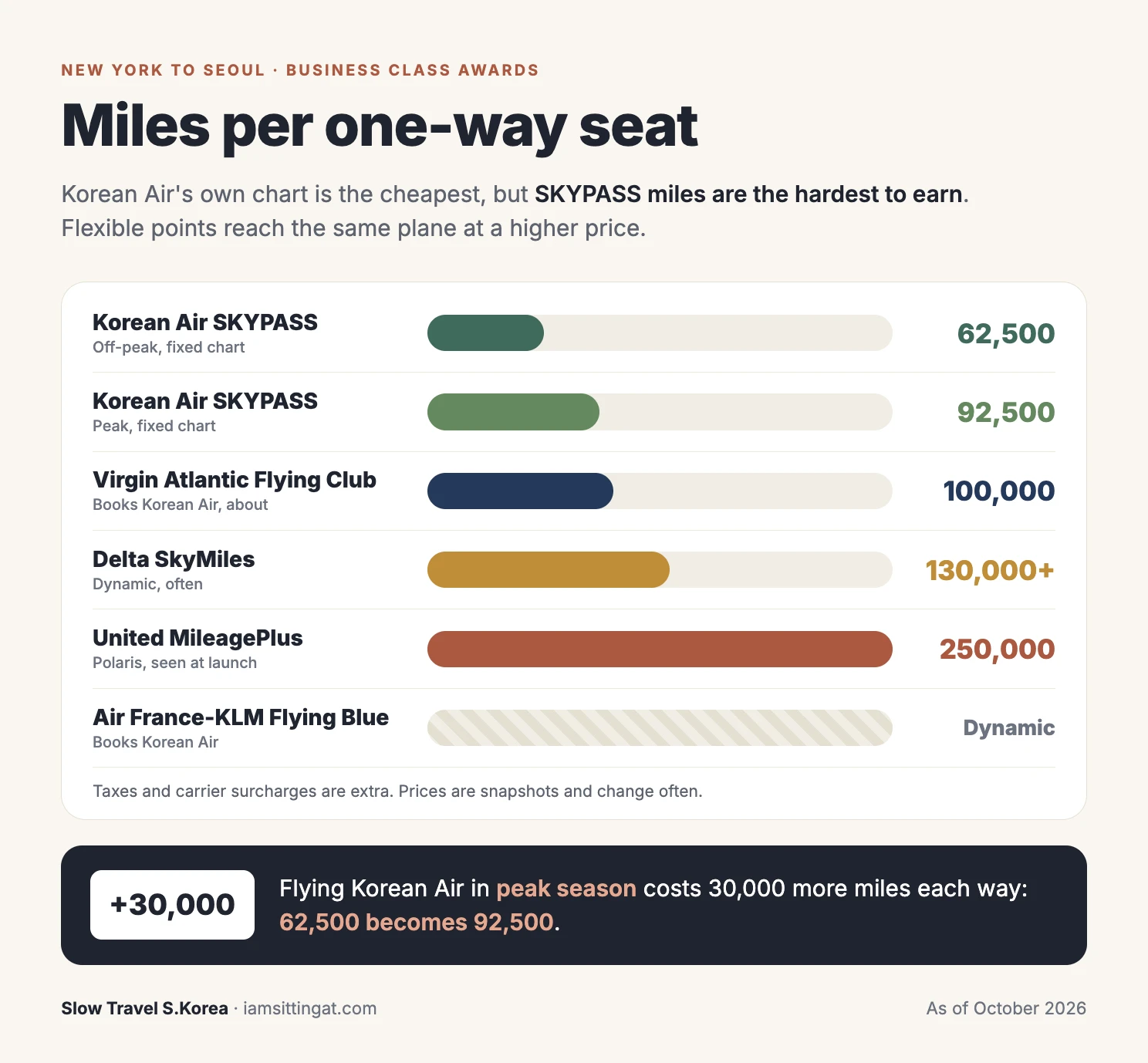
Taxes and carrier surcharges come on top of every row. More on that in the Reality Check.
Korean Air SKYPASS: The Best Price, the Hardest Miles
If your goal is the lowest number of miles for business class to Seoul with points, SKYPASS wins. Korean Air still prices its own flights on a fixed chart, not by demand. Here’s the US–Korea chart, one way.
| Season | Economy | Prestige (business) | First |
|---|---|---|---|
| Off-peak | 35,000 | 62,500 | 80,000 |
| Peak | 52,500 | 92,500 | 120,000 |
Peak dates are set by the boarding date of each flight segment, and Korean Air uses a separate peak calendar for flights leaving the Americas. For 2027, a SkyTeam partner’s published blackout calendar for Korean Air awards lists these peak windows for flights departing the US: February 12–13, May 7–8, May 13 to June 26, July 30–31, August 6–7, September 17–18, and December 9–25.
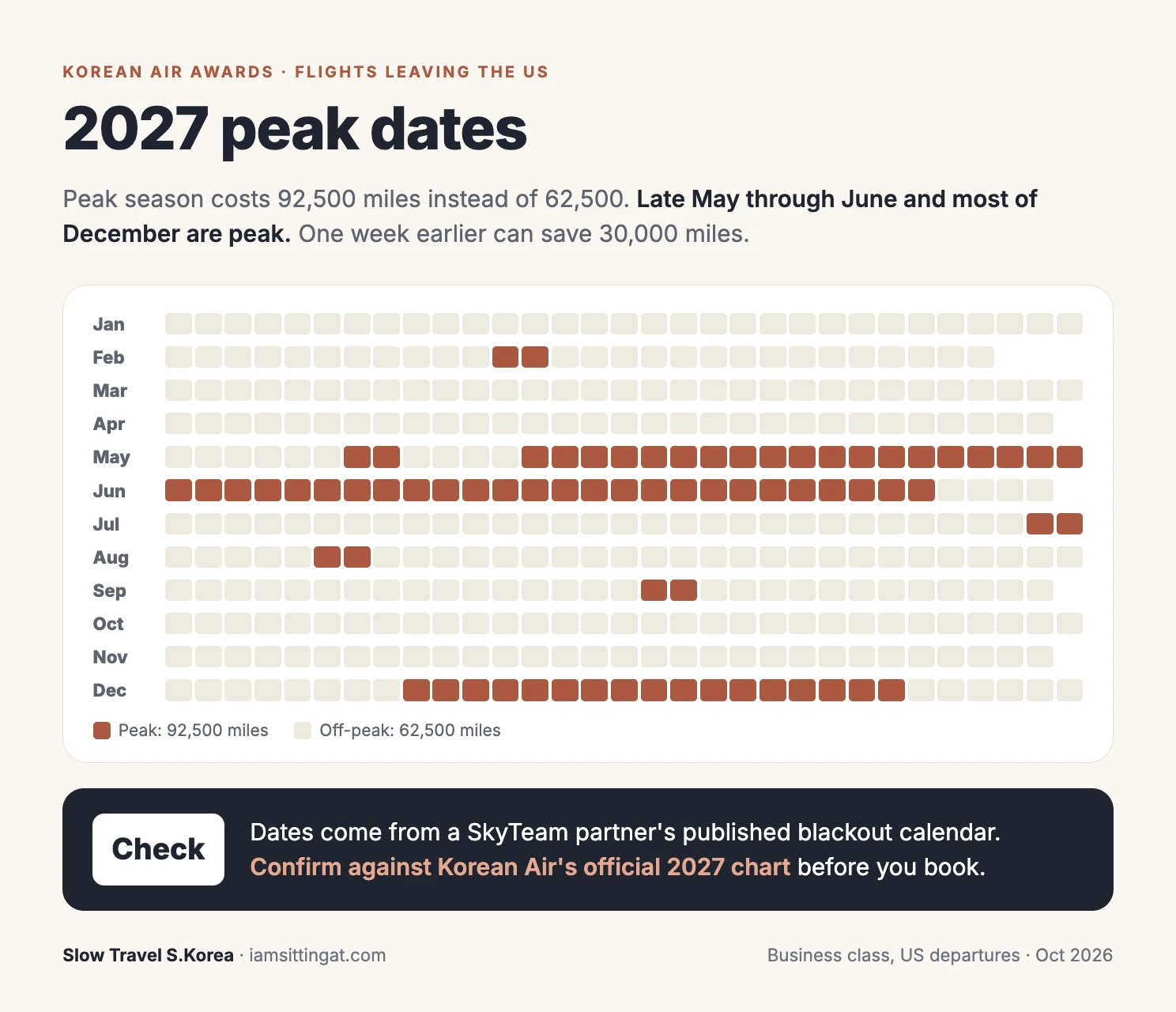
Notice what’s on that list. Late May through June and most of December are peak from the US side. Those are exactly when a lot of Korean Americans fly home, for summer breaks and for year-end family gatherings. If your dates are flexible, shifting an outbound flight by a week can save you 30,000 miles.
Earning SKYPASS miles from the US
Your realistic options:
- Fly Korean Air or Delta and credit the flights to SKYPASS.
- U.S. Bank SKYPASS cards. Korean Air lists three: the SKYPASS Select Visa Signature ($450 annual fee, 60,000 bonus miles after $5,000 in 90 days), the SKYPASS Visa Signature ($99, 40,000 miles after $4,000), and the no-fee SKYBLUE card (10,000 miles after $1,000). [AFFILIATE: SKYPASS credit card]
That’s it. No Amex, no Chase, no Citi, no Marriott. For most Americans, this is the dealbreaker. Collecting 125,000 miles for a round trip on one card takes a long time.
The family-only rule
SKYPASS miles can only pay for tickets for you and family members you’ve registered. That covers a spouse, parents and parents-in-law, children, siblings, grandparents, grandchildren, and sons- and daughters-in-law. You register them in your account and upload documents proving the relationship.
For Americans this rule often comes as a surprise. US programs let you book for anyone. From a Korean point of view, I think it makes more sense: miles in Korea are treated a bit like a household asset, the way some families share one bank account. Korean Air’s rule follows that idea, and it also makes it harder for people to sell miles to strangers. If you plan to fly your parents over on your miles someday, register them now. Gathering documents from two countries takes longer than you expect.
How to book
- Log in at koreanair.com and choose a mileage booking.
- Search JFK to ICN and select Prestige class. Search one way at a time; you can book Korean Air flights one way.
- Award seats open 361 days before departure. Award tickets are valid for one year from the date you book them.
Korean Air partner awards booked with SKYPASS, such as Delta, must be round trip. One-way pricing applies only to Korean Air’s own flights.
Using Amex, Chase, Citi, or Bilt Points
Most readers of this blog have flexible credit card points, not SKYPASS miles. You can still reach a Korean Air business seat through two SkyTeam partners.
Virgin Atlantic Flying Club uses a distance chart for Korean Air. New York to Seoul falls in the 6,001–7,000 mile band, which runs about 100,000 points one way in business, if Korean Air releases the seat to partners. That’s 37,500 more than SKYPASS charges, but you can actually earn Virgin points: Amex, Chase, Citi, and Bilt transfer to Flying Club.
Flying Blue prices Korean Air awards dynamically. Sometimes it’s competitive. Sometimes it’s absurd. One Paris–Seoul month of searches for January 2027 ranged from 85,000 to over 600,000 miles one way. Flying Blue also lists blackout dates for Korean Air.
The golden rule with both: find the seat first, then transfer. Points transfers can’t be reversed. Use the partner’s own website or an award search tool to confirm availability before you move a single point. [AFFILIATE: award search tool]
If you’re building toward this, a card that earns transferable points does double duty in Korea, because many of them also have no foreign transaction fees. I compare those in Best Credit Cards to Use in South Korea. [AFFILIATE: transferable points credit card]
United’s Newark–Seoul Flight: Worth Watching
For Star Alliance flyers, United’s new route is the bigger story. It’s a daily Boeing 787-9 out of Newark, leaving mid-morning and landing at Incheon the next afternoon.
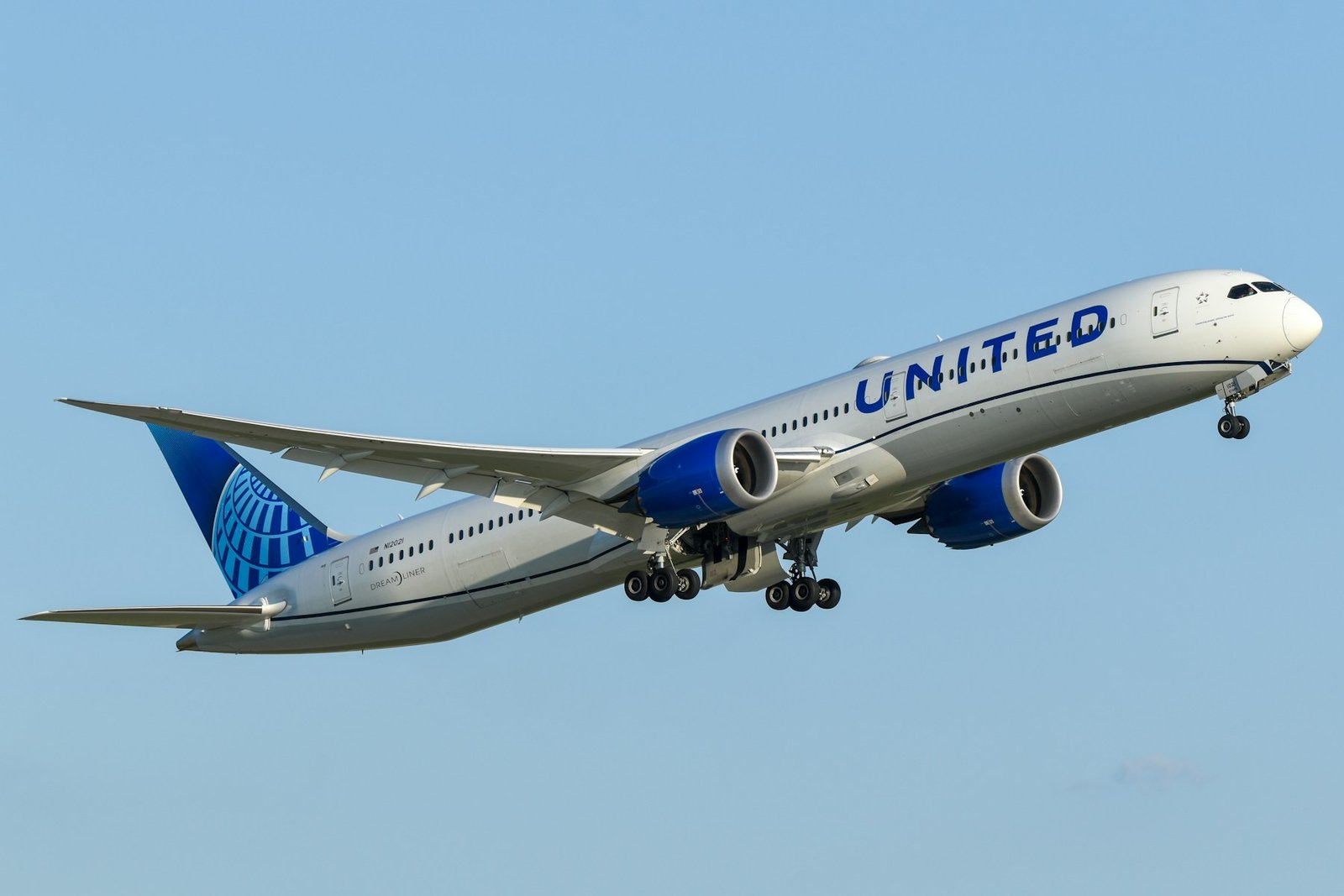
Award pricing so far has been steep. MileagePlus was charging 250,000 miles one way in Polaris around launch, and United prices dynamically. United has also been steering its cheapest business award seats toward its own cardholders. Partner programs that book United, like Air Canada Aeroplan, can only see saver seats United chooses to release.
My take: treat it as an option to check, not a plan. New routes sometimes open award space in waves, especially in quieter months.
If You (or Your Parents) Have Asiana Miles
This section is for the many Korean American families sitting on Asiana Club balances. Here’s what the approved plan says.
- On December 17, 2026, Asiana miles move automatically into a Korean Air SKYPASS account as a separate “Asiana miles” balance.
- You don’t have to convert. For 10 years, you can spend Asiana miles on Korean Air flights using Asiana’s old award chart, as it stood at the end of 2024. Korean Air first class isn’t included.
- If you convert, miles from flying convert 1:1, and miles from credit cards and other partners convert at 1:0.82. Conversion is all or nothing.
- After 10 years, whatever is left converts automatically.
- Seat supply: Korean Air committed to keeping long-haul award seats to the Americas, Europe, and Oceania at or above the best level of the past decade.
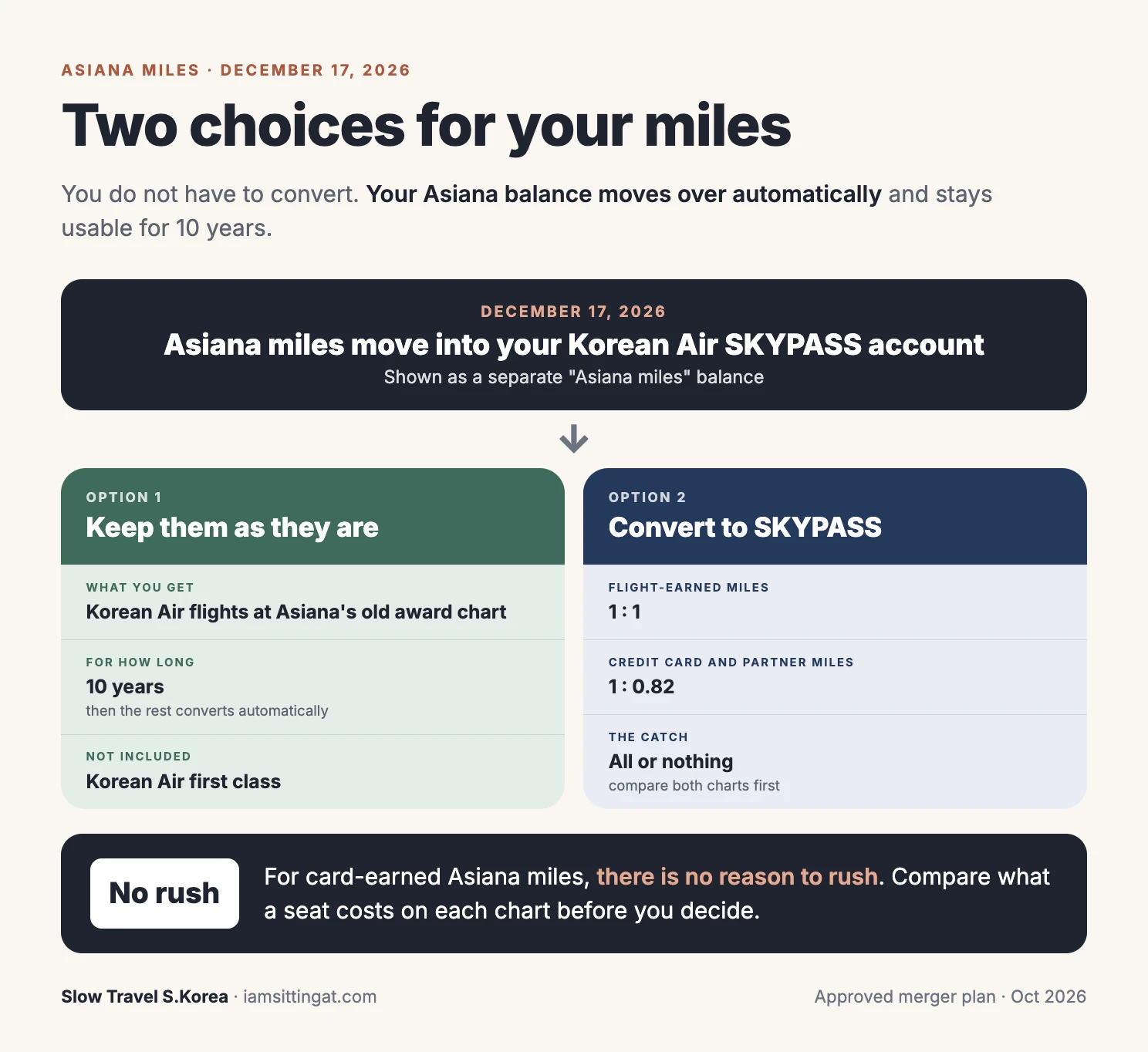
Why the two rates? In Korea, credit cards that earn airline miles directly are a mainstream product, so a lot of Asiana balances came from everyday card spending rather than flying. The approved plan keeps the 0.82 rate on those partner miles, but the 10-year option means nobody is forced to take that haircut.
For most people holding card-earned Asiana miles, there’s no reason to rush a conversion. Compare what a seat costs on Asiana’s chart versus SKYPASS’s chart before deciding.
The family rule applies here too. Asiana miles have also been limited to the member and registered family, so if your parents want to use their miles for you, they’ll need you registered.
Is It Worth It? A Quick Math Check
A simple way to judge any award: divide the cash price you’d otherwise pay (minus the taxes and fees you still pay on the award) by the miles. Here’s a made-up example to show the math, not a real fare:
- Cash one-way business: $4,000
- Award: 62,500 SKYPASS miles plus $250 in taxes and surcharges
- Value: ($4,000 − $250) ÷ 62,500 = 6 cents per mile
Most points sites value SKYPASS miles around 1.5 to 1.6 cents each, so anything far above that is a good use. Do the same math with a real cash fare for your dates.
Reality Check: What Can Go Wrong
- Surcharges add up. Korean Air adds carrier-imposed surcharges to award tickets on top of government taxes, and the amount moves with fuel prices. Expect a few hundred dollars round trip, not just the small government taxes you might be used to on domestic awards.
- Earning SKYPASS is slow. Without transfer partners, you’re relying on one card and actual flying.
- Partner seats are scarce. Korean Air is known for releasing more business seats to its own members than to partners. Virgin or Flying Blue may show nothing on the dates you want.
- Peak dates cost 50% more on Korean Air’s chart, and they overlap with the most popular weeks for family visits.
- Merger week could be messy. Any time two airlines merge their systems and loyalty programs, there’s a risk of glitches. I’d avoid booking anything complicated right around December 17, and screenshot your Asiana balance before then.
- Dynamic pricing changes overnight. Every Delta, United, and Flying Blue price in this guide is a snapshot, not a promise.
- Change and refund fees exist. Korean Air charges fees for changes and refunds on award tickets, and the award ticket expires one year after issue.
After You Land
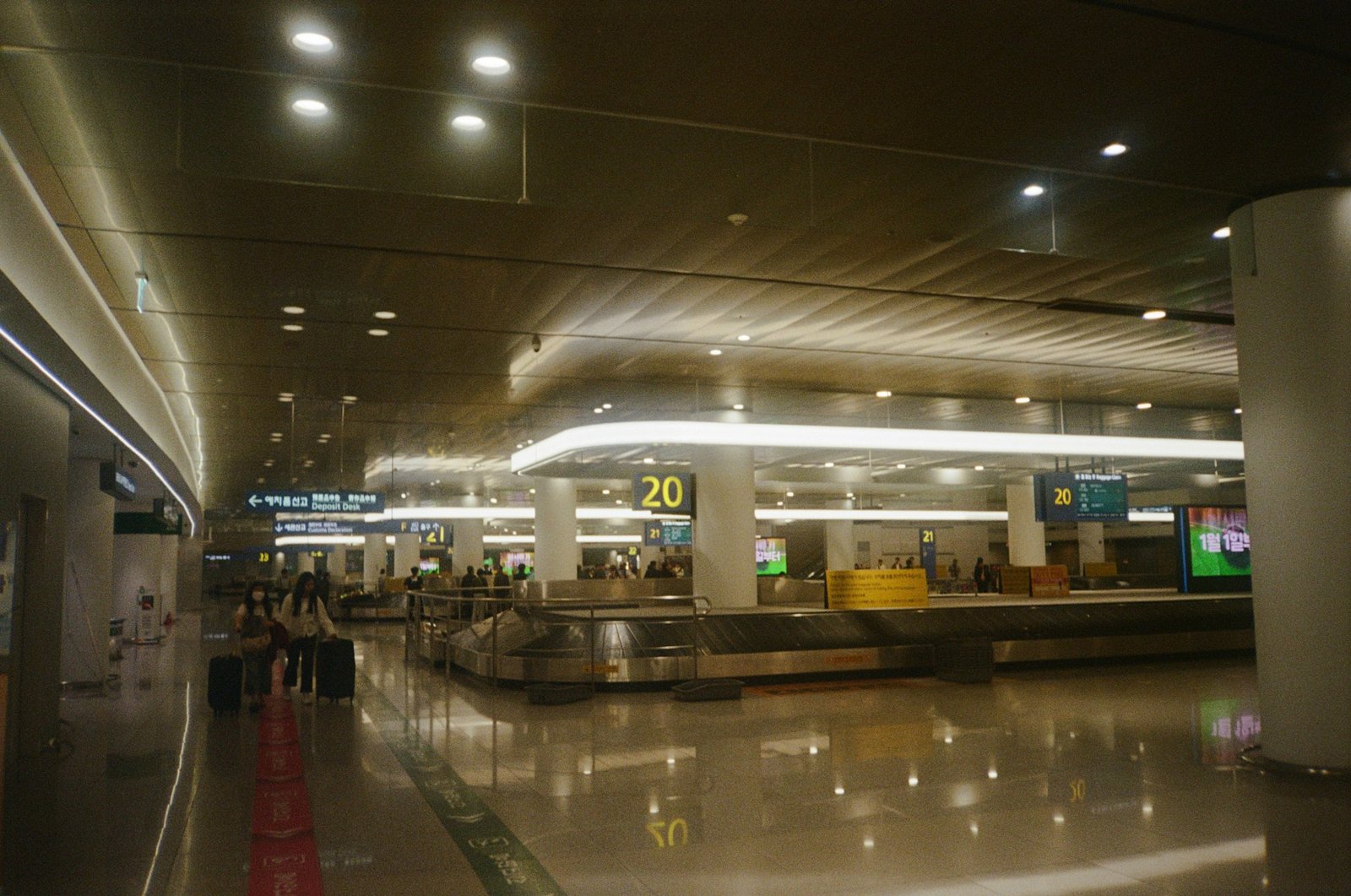
Fourteen to sixteen hours later, you’re at Incheon. Korean Air uses Terminal 2. Before you go, make sure your entry paperwork is sorted; the K-ETA exemption for US citizens currently runs through December 31, 2026, and I track what happens next in K-ETA and e-Arrival Card for U.S. Citizens.
From the airport, the AREX train or a limousine bus gets you into the city, and I compare them in AREX vs Airport Limousine Bus. Get your phone working before you leave the gate with an eSIM: Best eSIM for Korea. [AFFILIATE: Korea eSIM] And since award tickets come with limited protection, it’s worth reading Travel Insurance for South Korea before you go. [AFFILIATE: travel insurance]
Going the other way? My sister site covers that direction in Business Class to NYC With Points.
FAQ
What is the cheapest way to fly business class to Seoul with points?
Korean Air SKYPASS, at 62,500 miles one way off-peak between the US and Korea. The tradeoff is that SKYPASS miles are hard to earn in the US and can only be used for you and registered family members.
Can I transfer Amex or Chase points to Korean Air?
No. Korean Air SKYPASS has no credit card transfer partners. You can transfer Amex, Chase, Citi, or Bilt points to Virgin Atlantic Flying Club or Air France-KLM Flying Blue and use those to book Korean Air flights, usually at a higher price.
What happens to my Asiana miles after the merger?
On December 17, 2026, they move into a Korean Air SKYPASS account as a separate balance. You can use them on Korean Air flights at Asiana’s old prices for 10 years, or convert them to SKYPASS miles at 1:1 for flight-earned miles and 1:0.82 for card and partner miles.
Can I use Korean Air miles to book a flight for a friend?
No. SKYPASS awards are limited to the member and registered immediate family, such as a spouse, parents, children, siblings, and in-laws. You need to register family members with supporting documents first.
Is there a nonstop New York to Seoul flight on a US airline?
Yes. Since September 4, 2026, United has flown daily between Newark and Seoul Incheon on a Boeing 787-9 with Polaris business class. Delta and American don’t fly the route nonstop.
The Bottom Line
Flying business class to Seoul with points from New York comes down to one question: which points do you actually have? If you can build up SKYPASS miles, Korean Air’s fixed chart is still the best deal on the route, as long as you book early and avoid peak weeks. If your points live with Amex, Chase, Citi, or Bilt, Virgin and Flying Blue are your way onto the same plane, at a higher price and with less availability. And if your family has Asiana miles, don’t panic about December 17. You have 10 years, so take the time to compare before converting.
Sixteen hours is a long day either way. Spending it lying flat, and landing in Seoul ready to see people you love, is one of the few times I think the effort of chasing miles is clearly worth it.