Last updated: October 25, 2026
Stand at the counter of any cafe in Seoul for five minutes and count how many people pay with a phone. The person ahead of you holds up a barcode, the cashier scans it, and the line moves. A yellow QR stand sits next to the register. It’s natural to assume you should download the same app before your trip.
That’s why “Kakao Pay for foreigners” is one of the first things many Americans search when planning Korea. The short answer is less exciting than the search: for a US visitor with a US card, Kakao Pay mostly doesn’t work, and Naver Pay only works in narrow ways. This guide explains why, what changed in 2026, and the payment setup that actually gets you through a Korea trip without friction.
Quick Answer: Kakao Pay and Naver Pay for US Visitors
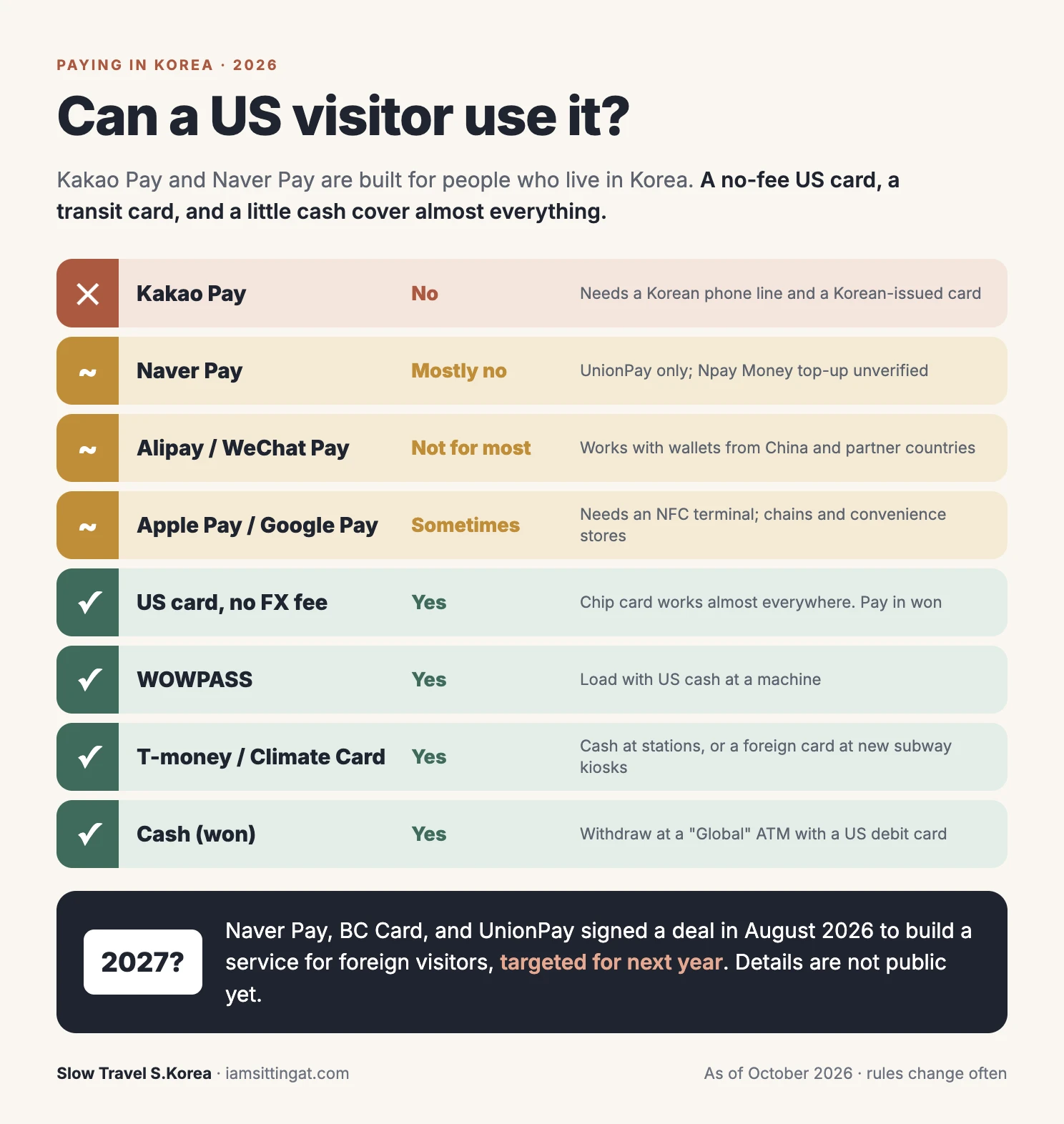
- Kakao Pay: You can’t add a US credit or debit card. Kakao Pay only accepts cards issued in Korea in your own name, and setup needs Korean identity verification.
- Naver Pay: Among foreign-issued cards, Naver Pay says only UnionPay works for direct payment. Visa, Mastercard, and Amex from US banks generally don’t.
- What’s new in 2026: Since June 4, 2026, Naver accepts passport verification, so you can book and order in Naver Map without a Korean number. That solves the ID problem, not the card problem.
- Who can pay “with Kakao Pay” in Korea: Visitors from China, Japan, Hong Kong, and parts of Southeast Asia, using their home wallets (Alipay, PayPay, AlipayHK, GCash, and others) at Kakao Pay and Zero Pay merchants.
- What Americans should use: a no-foreign-transaction-fee card, a prepaid travel card such as WOWPASS, a transit card, and a little cash.
Why Koreans Pay with Their Phones (and Why It’s Different from Apple Pay)
In New York, phone payment usually means tapping Apple Pay or Google Pay on a contactless reader. The phone is just a wrapper around your Visa card.
Korea took a different road. Kakao Pay and Naver Pay grew out of the two apps every Korean already has open all day: KakaoTalk, the messaging app, and Naver, the search portal. They started as checkout buttons for online shopping, then added barcodes and QR codes for stores. Many Korean terminals were built for card swipes and Samsung Pay’s magnetic signal rather than NFC taps, so a QR or barcode was the easiest way to bring phone payments to small shops.
The other piece is identity. Korean payment apps are regulated as electronic financial businesses, and they tie every account to a real-name Korean phone line and a Korean bank card. That’s normal to Koreans and invisible in daily life. For a visitor, it’s the wall. If you’ve read my guide to Korean phone number verification, this is the same wall, one level deeper: even when you pass the ID check, the app still wants a Korean card.
Kakao Pay for Foreigners: What Actually Works
Can you sign up and add a US card?
Not in a useful way. Kakao Pay’s help center lists the cards you can register as credit and debit cards issued in Korea in your own name. A Chase Sapphire or a Capital One card won’t register, and neither will a card from a US branch of a Korean bank. Setup also runs through phone-based identity verification tied to a Korean carrier, which a US number can’t pass.
KakaoTalk itself is a different story. The messaging app signs up fine with a US number, and you should still download it for messaging guesthouses and shops. Just don’t expect the Pay tab to work.
What about Kakao Pay’s “Global Home”?
You may see headlines saying Kakao Pay made things easier for foreigners. That’s true, but it’s for foreign residents. In November 2025, Kakao Pay launched a “Global Home” screen in English, Chinese, and Vietnamese, and in December it extended the translations to transfers and payments. Kakao Pay says about 740,000 foreigners living in Korea already use it. All of them have a Korean phone line, an alien registration card, and usually a Korean bank account. A tourist on a two-week trip has none of those.
Who can pay at Kakao Pay merchants?
This is the confusing part. You’ll see Kakao Pay logos on doors, and some of them really are for foreign visitors. Kakao Pay links overseas wallets to its Korean merchants through Alipay+, so a visitor from Shanghai can pay with Alipay, a visitor from Osaka with PayPay (added in September 2025), and a visitor from Manila with GCash. Kakao Pay says PayPay alone now works at more than 2 million Korean merchants.
None of the main partner wallets are American apps. PayPal, Venmo, and Cash App aren’t part of this network.
Naver Pay for Tourists: What Changed in 2026
Passport verification fixes the ID problem
On June 4, 2026, Naver started letting foreigners verify their identity with a passport on a smartphone. The process reads your passport, checks that it’s genuine, and matches your face to the photo. After that, Naver says you can use reservations, ordering, and payment in Naver Map without a Korean phone number.
That’s a real improvement, especially for restaurant and class bookings. I walk through the Naver Map side in How to Use Naver Map in English.
But the card rule hasn’t changed
Here’s the catch for Naver Pay for tourists. Naver Pay’s help center says that among foreign-issued cards, only UnionPay cards can be used for payment, and other foreign cards are difficult to use. Most Americans don’t carry UnionPay.
There’s one exception worth knowing. Naver Pay’s FAQ also says people living outside Korea can top up Npay Money with a foreign-issued credit card and pay from that balance. In theory, that’s a path for a US resident. In practice, I haven’t seen enough reports to tell you it works smoothly with US cards, or what fees your bank adds. Treat it as something to test at home before the trip, not a plan.
The Npay Connect terminal is the quiet win
You’ll see Naver’s own payment terminal, “Npay Connect,” on counters at more and more cafes and restaurants. Naver says more than 100,000 merchants used it by mid-2026, and it was built to take cash, cards, QR, and NFC on one device. In December 2025, the Korea Tourism Organization partnered with Naver Pay to spread these terminals at tourist spots and airports.
What this means for you: the terminal’s existence doesn’t require the Naver Pay app. Your physical US card or a contactless tap may go through on the same machine.
What’s coming in 2027
On August 25, 2026, Naver Pay, BC Card, and UnionPay signed an agreement to build a payment service for foreign visitors to Korea, with a launch target of next year. Details aren’t public yet. If it lets visitors fund Naver Pay with a Visa or Mastercard, this whole guide changes, and I’ll update it when it does.
Kakao Pay vs. Naver Pay vs. What Americans Can Actually Use
What About Alipay and WeChat Pay in Korea?
Alipay and WeChat Pay are everywhere in Korea’s tourist areas, which is why “Alipay in Korea” shows up so often in searches. In Seoul, Alipay+ partner wallets work in more than 70,000 taxis and on over 100 airport limousine buses, according to Alipay+. Since March 17, 2026, the new ticket kiosks on Seoul subway Lines 1 to 8 accept foreign cards and mobile wallets. In the first month, WeChat Pay averaged about 2,069 payments a day at those kiosks, more than three times the Korean wallets combined.
So can an American just download Alipay? Alipay’s international version lets you link a Visa or Mastercard, but Alipay says those foreign cards are for payments within mainland China. I wouldn’t count on it working in Seoul.
The useful takeaway from those subway numbers is the other one: Visa was the most-used payment at those kiosks, at about 3,788 transactions a day. Your plain US card is now a normal way to buy a Climate Card short-term pass or a single ticket. My T-money guide covers which kiosk to look for and the service fee.
The Setup I’d Use as a US Visitor
Korea is one of the easiest countries in Asia to travel with cards. You just don’t need Korea’s payment apps to get there. Here’s the simple stack:
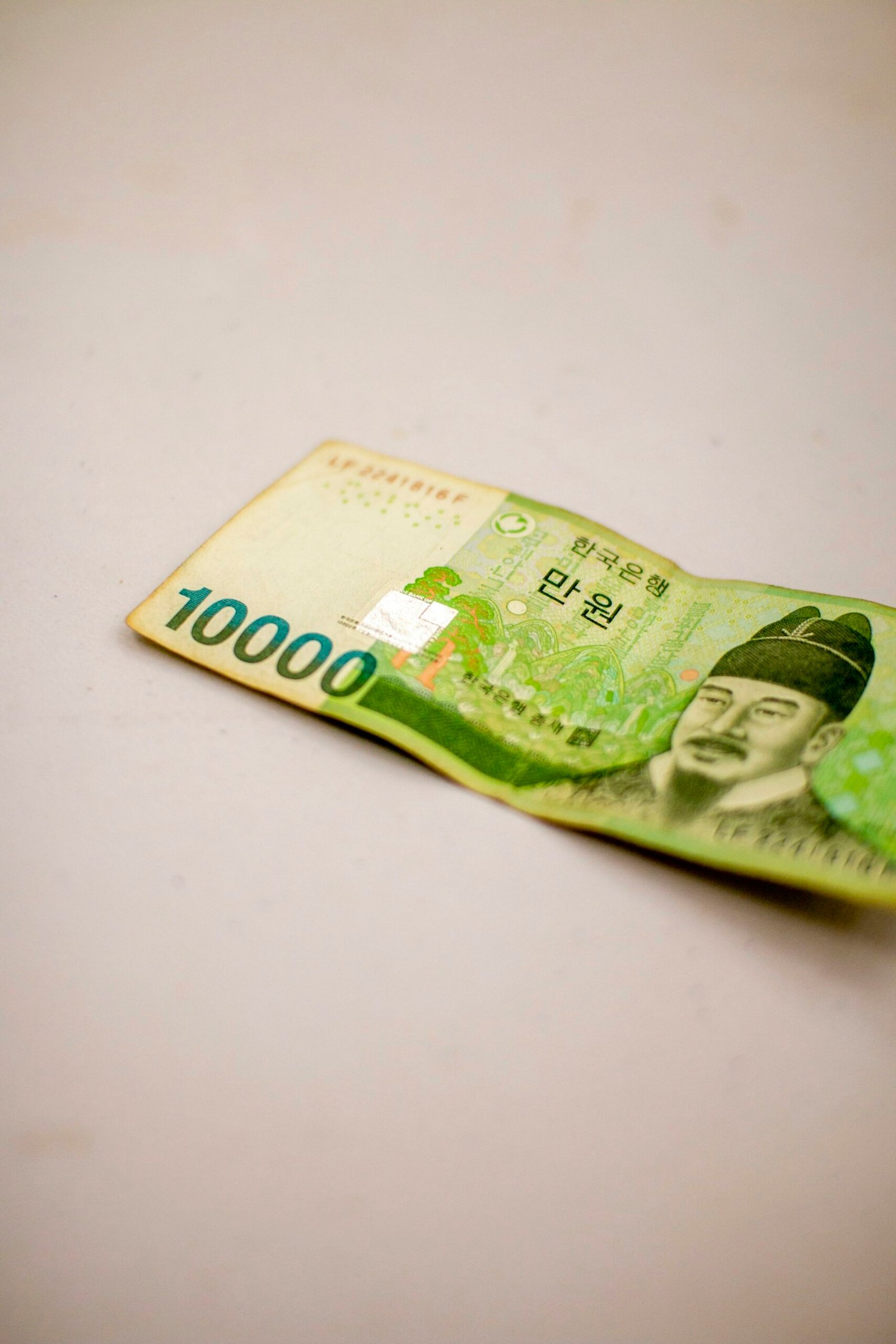
- A no-foreign-transaction-fee credit card for restaurants, cafes, shops, and hotels. Visa or Mastercard is safer than Amex at small places. Always pay in won, not dollars. [AFFILIATE: no foreign transaction fee credit card] Full details: Best Credit Cards to Use in South Korea.
- A prepaid travel card if you want a budget or a transit card in one. WOWPASS is the best known. [AFFILIATE: WOWPASS] My take on the exchange rate and fees: WOWPASS Review.
- A transit card (T-money or a Climate Card pass) for subways and buses.
- Some cash for markets, street food, and the occasional card-shy shop. See Where to Exchange Money in Seoul.
- App workarounds for the things Koreans do through Kakao: k.ride or Uber for taxis, Catchtable Global or Naver (with passport verification) for reservations.
- Mobile data so all of the above actually loads. [AFFILIATE: Korea eSIM] See Best eSIM for Korea.
Reality Check: Mobile Payment in Korea for Tourists
- The QR stand on the counter isn’t for you. Most are Kakao Pay, Naver Pay, or Zero Pay codes. Scanning one with your iPhone camera just opens a web page.
- Apple Pay is hit or miss. Korea added Apple Pay in 2023, but at launch fewer than 10% of card terminals supported NFC. Big chains and convenience stores are your best bet. Whether a US card in your wallet goes through depends on the terminal and your bank.
- “Easier for foreigners” headlines often mean residents. If an article mentions an alien registration card, it isn’t talking about you.
- Workarounds cost something. Prepaid cards have exchange-rate spreads, ATMs add operator fees, and the foreign-card subway kiosks add a service fee.
- Things move fast. Naver’s passport verification arrived in June 2026, and the Naver Pay–BC Card–UnionPay service is aimed at 2027. Check the date on any guide, including this one.
FAQ
Can foreigners use Kakao Pay in Korea?
Foreign residents can, if they have a Korean phone line and a Korean-issued card in their own name. Short-term visitors with US cards can’t register a card. Visitors from China, Japan, and parts of Asia can pay at Kakao Pay merchants with their home wallets through Alipay+.
Can I use Naver Pay with a US credit card?
Usually not. Naver Pay says only UnionPay works among foreign-issued cards. Its FAQ mentions that overseas residents can top up Npay Money with a foreign credit card, but test this before your trip rather than relying on it.
Do I need Kakao Pay or Naver Pay as a tourist in Korea?
No. A no-foreign-transaction-fee card, a transit card, and a small amount of cash cover nearly every situation. A prepaid card like WOWPASS fills most remaining gaps.
Can Americans use Alipay or WeChat Pay in Korea?
They work in Korea for wallets from China and partner countries. Alipay’s international version can link a US card, but Alipay describes that feature as being for payments in mainland China, so don’t plan your Korea trip around it.
Does Apple Pay work in Korea for tourists?
Sometimes. It needs an NFC terminal, which you’ll find mostly at chains, convenience stores, and department stores. Carry your physical card as the main plan.
The Bottom Line
Kakao Pay for foreigners is real, but it’s built for people who live in Korea. Naver Pay for tourists took a step forward with passport verification in 2026, and the 2027 plan with BC Card and UnionPay could be the change that finally opens these apps to visitors. Until then, the Korean way of paying with a phone is something you’ll watch at the cafe counter rather than join. Bring the right card, carry a little cash, and you won’t miss it.