Last updated: October 25, 2026
On October 16, 2026, one US dollar bought about 1,331 won at the Seoul market close. In June, the same dollar bought more than 1,500. That swing is a reminder that the exchange rate is mostly out of your hands. What you can control is how much of it you give away at the counter, and that depends on where you swap your cash.
So where’s the best place to exchange money in Seoul? For US dollars, it’s usually a licensed exchange shop in a busy area like Myeongdong, not the airport and not your bank back home. But for many Americans, the better question is whether you need to exchange cash at all, or whether a Korea ATM and a good debit card make more sense. This guide covers both.
Koreans pay for almost everything by card or phone, so cash has quietly become the backup in daily life there. Visitors still need some, though, and the gap between a good exchange and a bad one is bigger than most people expect.
Quick Answer: Where to Exchange Money in Seoul
- Best rate for US cash: licensed private exchange shops in Myeongdong, Hongdae, Dongdaemun, or Gangnam. On US dollars, the busiest shops often price within a fraction of a percent of the market rate.
- Bank counters, including at Incheon Airport: convenient and safe, but a walk-in customer usually pays the bank’s full cash spread. For US dollars, Korean banks build in about 1.75% on each side.
- Exchange only what you need at the airport. Enough for a transit card top-up and your first day, then exchange the rest in the city.
- ATMs: the easiest option if you don’t carry much cash. Look for “Global ATM” machines. Expect a Korean operator fee per withdrawal, plus whatever your US bank charges, unless your debit card reimburses ATM fees.
- Always decline the “convert to dollars” offer at an ATM or a card terminal.
- Most travelers need less cash than they think. A no-foreign-fee credit card covers most of a Seoul trip. Cash is for markets, street food, small shops, and T-money top-ups.
Your Options at a Glance
Here’s what each option roughly costs you on $500, using about 1,330 won to the dollar. These are estimates, not quotes. Rates and fees change daily.
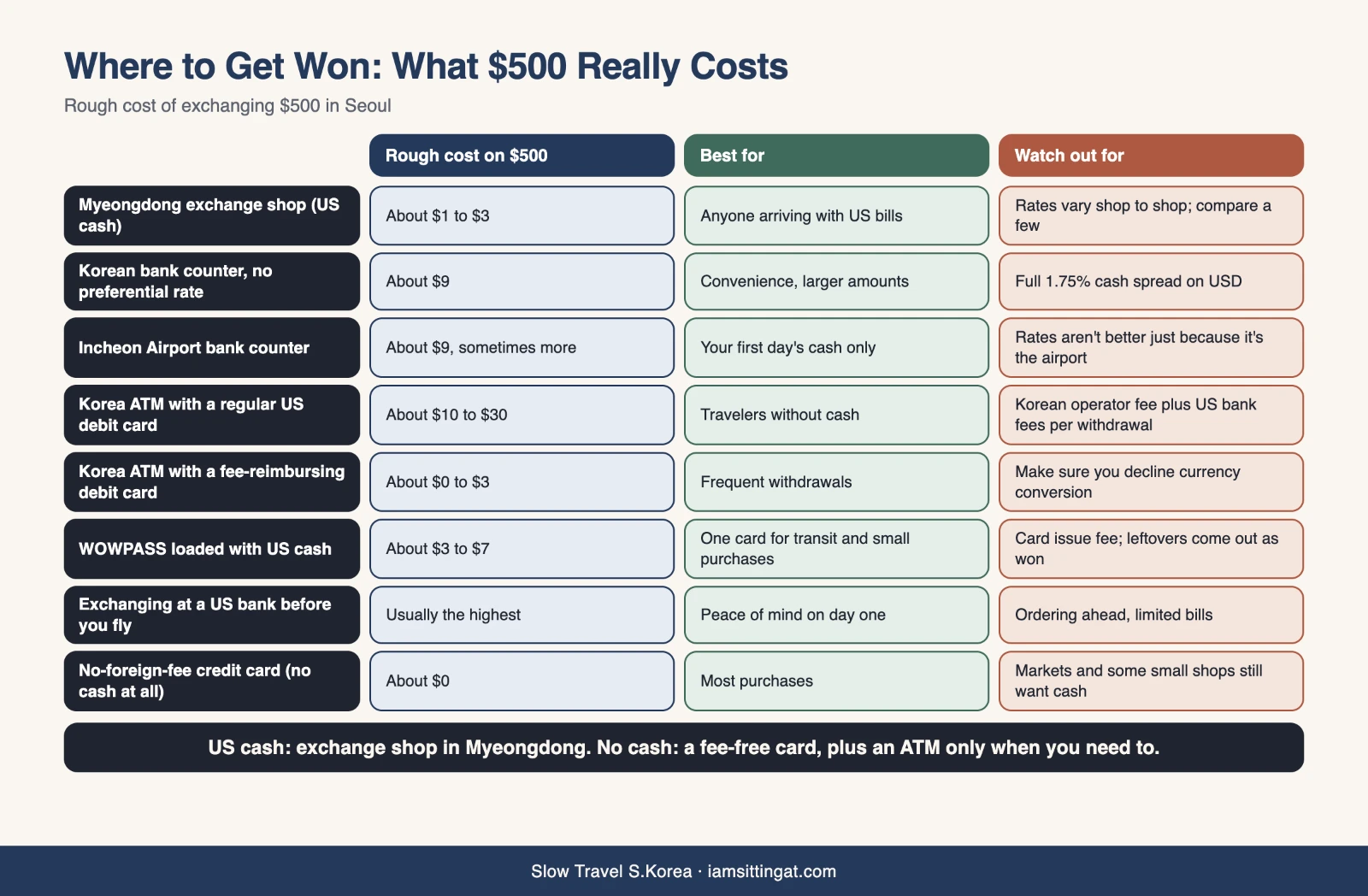
The short version: bring some US cash, exchange most of it in the city, and use a card for everything a card can pay for.
Why the Spread Matters More Than the “Fee”
Exchange shops in Korea rarely charge a fee you can see. Instead, they buy your dollars at one rate and sell dollars at another. The difference is called the spread, and it’s the real cost.
Korean banks publish a “base rate” (the mid-market rate for the day) and then buy and sell cash around it. For US dollars, KB Kookmin Bank explains that its standard cash spread is 1.75% on each side. So on a day when the base rate is 1,330 won, a bank buys your $100 bill at about 1,307 won per dollar. You lose about 2,300 won, or roughly $1.75, on every $100.
Korean residents shrink that spread through bank apps that offer “exchange preference” discounts of up to 90% on US dollars. Visitors mostly can’t use those apps. KB, for example, says foreigners can exchange in person at a branch or airport counter with a passport, but not through its app. That’s the main reason a walk-in visitor pays more at a bank than a local does.
Busy private exchange shops compete on exactly this number. One rate comparison from September 2026 found a Myeongdong shop buying US dollars at 1,379 won and selling at 1,385, a gap of just 6 won on a rate near 1,382. That’s well under 1% from end to end.
If you want a New York comparison, it’s like the difference between the currency window at JFK and the cash price at a busy exchange shop in Midtown. Everyone sells the same won. The price of the service is what changes.
Myeongdong Money Exchange: Why It Usually Wins for US Cash
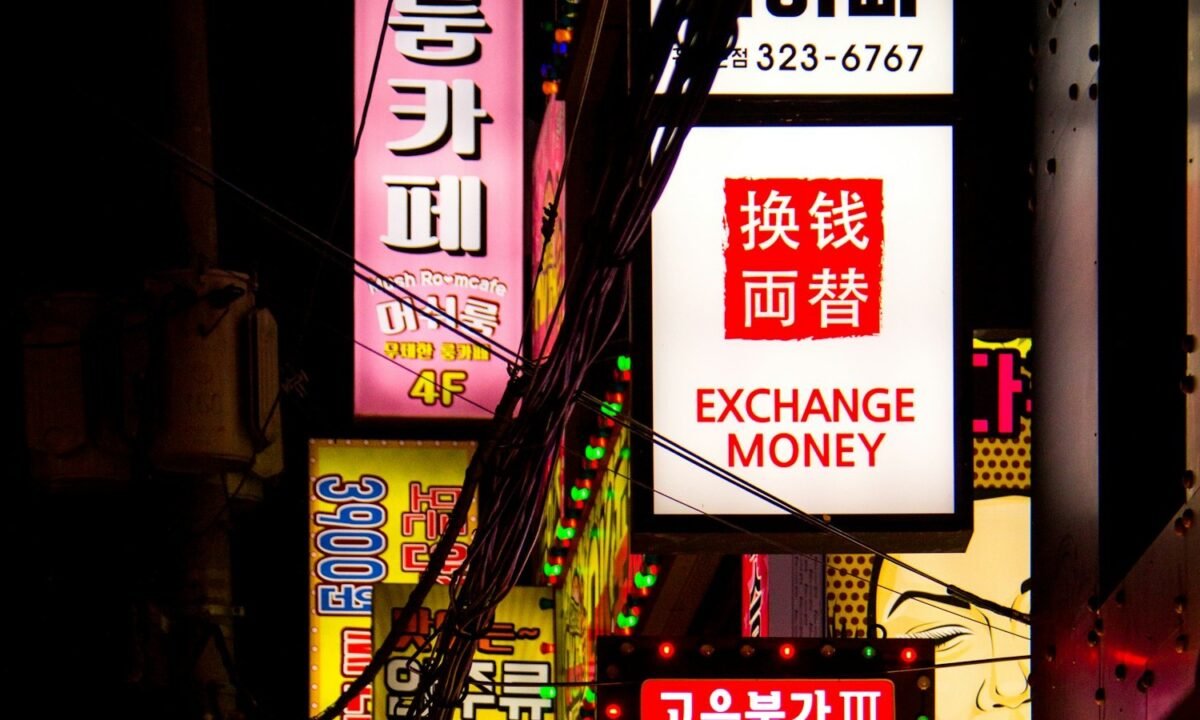
If you’re arriving with US bills, a Myeongdong money exchange is usually the best place to exchange money in Seoul. The neighborhood sees heavy foot traffic from foreign shoppers, the shops sit close together, and each one posts its rates on a board outside. That competition keeps the spread on US dollars tight.
A few things to know:
- Compare two or three boards. Rates differ by shop, by currency, and sometimes by the time of day. Check the “We Buy” column for US dollars, since that’s the rate you’ll get.
- Check whether the board quotes per $1 or per $100. It’s an easy mistake when you’re tired.
- Bring your passport. Licensed exchange businesses may ask for ID, and it’s normal to show it.
- Bring clean, newer $100 bills. Some shops pay a better rate for $100 bills than for smaller ones, and torn, marked, or very old bills may be refused or discounted.
- Count the won at the counter and keep the receipt.
- Use a registered shop. Exchange businesses in Korea register with and are supervised by the Korea Customs Service. Pick one with a storefront and a posted rate board, never someone who approaches you on the street.
Opening hours vary. Some shops open around 9 or 10 a.m. and close around 9 or 10 p.m., and a few chains run shops in Hongdae, Dongdaemun, and Gangnam too.
Myeongdong isn’t worth a special trip for $100. It makes sense when you’re exchanging a few hundred dollars, or you’re already nearby.
Incheon Airport: Exchange a Little, Not a Lot
Incheon Airport has bank exchange counters in both terminals, and many of them run 24 hours. That’s useful when you land at 5 a.m.
But the airport isn’t where you’ll find the best rate. Walk-in customers generally pay the bank’s posted cash rate, without the app discounts residents get. Exchange enough for your first day and your transit card top-up, then do the rest in the city.
How much is “enough”? Roughly 50,000 to 100,000 won covers a T-money card, a first top-up, an airport train ticket, and a meal or two. If you’re taking the AREX train or an airport bus into Seoul, I compare the two in my AREX vs Airport Bus guide.
Korea ATM Foreign Card Fees: What a Withdrawal Really Costs
ATMs are the easiest way to get won if you don’t carry much cash. But the fees come in two layers.
Layer 1: the Korean ATM operator fee. Korean banks charge a per-withdrawal fee when you use a foreign card. Reported figures run about 2,000 to 3,000 won at major bank ATMs and 3,000 to 6,000 won at convenience-store ATMs.
Layer 2: your US bank’s fees. Many US banks charge a flat out-of-network fee (often a few dollars) plus a foreign transaction fee of up to 3%. On a 300,000-won withdrawal, that can add $10 or more.
Here’s how Korea ATM foreign card fees compare on a 300,000-won withdrawal (about $225):
| Your card | Korean operator fee | US bank fees | Rough total |
|---|---|---|---|
| Regular US debit card | About $2 to $4.50 | About $3 to $5 flat, plus up to 3% | About $5 to $16 |
| Debit card with no foreign fee, no ATM rebate | About $2 to $4.50 | Often $0 to $2.50 | About $2 to $7 |
| Debit card that reimburses ATM fees | Refunded | $0 | About $0 |
| Credit card cash advance | About $2 to $4.50 | Cash advance fee plus interest from day one | Avoid |
A fee-reimbursing debit card changes the math. Schwab Bank’s Investor Checking, for example, rebates ATM fees worldwide and charges no foreign transaction fee on its debit card, though it requires a linked Schwab brokerage account and doesn’t cover currency conversion charges. [AFFILIATE: no-ATM-fee debit card]
How to use a Korea ATM with a US card
- Look for a “Global” or “Foreign Card” ATM. Not every ATM in Korea takes foreign cards. Bank branches, subway stations, the airport, and some convenience stores have them.
- Choose English on the first screen.
- Withdraw fewer, larger amounts. The operator fee is per withdrawal, so one 300,000-won withdrawal costs less than three 100,000-won ones. Convenience-store ATMs may cap each withdrawal.
- Decline any offer to convert to US dollars. If the screen shows you a dollar amount and asks you to accept a “guaranteed rate,” choose no or “without conversion.” That’s dynamic currency conversion, and the markup is built in.
- Know your PIN and confirm your daily withdrawal limit before you leave.
Older blog posts often say Citibank Korea ATMs are free for foreign cards. Citibank Korea exited consumer banking in 2021 and 2022, so I wouldn’t plan around that tip.
Other Ways to Get Won
Self-service exchange kiosks. Unmanned exchange machines are spreading in Korea, mostly in hotels, airports, and some subway stations. Incheon city added several at subway stations in spring 2026, and they handle about 15 currencies. Passport scanning is usually required, and rates and limits vary by machine. They’re handy late at night, but compare the rate with a staffed shop when you can.
WOWPASS. If you load US cash onto a WOWPASS card at one of its machines, the company says there’s no top-up fee and a margin of about 0.5% in the rate. You don’t get cash in hand, but you can pay at most shops and use it as a transit card. I ran the numbers in my WOWPASS review.
Exchanging in the US before you fly. Some US banks let you order won ahead of time. It’s reassuring, but the rate is usually worse than in Seoul, so keep the amount small.
How Much Cash Do You Need in Korea?
Less than you’d guess. Korea runs on cards, and a no-foreign-fee Visa or Mastercard handles cafes, restaurants, convenience stores, department stores, hotels, and most taxis. I cover which cards work best in my guide to the best credit card to use in South Korea. [AFFILIATE: no-foreign-transaction-fee credit card]
Where you’ll still want cash:
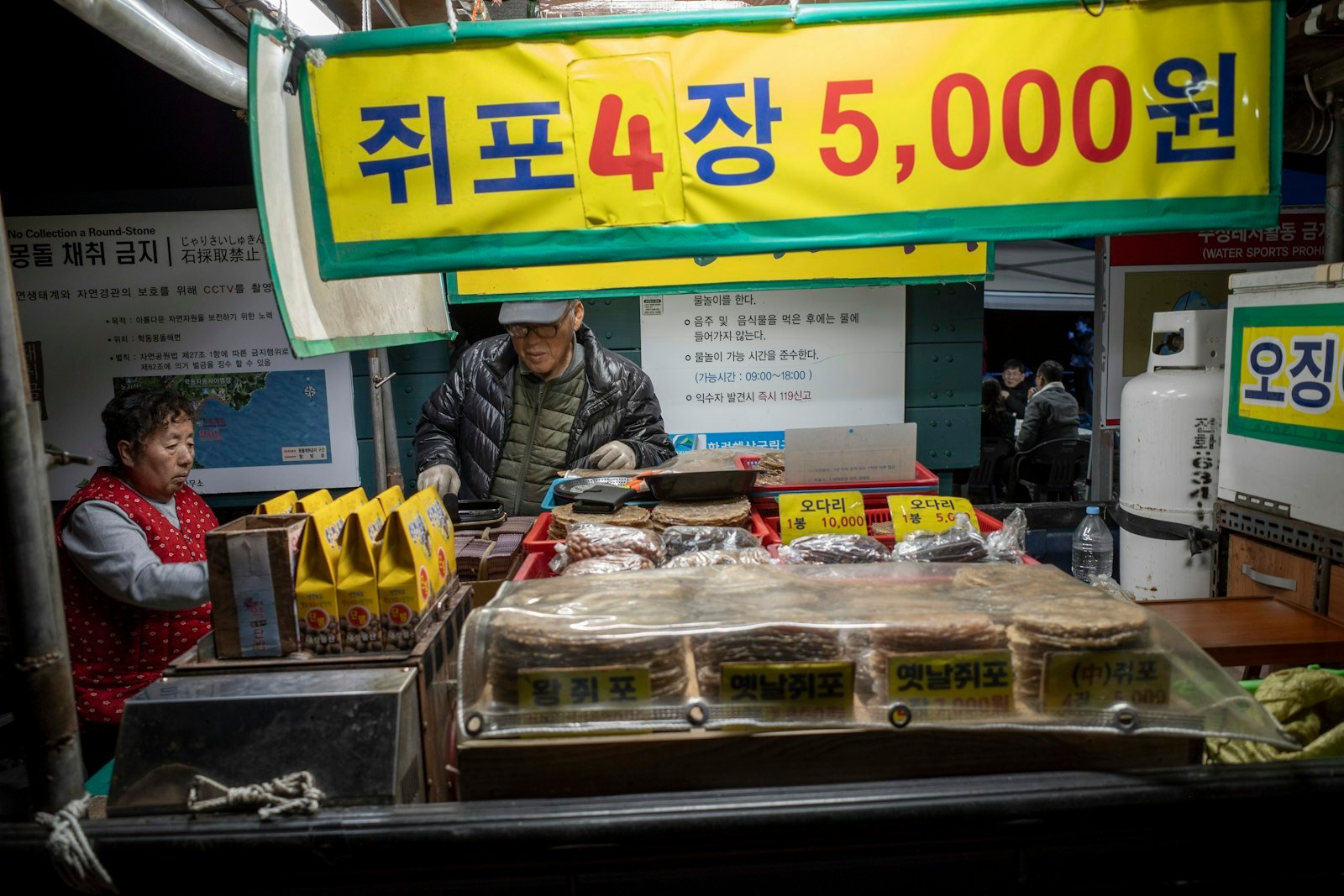
- Traditional markets and street food stalls. Many take cards or bank transfers now, but cash is still the safe bet.
- T-money top-ups. Convenience stores and station machines usually take cash only. I explain the details in my T-money card guide.
- Small, older restaurants and shops.
A simple starting point for a slow-paced trip: about 30,000 to 50,000 won per day you plan to spend at markets or small shops, plus 20,000 to 30,000 won for transit top-ups.
Ask for 10,000-won bills when you exchange. The 50,000-won bill is common, but a street vendor selling a 3,000-won snack won’t love breaking it.
Traveling with a lot more cash? Bringing more than $10,000 (all currencies combined) into Korea means filling out a customs declaration on arrival. Up to that amount, there’s nothing to declare.
Reality Check: Costs, Limits, and Things That Go Wrong
- The exchange rate moves daily, sometimes a lot. In 2026 alone, the won went from above 1,500 per dollar in June to about 1,331 in mid-October. Don’t try to time the market for a vacation. Exchange in a few rounds if you’re nervous about it.
- Small fees add up. Three ATM withdrawals with a regular debit card can cost more than a nice lunch.
- ATMs can reject your card or your bank can block it. Try another bank’s Global ATM, and keep your bank’s app notifications on.
- Getting leftover won back into dollars costs you twice. You pay the spread again when you convert it back. Bank counters at the airport will re-exchange won, and keeping your exchange receipts can help. The simpler move is to spend down to a small amount, or keep it for your next trip.
- Coins rarely convert back. Spend them on snacks or a T-money top-up.
My Simple Money Plan for a Week in Seoul
If you want a template, this is what I’d suggest to a first-time visitor from the US:
- ☐ Main card: a no-foreign-fee Visa or Mastercard for most purchases
- ☐ Debit card: one that reimburses ATM fees, with a PIN you’ve confirmed
- ☐ US cash: $200 to $300 in clean $100 bills, exchanged in the city
- ☐ Airport: exchange only enough for day one, or use a Global ATM
- ☐ Transit: T-money card topped up with won
- ☐ Phone data sorted before you land, so card alerts reach you: eSIM guide [AFFILIATE: Korea eSIM]
- ☐ Tax refunds: shopping plans? Read my Korea tax refund guide first
FAQ
Where is the best place to exchange money in Seoul?
For US cash, licensed private exchange shops in busy areas like Myeongdong usually give the best rate, because they compete on posted rates. Bank counters are fine for convenience but charge a wider spread to walk-in visitors.
Is it better to exchange money at Incheon Airport or in Seoul?
In Seoul. Airport counters are convenient and often open 24 hours, but walk-in visitors pay the bank’s posted cash rate. Exchange enough for your first day at the airport, then exchange the rest in the city.
How much are Korea ATM foreign card fees?
Korean banks charge a per-withdrawal fee for foreign cards, commonly a few thousand won, higher at convenience-store ATMs. Your US bank may add its own fees. A debit card that reimburses ATM fees and has no foreign transaction fee removes most of that cost.
Should I bring US dollars to Korea or use an ATM?
Either works. If you already have US cash, exchanging it at a city exchange shop is usually cheapest. If you don’t carry cash, a Global ATM with a fee-free debit card is just as good and simpler.
How much cash should I bring to Korea?
Less than you might expect. A no-foreign-fee credit card covers most spending. Plan on roughly 30,000 to 50,000 won per day for markets and small shops, plus transit top-ups, and adjust to your trip.
The Bottom Line
The best place to exchange money in Seoul is usually a busy, licensed exchange shop, and the worst is wherever you’re most rushed: the airport at 6 a.m. or your US bank the week before you fly. If you’d rather not carry cash at all, a Global ATM and a fee-free debit card do the job. Either way, keep the amount small, pay by card where you can, and decline every offer to convert to dollars. Then the money side of the trip stays quiet, and you can get back to the reason you came.